

"I wanted to go to America and work as a hairdresser." Aziz Rajabiy on the event that changed his life and giving his daughter away in marriage
“I wanted to go to America and work as a barber.” Aziz Rajabiy on the event that changed his life and marrying off his daughter
Singer Aziz Rajabiy, a representative of the Rajabiy dynasty who has made a great contribution to Uzbek national music, maqom, and theater art, gave an interview to the “Navo” TV channel. In the conversation, he spoke about his childhood, the event that changed his life, and his ancestors.
**“I wanted to work as a barber in America”**
This goes back to 2001. At that time, I was searching for myself; it was a period when I had been a musician for almost 10 years and then started doing business. An acquaintance of mine suggested going to America under the pretext of studying. I prepared my documents and went for the interview. The interview went well, but at the end, they said, “We are rejecting you.” My heart sank, and I walked out feeling completely cold.
At that time, I was married and had a son. I thought that by going to America, my life would change. I also knew how to cut hair, and I had made calculations in my mind that I would go and earn good money. But that rejection turned my life in a different direction. At first, I was upset, but then I came to the conclusion: “So, it means I have to sing.” My father also always used to say, “You must be a singer. Your grandfather is a singer, and I am a singer.”
After that, in 2001, I performed the song “Kuygay.” My friends liked it and asked me to sing again. Then more requests started coming in. Thus, without even realizing it, I became a singer. Today, I am recognized as a successor of the Rajabiy dynasty. Looking back, that rejection at the time was not in vain. Now, we go to America almost every year, but only to travel, not to work, he says.
If Aziz Rajabiy had the opportunity to talk to his younger self, what would he say to him?
— In my childhood, I was a calm and quiet boy. First, I would study the situation and understand everything, and then, if necessary, we would make a fuss and be mischievous. There were times when we ran around like children, played football, and kicked up dust in the street. In general, I had a lot of energy.
When you have a child and start raising them, you want to give your child the things you didn't have, and you want your child to achieve what you didn't achieve. I also want my child not to have the shortcomings that I had.
I grew up very free. My parents gave me freedom in many things. They would tell me to do my homework, but if I didn't, they didn't control me strictly. Later, my teachers also often told me, “You are not doing your lessons on time, learn to work on yourself and shape your character starting from now. You will need this in the future.” At that time, I used to think, “What would happen in the future?” Now I understand that if a person learns to perform the tasks given to them on time from childhood, this habit continues when they grow up, says the singer.
**“I didn't cry when marrying off my daughter, but then...”**
— Standing in the back at my friends' daughters' wedding ceremonies, tears would come to my eyes and I would cry. At that time, I hadn't married off a daughter of my own yet. I used to think, “When it is my own daughter's wedding, it will probably be very difficult.” Then I married off my daughter. At the wedding, I performed my song “Qizim” (My Daughter) myself. My daughter passed by me with the groom, we said goodbye, and even when she was getting into the car to leave, tears did not come to my eyes. Because I was happy. There was a feeling of joy: “Thank God, my daughter has found her place, we are becoming in-laws with people suitable for us. May she be happy in a good family.”
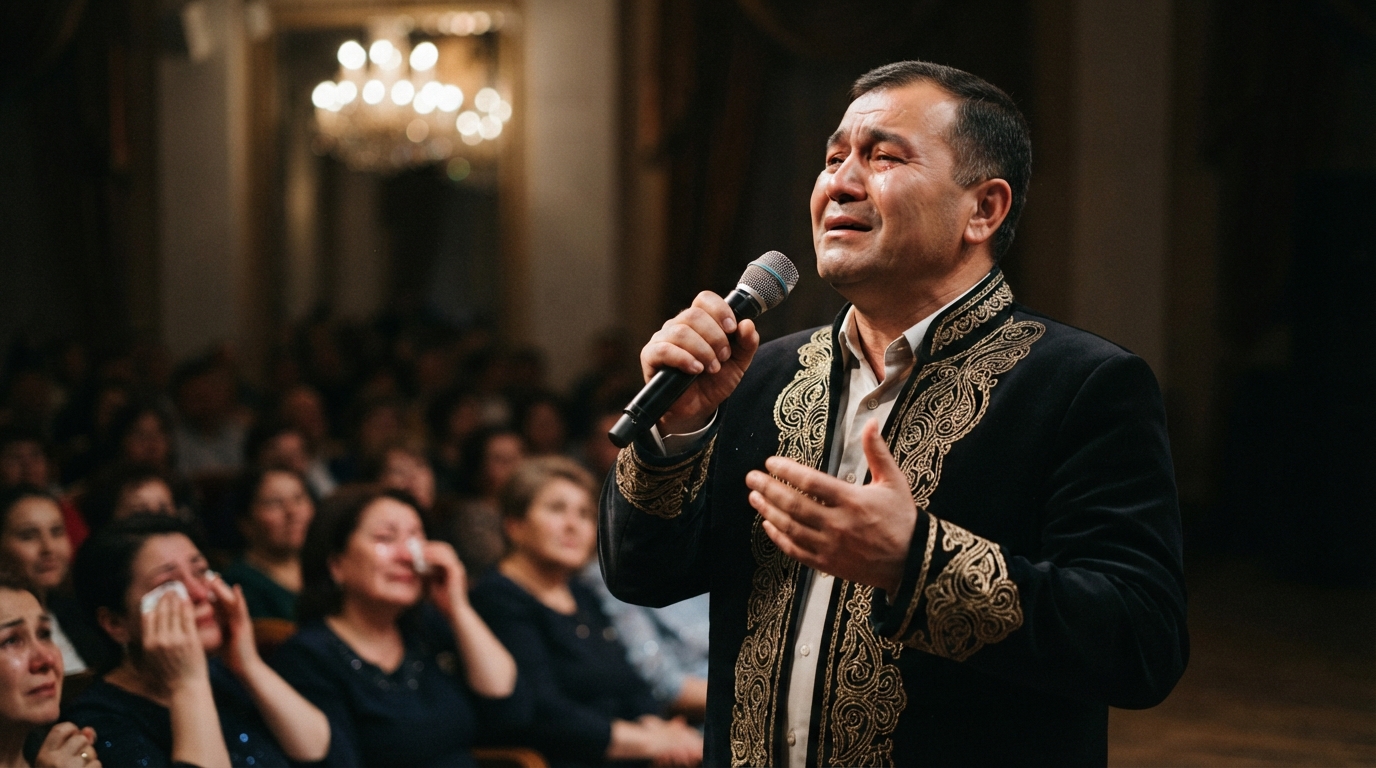
A week or two later, we went to the Namangan region for events. There, I was supposed to sing the song “Qizim.” When the song started playing, I suddenly burst into tears. Unable to control myself, I cried until the end of the song.
The audience sitting at the event was also surprised. Struggling to speak through my tears, I told them, “Don't be surprised, I married off my daughter. Two weeks have passed, and I miss my daughter so much.” While singing the song, all the days from my daughter's childhood to raising her to adulthood passed before my eyes. I cried remembering this. Seeing my state, many of the women in the audience also cried with me. They even asked, “Is your daughter happy?” I said, “Alhamdulillah, my daughter is happy. I just miss her very much.” After that, I sang that song crying for about six months, says the singer.
**Does fame help to create more or does it get in the way?**
— I think fame does not get in the way of creativity. This is both a blessing and a share of destiny. I have also seen people who spent a lot of money but whose names did not become known. On the contrary, there are artists who became famous and well-known with just one song.
A person should not lose themselves when fame comes. Sometimes a person forgets their true self, who they are. At that moment, fame can become a danger. Yunus Rajabiy was also one of the most famous people of his time. But he always impressed upon his children, “Be humble. The higher you rise, the more you should bend, be close to the ground.”
I saw this in my father and my uncles as well. Obid Yunusov, my father, and our other relatives were very famous, but they had no arrogance. They used fame correctly. I think the most important thing is this — even if a person is famous, they should not lose their identity and humility.