

"I Want to Live": Over 20 thousand Central Asian citizens have signed contracts with the Russian Armed Forces, 40% of them are Uzbeks
According to the Ukrainian project "I Want to Live", more than 20.4 thousand citizens of Central Asian countries have been identified as having signed contracts with the Russian Federation to participate in the war against Ukraine. Of these, 40% are citizens of Uzbekistan. Uzbek citizens are also among the most numerous groups of foreigners captured as prisoners of war by Ukraine.
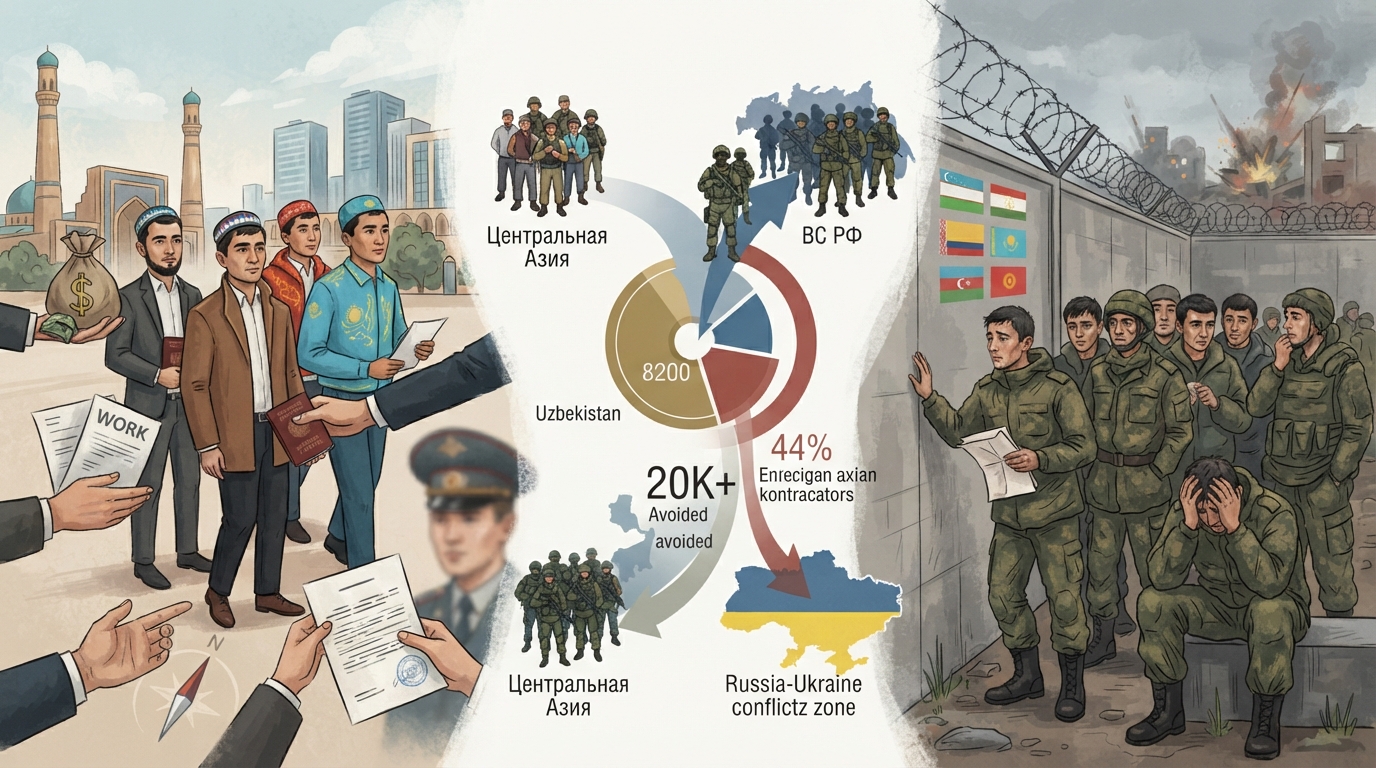
"I Want to Live": Over 20 Thousand Central Asian Citizens Have Signed Contracts with the Russian Armed Forces, 40% of Them Are Uzbeks
The "I Want to Live" project reported that as of October 1, 2026, over 20.4 thousand citizens of Central Asian countries had concluded contracts with the Armed Forces of the Russian Federation to participate in the war against Ukraine. These data were presented at a briefing on October 20 with the participation of the region's media.
More than 8,200 of them, or 40% of the total number for the region, are citizens of Uzbekistan.
They are followed by Tajikistan (5,308 people, 26%), Kazakhstan (3,819, 19%), Kyrgyzstan (2,219, 11%), and Turkmenistan (884, 4%).
Citizens of Central Asia constitute 44% of the total number of foreign contract soldiers in the Russian army identified by the project.
At the briefing, an "I Want to Live" representative emphasized that the statistics do not include ethnic natives of Central Asia holding Russian citizenship. According to him, if they are taken into account, the final figure would be even higher.
According to data from "I Want to Live", in 2025, the number of citizens of Central Asian countries who signed contracts with the Russian Armed Forces increased by 2.1 times: from 4,119 people (1,446 from Uzbekistan) in 2024 to 8,497 (3,487 from Uzbekistan) in 2025. In the first nine months of 2026, another 6,043 people (2,602 from Uzbekistan) concluded contracts, which constitutes 71% of the previous year's indicator.
"Recruiting residents of neighboring countries is especially convenient thanks to linguistic, cultural, and migration ties," the project claims.
According to "I Want to Live", as of October 12, 2026, hundreds of foreigners who fought as part of the Armed Forces of the Russian Federation are in Ukrainian captivity. These are citizens of 59 countries around the world. According to a project representative, their number is growing annually.
According to the project's presentation, the top seven countries by the number of foreign prisoners of war include citizens of Uzbekistan, Tajikistan, Belarus, Colombia, Kazakhstan, Azerbaijan, and Kyrgyzstan — listed in this exact order in the presentation.
The project did not specify the number of prisoners by country.
The "I Want to Live" project names three main methods of recruiting foreign citizens into the Armed Forces of the Russian Federation: bribery, deception, and coercion.
As stated in the presentation, for participating in hostilities, recruiters promise a relatively high salary — from $2,000 to $3,000 per month, Russian citizenship, and benefits. The project notes that many foreigners consciously agree to join the Russian Armed Forces expecting to earn money.
Deception, according to the project, consists of invitations to a "high-paying job" at a construction site, in security, in warehouses, or as a driver. Advertisements may state that the job is "in the interests of the Ministry of Defense", but without mentioning participation in combat operations. After signing a contract, a person is sent for a short course at a training ground, and then to the front. According to the project, citizens of Sri Lanka, Cuba, Nepal, and African countries are most often recruited this way.
Coercion is connected with raids during which police detain illegal migrants and people with expired documents. They are threatened with imprisonment or deportation and offered an "alternative": to conclude a contract with the Ministry of Defense of the Russian Federation for money and citizenship. The project notes that this is a common scenario for natives of Central Asia.
According to a representative of the "I Want to Live" project, over 90% of foreign prisoners of war completed a questionnaire in which, among other things, they answered questions about the reasons for signing a contract with the Armed Forces of the Russian Federation and shared their wishes for the future.
The survey results are divided by region: Central Asia, Eastern Partnership countries (Armenia, Belarus, Moldova, and Georgia), Latin America, Africa, the Middle East and North Africa (MENA) countries, and Asia. The number of respondents was not mentioned in the presentation or at the briefing. Respondents could select multiple answer choices, and the percentages are given relative to the total number of answers in each group.
According to the survey results, the main motive among prisoners of war from Central Asia was the desire to obtain Russian citizenship — 32% of answers. Another 20% of answers fell on the desire to get out of prison or avoid criminal prosecution — by this metric, the region leads all other groups. 10% of answers were related to the desire to earn money, 6% — to the desire to avoid deportation from Russia.
In 12% of answers, it was indicated that the contract was signed voluntarily out of support for Russia's actions. According to the "I Want to Live" representative, in personal conversations, this was said, in particular, by ethnic Russians who lived in Central Asian countries before the war.
The overwhelming majority of answers from Central Asian prisoners of war to the question about plans for the future fell on the option "Return to Russia" — 82%.
Returning to their country is mentioned in 11% of answers.
The project representative recounted that in conversations with "I Want to Live", prisoners from Central Asia say that they consider themselves Russian citizens, even if they received a passport only after signing the contract. In addition, they are afraid of returning home, as, according to them, criminal liability for mercenary activity is provided in the region's countries. The prisoners also noted that they want to receive monetary compensation for participating in combat operations.