

"I signed to serve my sentence in Uzbekistan, but it turned out to be a military contract." The freedom of a citizen who fought in Ukraine was restricted for 4 years and 4 months
37-year-old T.N., who went to Russia to work and was sentenced to 9 years in prison, signed a military service contract and participated in the battles in Ukraine. He was injured in a mine explosion and returned to Uzbekistan from Russia via Kazakhstan. The Toyloq District Court sentenced him to 4 years and 4 months of restriction of liberty.
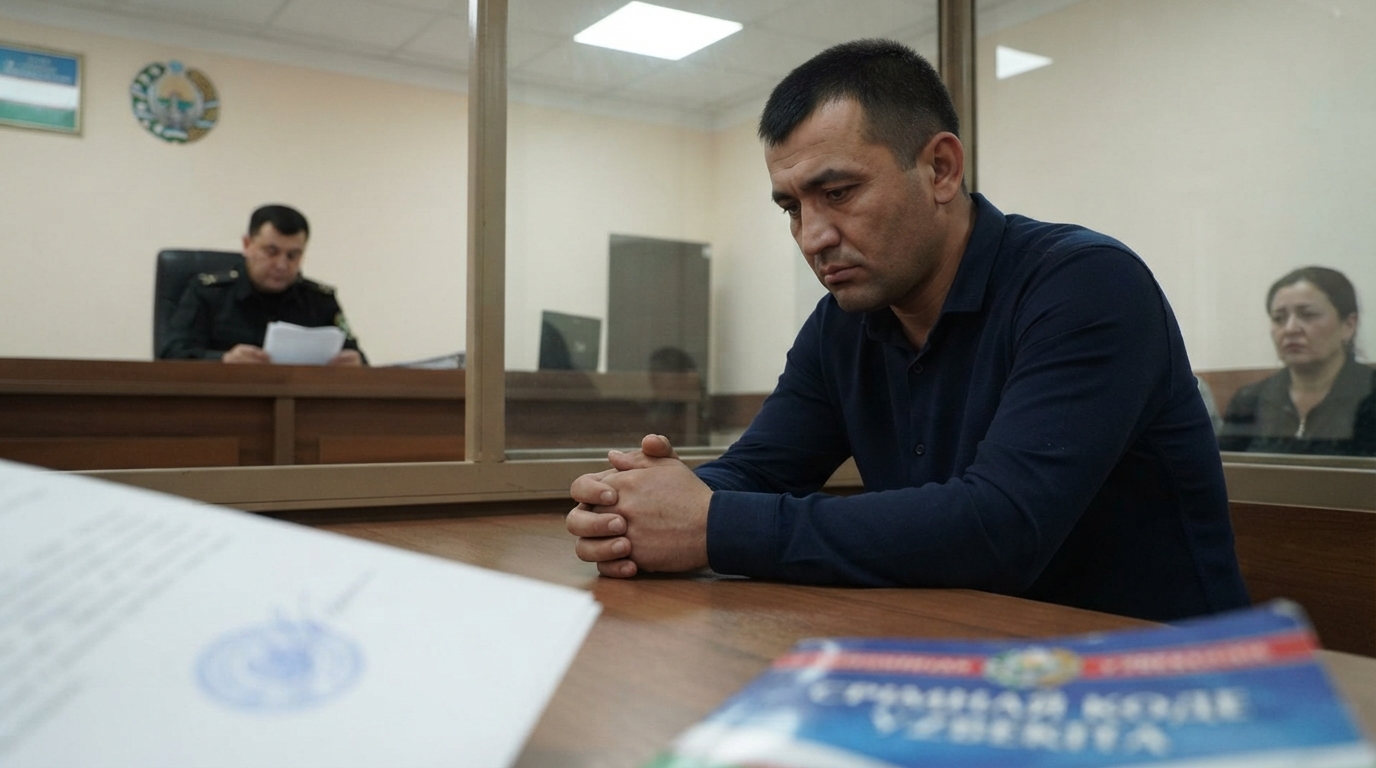
“I signed to serve my sentence in Uzbekistan, but it turned out to be a military contract.” The freedom of a citizen who fought in Ukraine was restricted for 4 years and 4 months
On August 25, the criminal court of Toyloq district (Samarkand region) reviewed a criminal case against a 37-year-old citizen, T.N., who fought on the Russian side in the Russia-Ukraine war.
According to court documents, while serving a sentence in Russia, T.N. signed a contract with a military unit under the Ministry of Defense on December 9, 2025, and was recruited into the ranks of the Russian Armed Forces. He underwent training at a military unit in the Donetsk region and participated in battles against Ukraine in January 2026.
During the battles, he was injured as a result of a landmine explosion. During operational-search activities, his contract with the Russian Ministry of Defense, information about his treatment in a military hospital, and a photograph of his military dog tag were discovered.
According to the forensic medical examination conclusion, the injuries could have been caused by the impact of a blast wave and shell fragments. They were classified as injuries of moderate severity.
The defendant fully pleaded guilty in court. According to him, since 2007, he had been traveling to the Russian cities of Moscow and Saint Petersburg, working in various private firms. On January 29, 2022, he headed to Saint Petersburg to work and earn an income.
According to him, in 2023, he met a woman who was a Russian citizen. Later, a dispute arose between them, and the woman contacted law enforcement agencies. In November 2024, T.N. was convicted under Article 131, Part 2 of the Criminal Code of the Russian Federation (Rape) and sentenced to 9 years of imprisonment.
“I signed to serve my sentence in Uzbekistan, then I found out it was a military service contract”
In January 2025, he was sent to serve his sentence at the IK-3 facility in Tomsk. According to T.N., in December 2025, prisoners were informed about the opportunity to serve the remainder of their sentence in their home country and were made to sign various documents. Later, he found out that these documents were a military service contract with the Russian Ministry of Defense.
“I signed the papers given to me because I agreed to serve the remainder of my sentence in Uzbekistan. Later, I found out that I had signed a contract for military service with the Russian Ministry of Defense,” the defendant said.
According to T.N., in December 2025, he and other Central Asian prisoners were taken in military vehicles and stationed at a training ground in the Donetsk region.
There, for about two weeks, they underwent military training, including dismantling and assembling weapons, shooting, throwing grenades, administering first aid, and capturing and neutralizing people.
On December 28, they were taken to the town of Boshatiri in the Donetsk region and were provided with weapons. According to T.N., on January 7, the group was given a combat mission.
“Servicemen who planned to escape were shot dead in front of everyone”
According to T.N., on January 9, they approached the area where active combat was taking place. There, along with U.X., who was from the Toyloq district of the Samarkand region, and a Tajik citizen nicknamed “Laqay,” he made a plan to escape the area.
According to him, initially, they planned to reach Europe through Ukrainian territory, but later he decided to return to Uzbekistan via Moscow.
According to T.N.’s testimony, he started walking backward. Despite knowing that servicemen who attempted to escape were shot dead by order of the military unit commander, he decided to return to Uzbekistan.
“By order of the commander of the military unit we served in, servicemen who planned to retreat or escape were shot dead in front of everyone; despite this, I firmly decided to return to Uzbekistan,” the defendant said.
“I stepped on a landmine and got injured”
On the morning of January 9, on the way, he sustained injuries to both legs and his right hand due to a landmine exploding under his foot. Later, Russian military personnel found him, administered first aid, and took him to a hospital.
T.N. was treated in several military hospitals. On January 22, he underwent surgery on his left leg in Saratov. Later, he was also treated in hospitals in the Moscow region and Zvenigorod.
“I received 2.9 million rubles for being wounded in battle”
According to T.N., on April 10, a total of 2.9 million rubles (approximately 34.5 thousand dollars) was deposited into his Russian bank card for participating in the battles and being wounded. He stated that he cashed out 2.5 million rubles, of which he gave 2 million rubles to a doctor at the hospital.
According to him, following this, he was assigned category “D,” indicating unfitness for participation in military actions. T.N. received the official document confirming this category two weeks later.
On April 14, he approached the Embassy of Uzbekistan in Moscow, presented documents related to his military service and treatment, and requested practical assistance in returning to Uzbekistan.
According to him, embassy representatives told him that since he had his passport, he could travel to Uzbekistan.
“They wanted to send me to Donetsk again”
According to T.N., on April 24, he was taken with a referral from the 45th hospital, where he was being treated, to a military unit in the city of Chelyabinsk. There, the issue of either sending him back to participate in combat operations or treating him at a military medical point was discussed.
On May 4, they wanted to send him to the combat zone in the Donetsk region. On that day, T.N. said that his family and relatives had arrived in Chelyabinsk and obtained permission to go and say goodbye to them. He went to Moscow and found a person via Telegram who was engaged in transporting people to Kazakhstan.
On May 6, he went to the city of Orenburg and agreed with a person named “Talgat” on crossing from Russia to Kazakhstan. According to him, he agreed with “Talgat” because in 2025 he faced deportation in Russia, a fine of 400 thousand rubles, and a ban on leaving the country. According to the agreement, “Talgat” was to legally cross him from Russia to Kazakhstan, and in return, T.N. was to pay him 1.2 million rubles.
“I went to the Department of Internal Affairs of my own free will and reported all the circumstances”
According to T.N., “Talgat” took him across the Russia-Kazakhstan border, having the relevant seals and stamps placed in his passport. According to “Talgat,” he gave 1 million rubles to a border official who was a Russian citizen at the border post in Orenburg.
On May 8, T.N. entered Uzbekistan from Kazakhstan through the “Qoplonbek” border post. On May 11, he went to the Toyloq District Department of Internal Affairs of his own free will and reported the events that had occurred.
The defendant expressed remorse for his actions and asked for leniency.
The court considered T.N.’s full admission of guilt, his remorse for his actions, and the fact that he had no prior convictions as mitigating circumstances. It also took into account his personality, family circumstances, positive character reference from his place of residence, and his post-crime behavior. It found that committing the crime with mercenary motives was an aggravating circumstance.
T.N. was found guilty under Article 154, Part 1 (Mercenarism) and Article 154-1, Part 1 (Entering into service, recruitment into military service, security, police, military justice, or other similar bodies of foreign states) of the Criminal Code. Under Article 154, Part 1 of the Criminal Code, he was sentenced to 4 years of restriction of freedom, and under Article 154-1, Part 1, he was sentenced to 2 years of correctional labor with a 20 percent deduction of his salary to the state revenue.
By partially combining the sentences, T.N. was ultimately sentenced to 4 years and 4 months of restriction of freedom.
He will serve the sentence at his place of residence in the Toyloq district. His leaving the house is restricted, except for the time necessary to go to work and return home.
Additionally, he is prohibited from changing his place of residence and leaving the territory of the Samarkand region without the consent of the supervisory body. Supervision of the execution of the sentence was entrusted to the probation group of the Toyloq District Department of Internal Affairs.