

'I have never felt heat like that' - a survivor on watching 33 cellmates die in Nigeria
The BBC goes inside the prison where prisoners were trapped in stifling, cramped conditions.
‘I have never felt heat like that’ - a survivor on watching 33 cellmates die in Nigeria
Usman Muhammad survived, but 33 others died in the cell and four more later died in hospital.
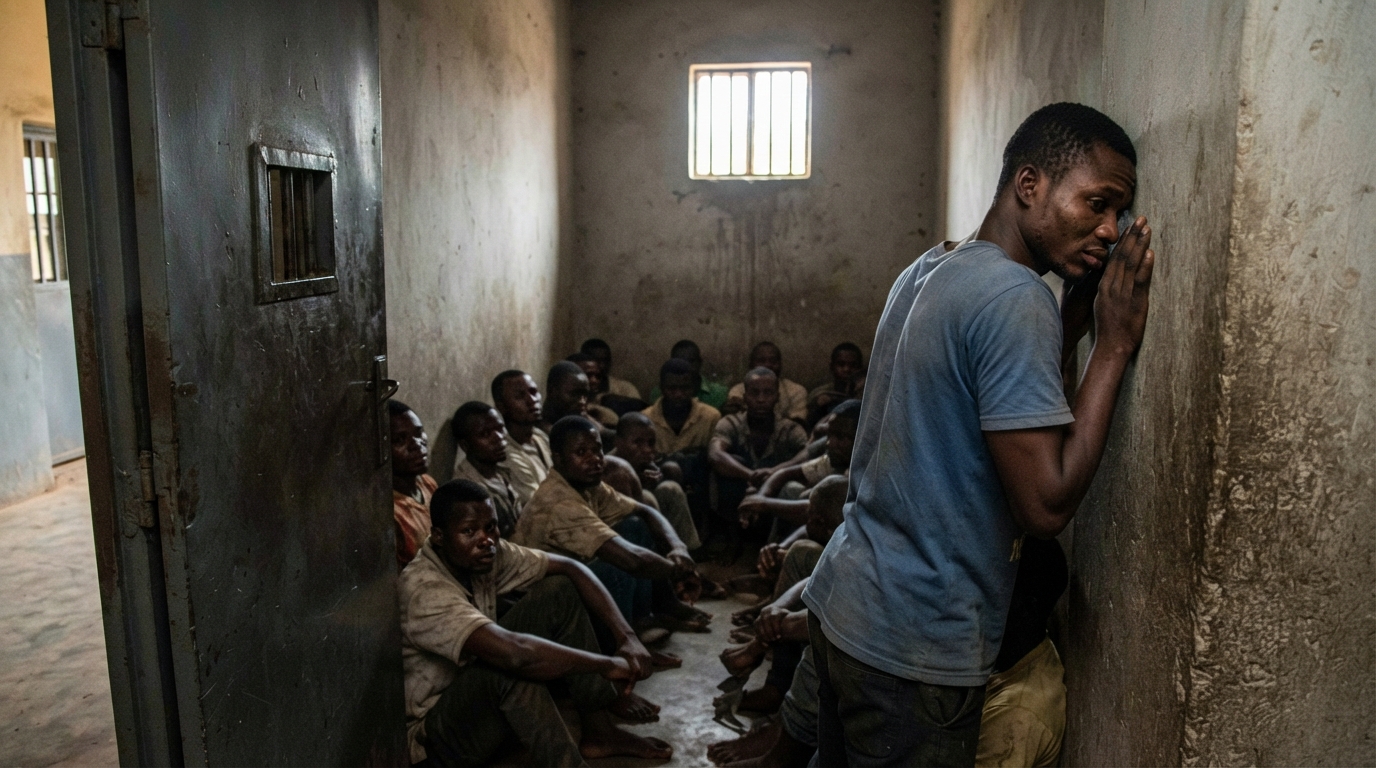
Usman Muhammad stands at the entrance to a tiny Nigerian prison cell, pressing his forehead against the wall and unable to speak.
The day before, he had been trapped inside the suffocating room, which measured roughly 6m (19.7ft) by 3m (9.8ft), along with more than 50 other prisoners.
Thirty-three of his cellmates died in the cramped conditions at the prison in Minna, the capital of Nigeria’s Niger state, and four others later died in hospital.
The mass deaths triggered an outcry and protests, including attacks on public buildings, as relatives and local residents demanded answers.
Federal officials had first blamed the deaths on a diphtheria outbreak, but the exact cause is now under investigation.
“I have never felt heat like that in my life. When we touched each other’s bodies, it felt like fire burning,” Muhammad tells the BBC once he is able to collect his thoughts.
When he was locked inside, there was only standing room, with humidity above 90%, which in some circumstances can be dangerous to human health because it stops sweat from drying on the skin and prevents the body’s natural cooling process.
The temperature outside was above 25C, and the only ventilation came from a small window high up on the wall.
“One of us fainted and we started knocking at the [cell] door. When [a guard] came we asked him for water. He looked at the guy that fainted and closed the door. That’s how they started dying one after the other,” Muhammad says.
Like the others who had been detained, the man in his 20s is an artisanal miner, trying to make a living by searching for precious metals at mine sites.
The federal government has sought to crack down on this alleged illegal activity, saying it deprives the country of revenue, harms the environment and can be tied to broader criminal activity.
Officers from the Nigeria Security and Civil Defence Corps (NSCDC) arrested a large group of miners near Minna last Tuesday and Wednesday.
The prisoners were kept at its detention centre in the city, but the NSCDC has not disclosed the names or the number of people it was holding.
As the hours passed inside the cell, the heat and dehydration became unbearable, and Muhammad says some detainees began drinking their own urine and collecting sweat from their bodies in an effort to survive.
He says he saw people in distress and struggling to breathe.
“People were calling for help, some were already very weak.”
But, he and others allege, no one came to help.
“While in the cell, we were shouting and telling them that people were dying,” another survivor, Adamu Isah, told Reuters.
“We tried to break down the door when they refused to open it… At one point, a security officer came to the door.
“We were shouting and telling him that people were dying, but he said it wasn’t his problem if people died.”
Eventually, on Thursday, the cell door was opened and the guards found the bodies.
The NSCDC has not directly answered the accusations of neglect and mistreatment, but says 24 of its personnel are now in custody in connection with the deaths, including its suspended Niger state commandant, Suberu Aniviye.
“The people who were killed are not flies. How can this go unlooked? We will get to the bottom of this,” Niger state Governor Umaru Bago told the BBC.
The only air entering the cell came from a small window high on the wall.
Because the organisation involved is a federal body rather than a force under his jurisdiction, such as the police, the governor cannot exert direct influence, but he welcomes the investigation ordered by the government in Abuja.
A 10-member committee has now been set up to determine exactly what happened.
It has two weeks to establish the causes of the deaths and identify who was responsible, and it can recommend legal action against anyone found culpable.
Interior Minister Olubunmi Tunji-Ojo said no officer, regardless of rank, would be protected and that any attempt to obstruct the investigation would be taken seriously.
As he leaves the cell after speaking to the BBC, Muhammad says he hopes that by speaking out he can help secure justice and bring some closure to this traumatic event.