

How was New York's Central Park created? A report by Gazeta photojournalist Yevgeniy Sorochin from the place considered a model of urban planning
Cities need accessible public parks. New York's Central Park is a prime example of what such a place can be: a large, meticulously planned park protected from development. Both public organizations and the city administration are equally responsible for its preservation. Gazeta photojournalist Yevgeniy Sorochin spent several hours in the park, capturing how it is organized and what attracts city residents and tourists from all over the world.
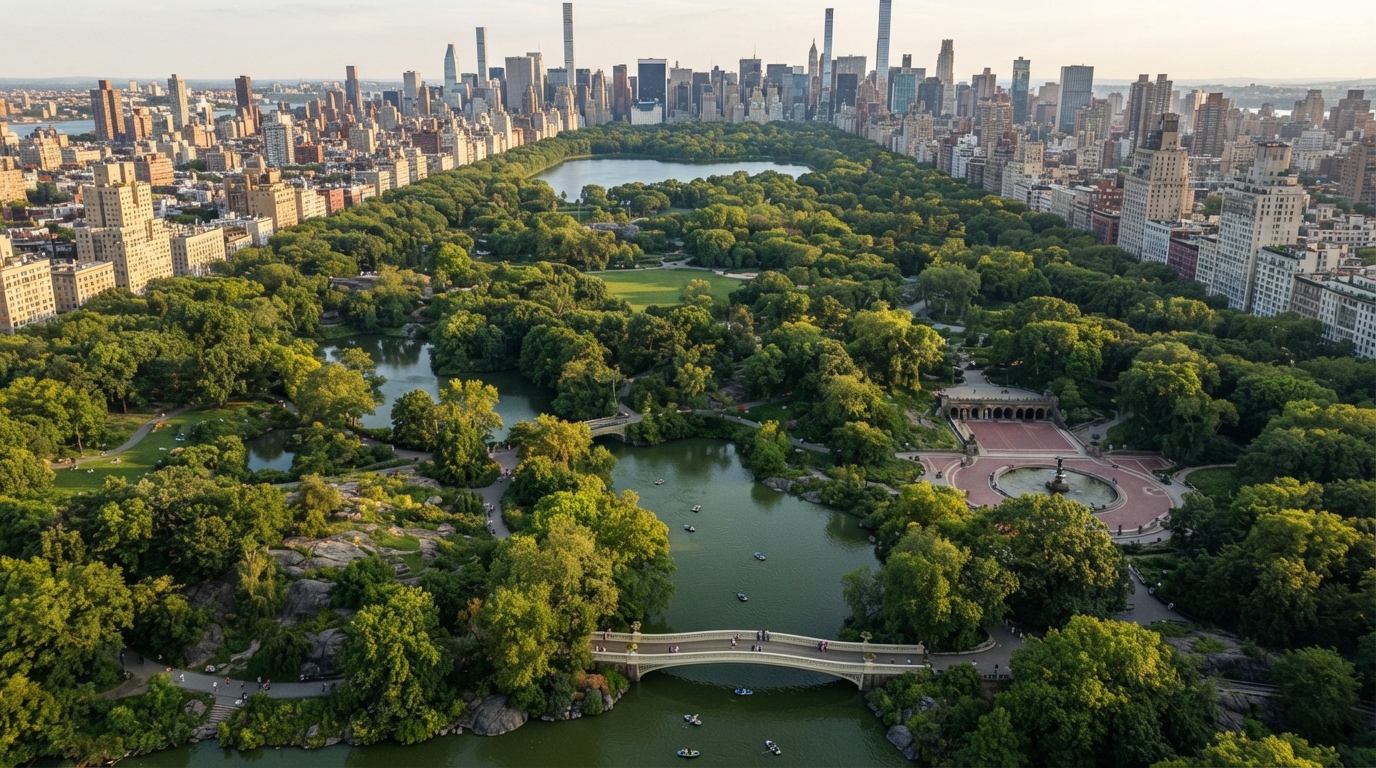
How was New York's Central Park created? A report by Gazeta photojournalist Yevgeniy Sorochin from this destination, which is an exemplar of urban planning
In Uzbekistan, there is increasing talk about the need for full-fledged public parks that are open to the public and protected from development, rather than just newly landscaped areas.
Central Park in New York is one of the most famous examples of a well-thought-out public space in a large city. Its diverse, natural-looking landscape is the result of the work of architects, engineers, and gardeners.
Gazeta photojournalist Yevgeniy Sorochin spent several hours walking through the park from beginning to end, capturing its main attractions and details.
The 1840s. New York is expanding rapidly. More and more Irish and German immigrants are beginning to move to the city. They join an already diverse population — by this time, descendants of Dutch, English, French, Scottish, and Scandinavian settlers, as well as African Americans and Jews, were living in the city.
The city was becoming denser, and the lack of public spaces was becoming even more apparent. Some parks and avenues of that era were private, accessible only to wealthy New Yorkers.
Journalists, architects, and urban reformers opposed this.
They called on the government to create a large public park in New York — a spacious area that people could visit regardless of their wealth and background.
In 1853, the New York State Legislature approved the creation of a park. The city began purchasing land parcels from owners between 59th and 106th streets in Manhattan, and in 1857, a commission announced a competition for the design of the future park.
Out of 33 entries, the Greensward plan by writer and farmer Frederick Law Olmsted and young English architect Calvert Vaux won. They proposed transforming the rocky and swampy area into a carefully designed landscape that looked natural and resembled untouched nature.
The construction of Central Park began in 1858 and lasted 16 years. More than 20,000 workers were involved in the construction. According to the architects' drawings, they leveled parts of the hills, filled in swamps, and blasted protruding rocks with gunpowder to alter the terrain.
One of the main engineering tasks was to hide the city inside the park.
To provide east-west transit, four transverse roads were laid at 66th, 79th, 86th, and 96th streets, but they were sunken below ground level and concealed by embankments and dense trees. A person walking on the lawn above, just a few meters away, does not see what is happening below.
The principle of separating different types of traffic also defined the park's other infrastructure. Thirty bridges and arches were built within the park. Some separate pedestrians, equestrians, and carriage traffic so they do not cross paths, while others serve as part of the landscape composition. All bridges and arches are made of various materials — cast iron, granite, stone, brick, and wood — that harmonize with the surrounding scenery.
The Dalehead Arch, a stone arch located in the southern part of the park, was built in 1860–1862 based on a design by architect Calvert Vaux.
The uniqueness of the park is particularly evident in the urban environment. Surrounding Manhattan was laid out based on a strict rectangular street grid approved in the early 19th century, a style that was rational and economical but barely took into account the island's original terrain of hills and valleys. Central Park is the greatest exception to this rule, using winding paths and natural landscape forms instead of straight lines.
Today, the park covers an area of 341 hectares. Around 20,000 trees of more than 170 species grow in the area. Among them are native oaks, elms, maples, and American elms, as well as species specially brought from other regions.
There are a total of nine bodies of water in the park. The largest of them is the Jacqueline Kennedy Onassis Reservoir, located between 86th and 96th streets, covering an area of approximately 43 hectares. Waterfowl and migratory birds can be regularly observed here.
Five species of turtles and various fish live in the ponds and lakes. Fishing is allowed here only on a catch-and-release basis.
About 2,400 squirrels run around the lawns — they were even counted in 2018 as part of a special project called the Central Park Squirrel Census.
A major bird migration route passes through the park, which is why more than 200 bird species, including hawks, owls, woodpeckers, ducks, and geese, have been recorded here. The most attractive spot for them is The Ramble, a 15-hectare woodland area of winding paths, rocks, and streams.
Not only tourists but also birdwatchers from all over the city flock here. They spend hours observing migratory birds that have chosen Manhattan's "wildest" corner to rest.
The daily maintenance of the park is handled by the Central Park Conservancy, a private non-profit organization that manages the park in partnership with the city administration.
It provides about 75 percent of the funding through private donations, with the remainder allocated by the city.
The organization was founded in 1980 by landscape historian Elizabeth Barlow Rogers and a group of New York activists in response to the decline of the area. By the late 1970s, lawns had turned into dusty barren ground, and monuments, bridges, and rocks were covered in graffiti. This was the result of the city's underfunding of the park for many years, especially during the New York fiscal crisis of the 1970s, as well as neglect and inefficient management.
Today, the Central Park Conservancy employs about 400 permanent staff. They monitor lawns, trees, and bodies of water, prune branches, and treat diseased trees.
The park is also supported by thousands of private donors. For example, under the "Adopt-a-Tree" program, anyone can donate $500 to plant a new sapling or $7,500 for a mature tree. For "adopting" a mature tree, the donor receives a granite paving stone installed in the Literary Walk area as a token of appreciation.
From 2008 to 2010, naturalist writer Edward Barnard and graphic designer-birdwatcher Ken Chaya worked on creating Central Park Entire — a detailed, illustrated map-guide showing the trees and landscapes of Central Park.
For two and a half years, they walked the area, recording every tree by hand. As a result, they mapped almost all of the approximately 20,000 trees in the park. The printed edition of the map was released in 2010. Its interactive version is available as a mobile app.
Central Park is sometimes called the world's largest open-air art museum. Initially, the park's creators rejected the European tradition of decorating it with sculptures, with the exception of the Bethesda Terrace architectural complex, consisting of a plaza, stairs, a fountain, and an arcade — it was designed as the primary space for public art.
A fountain is located in the center of the public plaza, topped by Emma Stebbins's "Angel of the Waters" statue. The statue references the biblical story of the healing power of water and at the same time symbolizes the opening of the Croton Aqueduct, which began supplying clean water to New York in 1842.
Another well-known element of the architectural complex is the Bethesda Terrace Arcade, a covered arched passageway. Its ceiling is covered with about 16,000 encaustic tiles decorated with geometric and floral patterns. The uniqueness of this technique is that the pattern is made of colored clay, placed into recesses on the tile surface, and fired together with it.
The technique has been known in Europe since the 13th century and was widely used in medieval England to decorate the floors of cathedrals and abbeys. In the 19th century, the English company Minton revived this tradition and produced encaustic tiles specifically for the Arcade.
Bethesda Terrace with its fountain is one of the most recognizable filming locations.
In the final scene of "The Avengers" (2012), this is where Thor bids farewell to his team before flying back to Asgard. In "John Wick: Chapter 2", Keanu Reeves meets Winston, one of the franchise's main characters. And in "Home Alone 2", young Kevin feeds the pigeons here.
Another must-visit place for movie buffs is the Bow Bridge, an elegant cast-iron bridge built over the lake in 1862. It appears in Woody Allen's "Manhattan" and in an episode of "Enchanted" where the characters sing and dance on the bridge. Interest in the bridge multiplied after the release of "Spider-Man 3" — this is the exact spot where Peter Parker intends to propose to Mary Jane, but she ends their relationship.
Numerous memorial plaques, bas-reliefs, and especially statues installed in the park through donations by private individuals, professional and public organizations, and immigrant communities create a unique map of New York's cultural and migration history.
For example, the German community presented the park with a bust of the philosopher and playwright Friedrich Schiller; the Scots erected statues of their national poet Robert Burns and writer Walter Scott; the Italians installed a bust of the patriot Giuseppe Mazzini, and the Irish erected a statue of the poet Thomas Moore.
In 1945, a statue of the Polish King Władysław Jagiełło appeared in the park. It was originally created for the Polish Pavilion at the 1939 World's Fair. The statue was installed in the park with the participation of Polish-American organizations.
One can navigate the area using information kiosks, printed maps, and signs on the paths. The most unexpected method is the lampposts. A four-digit code is embossed on each of them, which can be used to determine your location: the code indicates the nearest cross street and which side of the park you are on.
This system was originally devised so that staff could quickly find the right lamppost for repairs, and was later adopted by visitors. The code also helps identify your location in emergencies.
The only place where this system does not work is The Ramble. There are simply no lampposts there.
Benches are installed throughout the park for sitting and resting. There are more than 9,000 of them here — many dedicated to the memory of people or donated under the "Adopt-a-Bench" program.
Central Park receives more than 42 million visitors annually.
People happily walk, have picnics, jog, ride bicycles and boats, and play baseball and other sports here.
For children, 21 free playgrounds have been built, each with a unique design and set of attractions.
The park regularly hosts outdoor events and workshops: summer walks to the secret butterfly garden, chess lectures and tournaments, tours of Seneca Village (the largest community of African-American landowners in New York before the park's construction), guided walks through the Conservatory Garden with gardeners, and birdwatching basics classes.
Most events are free, while some are paid; their schedule and details can be found on the park's website.