

How New York's Central Park Works. A photo essay from Gazeta.
Cities need accessible public parks. Central Park in New York City exemplifies what such a space can be: spacious, meticulously designed, and protected from development. Both public organizations and city authorities are responsible for its preservation. Gazeta photojournalist Yevgeny Sorochin spent several hours in the park, capturing its layout and what attracts residents and tourists from around the world.
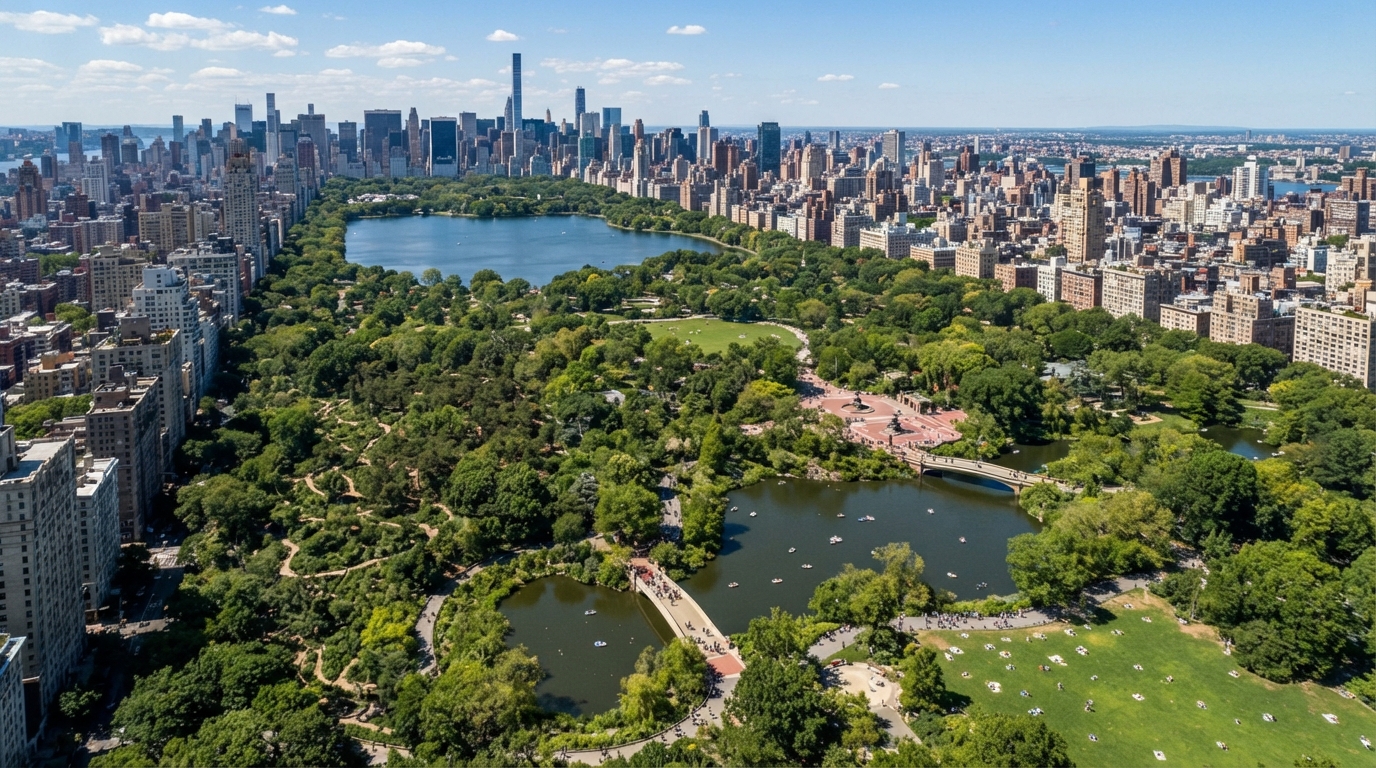
**New York's Central Park: A Detailed Photo Report by Gazeta**
In Uzbekistan, the need to create not just landscaped areas, but fully fledged public parks accessible to all residents and protected from development is increasingly being raised. New York's Central Park serves as a shining example of such a well-designed urban space. Its seemingly natural, yet in fact carefully designed, landscape is the result of the labors of architects, engineers, and gardeners.
Gazeta photojournalist Evgeny Sorochin traversed the entire park in just a few hours, capturing its key landmarks and details.
**History of Creation**
In the 1840s, New York City experienced rapid population growth, fueled by an influx of Irish and German immigrants, who joined an already multinational population that included descendants of Dutch, English, French, Scottish, and Scandinavian settlers, African Americans, and Jews. The city became increasingly dense, and the acute shortage of public space became increasingly acute. The existing parks and squares were often private and accessible only to wealthy citizens.
Journalists, architects, and urban reformers spoke out against this situation, calling on the authorities to create a large public park in New York City, open to people of all income levels and backgrounds.
In 1853, the New York State Legislature approved the park plan. The city began acquiring land between 59th and 106th Streets in Manhattan. In 1857, a design competition was announced, receiving 33 submissions.
The winning plan, called Greensward, was developed by writer and farmer Frederick Law Olmsted and the young English architect Calvert Vaux. They proposed transforming the rocky and marshy area into a carefully designed landscape that would imitate untouched nature.
Construction of Central Park began in 1858 and lasted 16 years. More than 20,000 workers participated in the work. They modified the terrain according to the architects' plans: they cut down hills, filled in swamps, and blasted and crushed rock outcrops.
One of the key engineering goals was to "hide" the city within the park itself. To provide through traffic from east to west, four transverse roads were built on 66th, 79th, 86th, and 96th Streets. These roads were sunk below ground level and concealed by slopes and dense plantings, so that a person walking on the lawn just a few meters above could not see what was happening below.
The same principle—separating traffic flows—formed the basis for the rest of the park's infrastructure. Thirty bridges and arches were built within it. Some of them separate pedestrian, equestrian, and vehicular routes, preventing them from crossing, while others are part of the landscape composition. All the bridges and arches are constructed of various materials (cast iron, granite, stone, brick, and wood), selected to harmonize with the surrounding landscape. The stone Dalehead Arch, located in the southern part of the park, was erected between 1860 and 1862 according to the designs of architect Calvert Vaux.
The park's uniqueness is particularly noticeable against the backdrop of the urban environment. Manhattan around it is laid out according to a strict rectangular street grid, established in the early 19th century—a rational, economical grid that pays little attention to the island's original topography, with its hills and streams. Central Park was the largest exception to this grid, where winding paths and natural landscape forms were used instead of straight lines.
**Nature and Habitats**
Today, the park covers 341 hectares. Its grounds are home to approximately 20,000 trees of over 170 species, including native oaks, elms, maples, and sycamores, as well as species imported from other regions.
The park has nine bodies of water. The largest is the Jacqueline Kennedy Onassis Reservoir, which covers approximately 43 hectares between 86th and 96th Streets. Waterfowl and migratory birds are regularly observed here. The ponds and lakes are home to five species of turtles and various fish. Fishing is permitted only on a catch-and-release basis.
About 2,400 squirrels roam the lawns; their numbers were counted as part of the Central Park Squirrel Census project in 2018.
A major bird migration route passes through the park, and over 200 species of birds have been recorded here, including hawks, owls, woodpeckers, ducks, and geese. Their main attraction is The Ramble, a forested area covering approximately 15 hectares with winding paths, boulders, and streams. It attracts not only tourists but also birdwatchers from all over the city, who spend hours observing migratory birds choosing to rest in Manhattan's wildest corner.
Management and Funding
The park's day-to-day maintenance is handled by the Central Park Conservancy, a private nonprofit organization that manages the park in partnership with the city. It provides approximately 75% of its funding through private donations, with the remainder provided by the city.
The organization was founded in 1980 by landscape historian Elizabeth Barlow Rogers and a group of New York activists in response to the park's decline. By the late 1970s, the lawns had become dusty wastelands, and the monuments, bridges, and cliffs were covered in graffiti. This was the result of years of underfunding by the city, particularly during the New York City financial crisis of the 1970s, as well as neglect and ineffective management of the park.
Today, the Central Park Conservancy employs approximately 400 full-time staff. They maintain the lawns, trees, and ponds, shape the canopy, and treat diseased trees. The park is also supported by thousands of private donors. For example, through the Adopt-a-Tree program, individuals can donate $500 to plant a new sapling or $7,500 to support a mature tree. In gratitude for "adopting" a mature tree, the donor receives a granite memorial stone, which is installed on Literary Walk.
From 2008 to 2010, nature writer Edward Barnard and birdwatcher Ken Chaya collaborated on Central Park Entire, a detailed illustrated guide to the trees and landscapes of Central Park. For two and a half years, they explored the area on foot, manually identifying every tree. They eventually mapped nearly all 20,000 trees. The printed version was published in 2010, and an interactive version is available as a mobile app.
**Art and Architecture**
Central Park is sometimes called the largest outdoor art museum in the world. Initially, its creators rejected the European tradition of decorating parks with statues, but the Bethesda Terrace architectural complex, with its plaza, staircases, fountain, and arcade, was an exception—it was conceived as a primary venue for public art.
At the center of the public space stands a fountain with Emma Stebbins' sculpture, "Angel of the Waters." It alludes to the biblical story of the healing power of water and simultaneously symbolizes the opening of the Croton Aqueduct, which began supplying New York City with clean water in 1842.
Another recognizable element of the architectural complex is the Bethesda Terrace Arcade, with a ceiling covered with nearly 16,000 ceramic tiles featuring geometric and floral patterns, using the encaustic technique. This technique is unique in that the design is created from colored clay, which is placed into depressions on the surface of the tiles and then fired alongside them. This technique has been known in Europe since the 13th century and was particularly widely used in medieval England to decorate the floors of cathedrals and abbeys. In the 19th century, the English factory Minton revived this tradition and produced encaustic tiles specifically for the Arcade.
Bethesda Terrace, with its fountain, is one of the most recognizable film locations. In the final scene of The Avengers (2012), it was here that Thor bids farewell to the team before departing for Asgard. In John Wick: Chapter 2, Keanu Reeves meets Winston, one of the franchise's key characters. And in Home Alone 2, young Kevin feeds pigeons.
Another must-see location for moviegoers is the graceful cast-iron Bow Bridge over the lake, built in 1862. It appears in Woody Allen's Manhattan and in Enchanted, in a scene where the characters sing and dance on the bridge. Interest in the bridge increased exponentially after the release of Spider-Man 3, as it was here that Peter Parker intended to propose to Mary Jane, but she broke up with him.
A unique map of New York's cultural and migratory history is created by the numerous memorial plaques, bas-reliefs, and especially statues erected in the park through donations from individuals, professional and public organizations, and immigrant communities. For example, the German community donated a bust of the philosopher and playwright Friedrich Schiller; the Scots erected monuments to their national poet Robert Burns and novelist Walter Scott; the Italians erected a bust of the patriot Giuseppe Mazzini; and the Irish erected a statue of the poet Thomas Moore. In 1945, a monument to Polish King Władysław Jagiełło, originally created for the Polish pavilion at the 1939 World's Fair, was erected in the park with the participation of Polish-American organizations.
Navigation and Recreation
You can navigate the park using information kiosks, printed maps, and trail signs. The most unexpected method is the lampposts. Each one is inscribed with a four-digit code that helps you navigate the area: it indicates the nearest cross street and the side of the park. The system was designed for employees to quickly find the right lamppost for repairs, but it was later adopted by visitors as well. The code helps you locate yourself, even in an emergency. The only place where the system doesn't work is The Ramble, where there are simply no lampposts.
There are over 9,000 benches throughout the park where you can sit and rest. Many of them are installed in memory of people or donated through the Adopt-a-Bench program.
More than 42 million people visit Central Park annually. People enjoy strolling and picnicking, running, biking, boating, playing baseball, and other sports. For children, there are 21 free playgrounds, each with its own design and range of attractions.
The park regularly hosts open events and workshops, including summer walks to the secret butterfly garden, chess lectures and tournaments, tours of Seneca Village (New York City's largest African-American homeowner community before the park's construction), tours of the Conservatory Garden with gardeners, and birdwatching basics classes. Most events are free, but some require a fee; the schedule and details can be found on the park's website.