

How to recognize food poisoning, what to do in the first hours, and when to see a doctor? Doctor's recommendations
Food poisoning can occur due to products that have been improperly produced, stored, transported, or prepared. The newspaper spoke with general practitioner Javokhir Khalmukhamedov about symptoms, first aid, and prevention.
How to recognize food poisoning, what to do in the first hours and when to see a doctor? Doctor's recommendations
Food poisoning is a condition that occurs as a result of consuming food or drinks contaminated with disease-causing microorganisms, their toxins or other harmful substances. Most often, bacteria, viruses or parasites cause it.
According to the World Health Organization (WHO), every year about 866 million people around the world, that is, almost every ninth inhabitant of our planet, fall ill as a result of consuming low-quality and unsafe products. This condition can occur due to violations at various stages, from food production and storage to its preparation and consumption.
Children under the age of five are especially vulnerable; they account for almost a third of all cases of food poisoning. Pregnant women, the elderly, people with weakened immune systems, and people with chronic diseases are also at high risk.
Javohir Khalmukhamedov told Gazeta about how to recognize food poisoning, when to seek medical help, and how to reduce the risk of illness.
Certain products, especially when improperly stored, improperly prepared, or insufficiently heat-treated, are more likely to cause food poisoning than others. These include:
If ready-made foods are left at room temperature for a long time, or raw and cooked products are stored together, the risk of cross-contamination, that is, the transfer of disease-causing microbes from raw foods to finished products, increases.
When symptoms appear depends on the pathogen, the amount of microorganisms that have entered the body, and the individual characteristics of the human body. For example, in staphylococcal toxicoinfection, symptoms can appear within 30 minutes to 6 hours, in salmonellosis - after 1-3 days, and in campylobacteriosis - after 2-5 days.
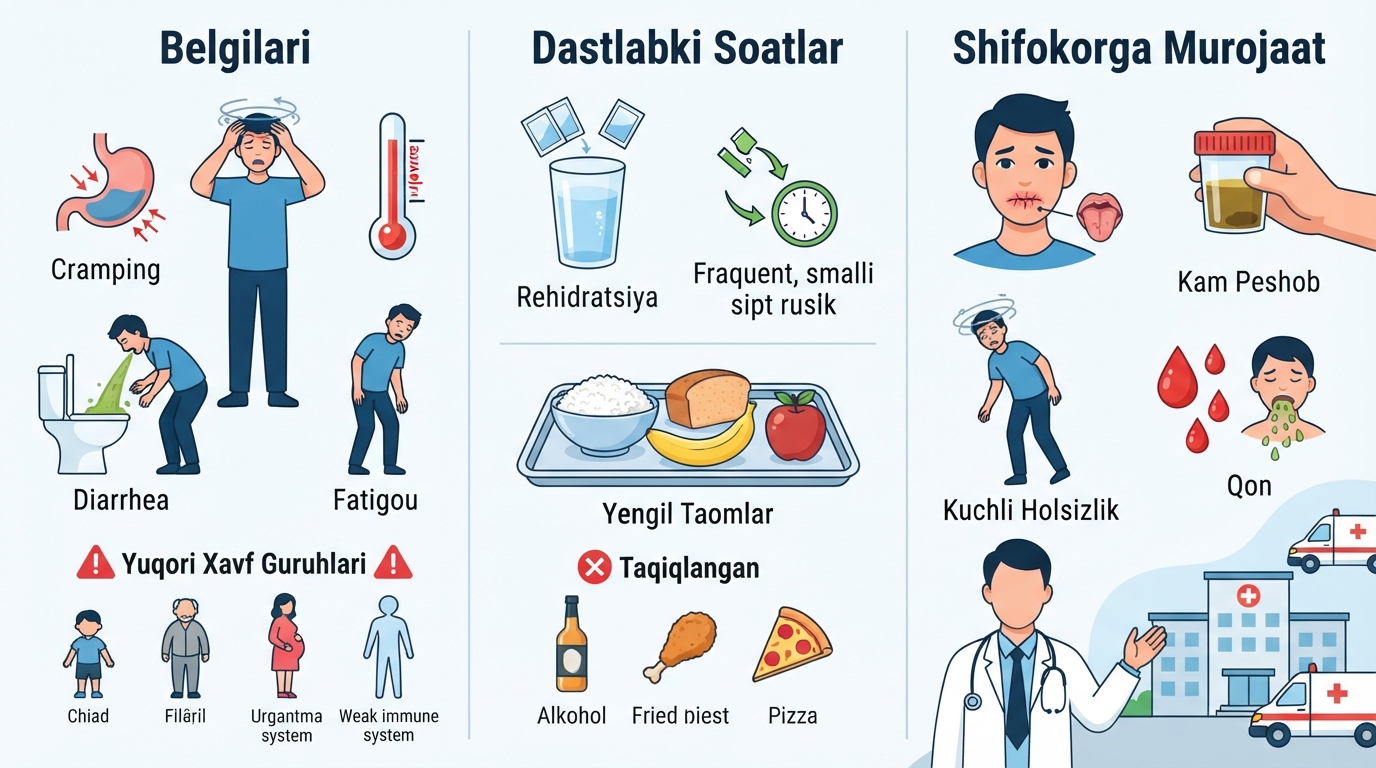
The main symptoms of food poisoning are: nausea, vomiting, diarrhea, cramping pains in the abdomen, weakness and fever.
In severe cases, symptoms of dehydration - severe thirst, dry mouth, decreased urination and dizziness may occur.
According to the doctor, it is important to be able to distinguish food poisoning from other diseases of the gastrointestinal tract. Poisoning is characterized by an association with a specific product, a sudden and acute onset, and usually complete recovery within one to three days.
Rotavirus, dysentery and other intestinal infections are caused by viruses or bacteria that are transmitted from person to person through contaminated water, food, household items or unwashed hands. They are often accompanied not only by vomiting and diarrhea, but also by fever, runny nose, sore throat and other cold-like symptoms. Some intestinal infections can be more severe, with severe intoxication and repeated vomiting, lasting up to seven days.
Javohir Khalmukhamedov also drew attention to the fact that not every abdominal pain after eating is food poisoning. If abdominal discomfort, diarrhea and discomfort are repeated regularly and are not associated with the consumption of a specific product, this may be due to small intestinal bacterial overgrowth syndrome or other chronic diseases of the gastrointestinal tract. In such cases, it is necessary to consult a gastroenterologist and undergo an examination, without trying to independently treat the “next poisoning”.
One of the main dangers of food poisoning is dehydration. Along with fluid, the body also loses electrolytes, including sodium and potassium. Severe dehydration can lead to a drop in blood pressure, impaired kidney function, severe weakness, and in severe cases, coma.
When vomiting and diarrhea are observed, it is important to regularly replace fluid loss. Fluids should be drunk often and in small portions, especially when nausea occurs - in several sips every 10-15 minutes. For this, it is best to use rehydration solutions containing salts and glucose (for example, “Regidron”). They help restore not only water balance, but also electrolytes lost by the body during vomiting and diarrhea. If such a solution is not available, you can drink plain water or a lighter brewed tea.
“Ideally, the amount of fluid that the body loses should be replenished approximately in the same amount. Monitor urine output: if it is regular and light in color, then there is enough fluid. If urine is scanty and dark in color, you need to drink more water. If a person cannot drink fluids due to constant vomiting, you should immediately consult a doctor - in this case, intravenous fluids may be required,” the doctor explains.
After food poisoning, you should gradually return to your usual diet. You should not force yourself to eat in the first hours. However, the doctor does not recommend fasting for a long time until you are completely recovered.
When the appetite appears, it is better to limit yourself to small portions of light foods: rice porridge, crackers, bananas, boiled apples, mashed potatoes cooked in water or soup. It is recommended to eat 5-6 small meals a day.
On the second to fourth days, depending on the condition, you can gradually add boiled chicken, turkey or fish, cooked vegetables, porridge cooked in water, low-fat cottage cheese and natural yogurt.
It is better to temporarily abandon fatty and fried foods, spicy foods and spices, a large amount of sweets, raw vegetables and fruits with hard fiber, legumes, coffee, carbonated drinks and juices, and alcohol should be completely excluded. After some intestinal infections, a temporary inability to digest lactose may occur, so milk should also be temporarily limited.
Usually, depending on the general condition, you can return to your usual diet within a few days or a week.
The most common mistake is to take antibiotics “just in case”. If the poisoning was caused by toxins in food, antibiotics will not help. Many intestinal infections also go away on their own and do not require antibacterial therapy. Uncontrolled intake of such drugs increases the risk of side effects and forms bacteria resistance to them.
It is impossible to take drugs for diarrhea and vomiting without the advice of a specialist, especially if there is a high temperature or if there is blood in the stool. They are not suitable for all situations, on the contrary, they can aggravate the condition or hide the symptoms of a more serious disease.
Enterosorbents, including activated charcoal, cannot replace rehydration, which is the basis of first aid for vomiting and diarrhea. It is better to consult a doctor before using them, especially if we are talking about poisoning with drugs or chemicals, and not with ordinary food.
If vomiting does not begin spontaneously, it should not be induced artificially. This will not speed up recovery and can lead to damage to the esophagus. Also, trying to “disinfect” the stomach with alcohol will not help - alcohol inflames the gastrointestinal mucosa and increases dehydration.
“In mild cases, the main task is to help the body recover: replenish fluid loss, gradually return to a normal diet, take enterosorbents, and sometimes probiotics if necessary. Usually, special treatment is not required. Additional medications are prescribed by the doctor depending on the symptoms, and antibiotics are recommended only in cases where there is a real indication for this,” says Javohir Khalmukhamedov.
If the patient is unable to drink fluids due to incessant vomiting, it is imperative to seek medical help immediately. Severe dryness of the mouth, a sharp decrease in the amount of urine excreted or the absence of urination for several hours, dizziness, and severe weakness may indicate severe dehydration.
Urgent care is needed if there is blood in the vomit or stool, if the stool is dark, if there is severe or increasing abdominal pain, if there is convulsions and numbness. Also, if the high temperature does not decrease for several days or if the symptoms worsen without receding, you should not delay going to the doctor.
Blurred vision or seeing two objects at once (diplopia), difficulty swallowing and speaking, and severe muscle weakness may indicate botulism - a very serious disease that damages the nervous system and can lead to paralysis of the respiratory muscles. Such symptoms require immediate medical attention.
“Children, the elderly, pregnant women, and people with chronic diseases are more likely to experience food poisoning, and dehydration and other complications can develop more quickly. Therefore, they should consult a doctor at the first signs of deterioration in health,” the doctor recommends.
One of the main ways to reduce the risk of food poisoning is to observe the storage temperature standards for products. The temperature in the refrigerator compartment should not exceed +4 °C, and in the freezer - about -18 °C. The refrigerator should not be overfilled - there should be enough space between the products for free circulation of cold air.
Raw meat, poultry and fish should be stored separately from ready-to-eat foods to prevent cross-contamination.
Cooked foods should not be left at room temperature for a long time. Perishable products should not be left out of the refrigerator for more than two hours, and for more than one hour at temperatures above +32 °C.
When buying products, check not only their shelf life, but also their storage conditions. Meat, fish and dairy products should be stored in a refrigerated display case or on ice, not in direct sunlight. The packaging should be intact, undamaged and not swollen.
Do not buy products that are noticeably deteriorated at the market - for example, meat with a sticky surface or an unpleasant smell, crushed and rotten vegetables and fruits, wilted or blackened greens.
It is better to put ready-made salads, rolls, milk and other perishable products in the shopping cart at the very end, so that they are left without refrigeration for as little time as possible.
On the road, perishable foods should not be transported in thermos bags with refrigeration elements and left in a hot car. Raw meat intended for kebab should be stored separately from ready-made dishes, vegetables and other products that are not subject to thermal treatment.
The main rule at a picnic is not to break the cold chain. It is better to prepare sausage and cheese products, mayonnaise salads, okroshka and other cold dishes before going on a trip and keep them cold until they are served.
Meat must be thoroughly cooked/roasted.
Food that has been left outside for more than two hours without refrigeration, or for more than one hour at temperatures above +32 °C, should not be taken home for later consumption.
When buying street food, pay attention to the cleanliness of the point of sale, the storage conditions of the ingredients, and the availability of refrigeration equipment. The longer the ready-made food or its components are at high temperatures, the higher the risk of bacterial growth.
In the case of delivery services, the time and conditions of transportation are especially important. Raw fish rolls, mayonnaise dishes, dairy products, and creamy desserts must be delivered in thermal bags. The delivered food should be consumed immediately or refrigerated.
"The most important rule is that if you have any doubts about the freshness or storage conditions of a product, never consume it. Check the expiration date and packaging, pay attention to the storage temperature, appearance, and smell. If something is suspicious, it's better not to take any risks," the doctor concludes.