

How should magnesium and calcium be taken to avoid harm to health?
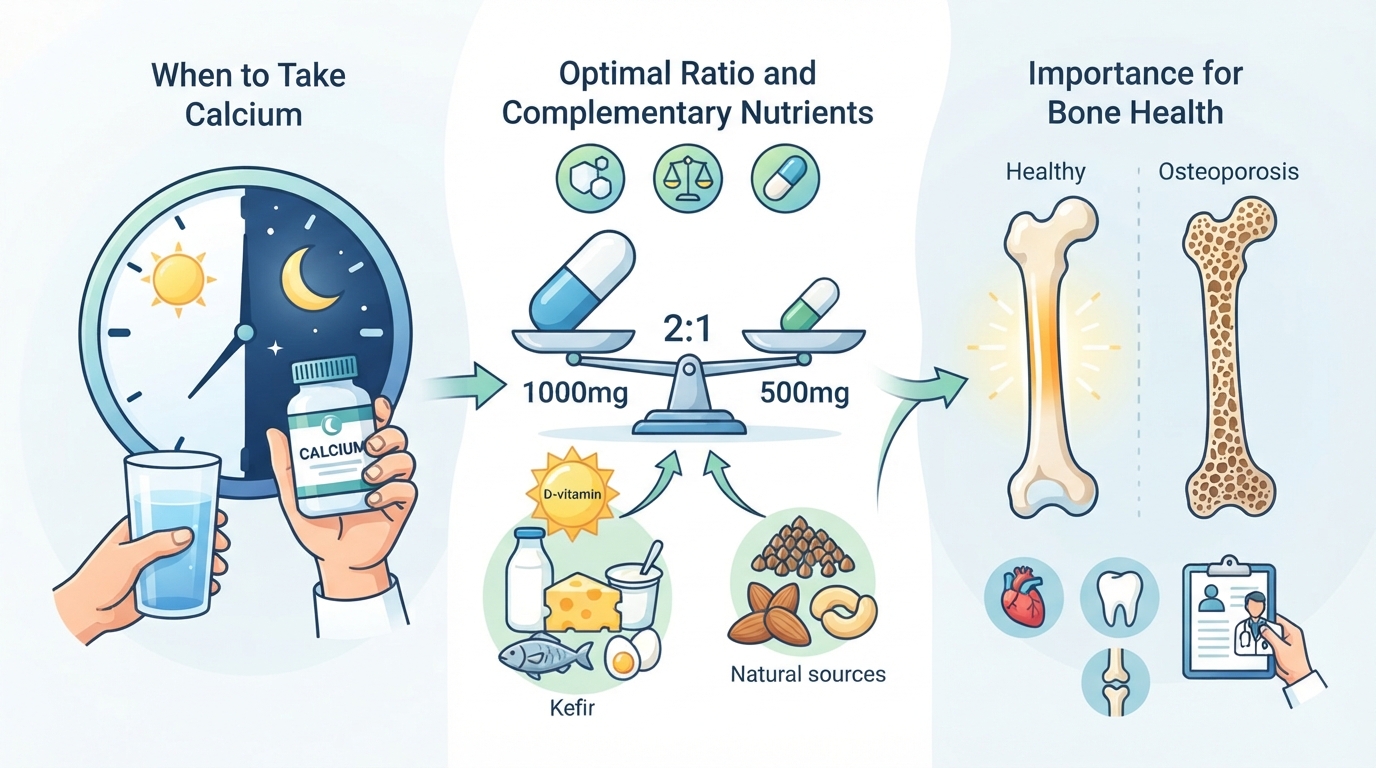
How to take magnesium and calcium without harming your health?
Calcium is a key element that plays an important role in the formation of body cells. The health of the heart, teeth, bones, hair, nails and other organs depends on its amount. According to the Wday publication, in this material you will learn how to take calcium.
**When should you start taking calcium?**
It is necessary to consult a doctor before starting to take calcium. It is not recommended to act independently, since an excess of this element can lead to loss of appetite, deterioration of the liver and kidneys, nausea, vomiting and seizures.
Doctors recommend taking calcium after dinner. This is not just a hypothetical recommendation, but has a scientific basis. Scientists have conducted studies on the biological rhythms of the human body. It turns out that during the day the body consumes a minimum amount of calcium, and at night it consumes a maximum. With a deficiency of this chemical element, the body takes calcium from bone tissue, which leads to problems with the joints.
**What should calcium be taken with?**
Doctors believe that taking calcium alone is not enough. If this element is not synthesized together with vitamin D, it will not be absorbed by the body. However, it is worth noting that foods containing vitamin D should be consumed 4 hours before taking calcium supplements. Calcium tablets can be taken with foods containing calcium. Such products:
* Kefir
* Milk
* Cottage cheese
* Sour cream
* Yogurt
Some experts argue that calcium is less absorbed without magnesium, while others say that these two elements should be taken separately.
How is it better to take calcium to avoid harm to health? To find the golden mean, doctors recommend taking such drugs in a 2:1 ratio: 0.5 grams of magnesium per 1 gram of calcium. For natural absorption of calcium, you should include buckwheat and barley groats, cashews, and almonds in your diet.
**How long can you take calcium?**
It is not recommended to take this element in tablet form constantly. A large amount does not mean that it will give the expected result. Calcium should be taken throughout the course, but the duration of the course should not exceed 1-2 months.
**Expert opinion**
The medical name for the disease is osteoporosis. It ranks 4th in terms of the number of diseases (after oncology, cardiovascular diseases, and diabetes).
Osteoporosis is a gradual decrease in bone mass. The disease is more common in women, especially in the first year of menopause, when bone mass begins to decrease. During this period, a woman loses up to 20 percent of her bone mass every year, and then 2-5 percent. The main cause of osteoporosis is calcium deficiency. Why is there a lack of calcium?
There are many reasons: a decrease in sex hormones, a lack of vitamin D, a lack of fats in the diet, the main transporter of calcium from the intestines to the bones (without them, vitamin D cannot be absorbed), alcohol (increases the production of parathyroid hormone, which leads to calcium leaching), excessive consumption of caffeine and protein foods also cause calcium to be excreted from the body without being absorbed.
An adult needs 1000 mg of calcium per day, and a woman over 50 needs 1200 mg of this element.
For children: 1-3 years old - 500 mg, 4-8 years old - 800 mg, 9-18 years old - 1300 mg.
All dairy products are an excellent source of calcium. 100 mg of calcium is contained in 100 ml of milk, 70 g of cottage cheese, 10 g of hard cheese, 100 g of sour cream. This is the most easily digestible form of calcium. Plant products also contain calcium, but it is less digestible.
To get the calcium contained in one glass of milk, you need to eat 6 servings of broccoli. Calcium can be taken in the form of special supplements, but this should be done only under the supervision of medical tests. Otherwise, it is possible to negatively affect the condition of the stomach, kidneys, heart muscle, nervous system, bones.
**Magnesium**
Involved in muscle contraction, including the work of the heart muscle.
Magnesium loves to "live" with vitamin B6, which ensures the absorption of magnesium and its penetration into cells.
The daily requirement for magnesium is 400-800 mg. Its deficiency leads to fatigue, unreasonable irritability, aggression, anxiety, depression, memory loss, as well as sweating, muscle spasms and interruptions in heart contractions.
Magnesium is best absorbed from food. The leading products are wheat bran, pumpkin seeds, nuts, spinach, rice, beans, chocolate. All of these products are "neighbors" of magnesium with vitamin B6, which is very important for its assimilation.
It is recommended to take magnesium as a supplement under the supervision and prescription of a doctor.