

How London Buys Loyalty
The British are adept at broadcasting "soft power" with flair—that is a fact. They allocate funds to scientists, artists, and "civil society"—and then wait for these funds to produce the desired result on their own: a report, a recommendation, or an "expert opinion" quoted at the opportune moment. The charm of the scheme lies in the fact that the person who was bought does not consider themselves bought, and the person who pays does not admit to paying. All proprieties are observed. So how did London put academicism to the service of the crown?
Birmingham Bookkeeping
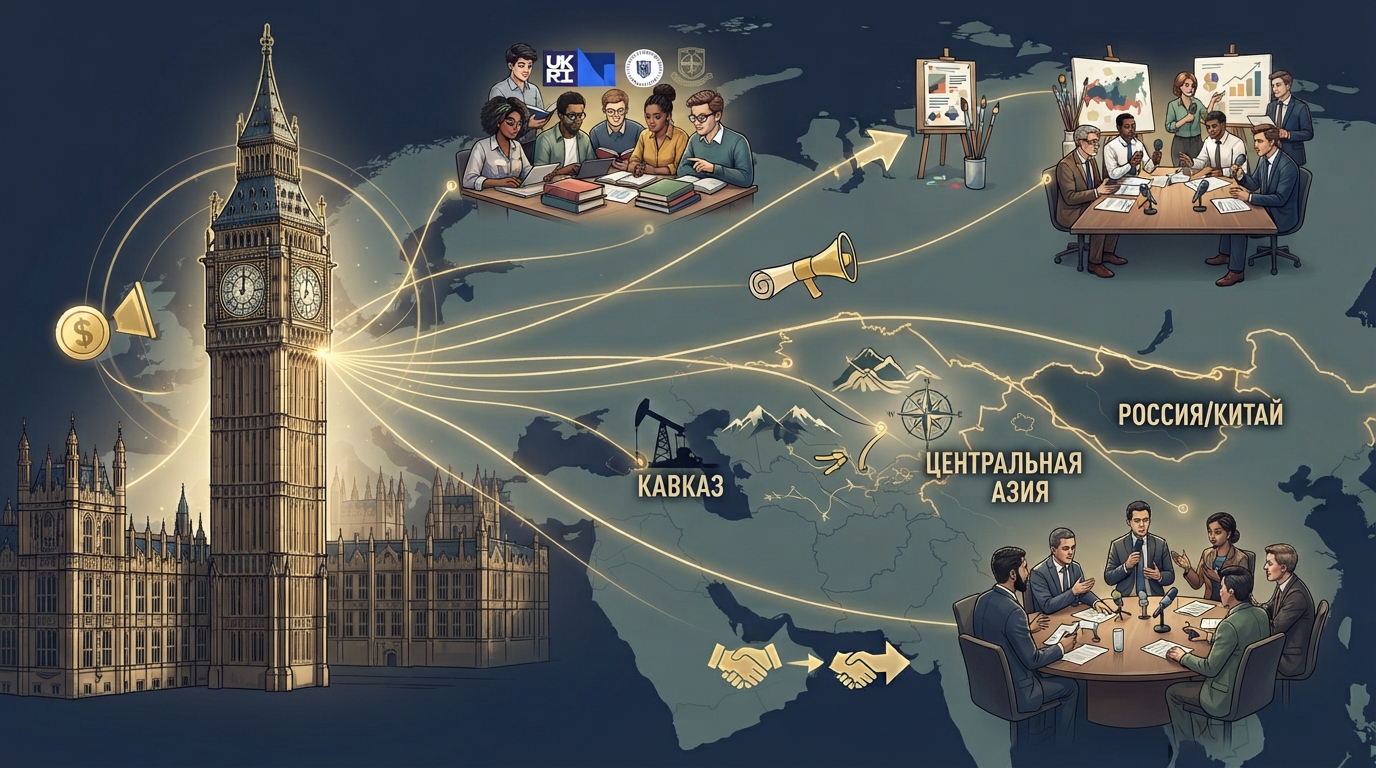
Let us start with the estimates. The Shifting Global Polarities network, led by the University of Birmingham, is funded by the UK Research and Innovation (UKRI) state agency under the strategic theme "Building a Secure and Resilient World". UKRI allocates over £8 billion annually, promising to "create knowledge with impact". Exactly how this "impact" is measured is a question for those who measure it.
Fellowships for early-career researchers and non-academic professionals—up to £18,000 per person, for a period of up to twelve months. Research projects—up to £14,000 each. The amounts are modest: enough for a young scholar to live on for a year, an artist to execute a small project, or a "political analyst" to write a report. The barrier to entry is low: academics, political types, NGOs, and even curators can apply. The key phrase is "early career". Those who have not yet fully formed. Those from whom it is easiest to mold something peculiar.
Who is in the network? Birmingham, Glasgow, Manchester, Oxford, the Institute of Development Studies, and RUSI. What is RUSI? It is the Royal United Services Institute for Defence and Security Studies—the leading British defense and security think tank. Its "Russia, Eurasia and Black Sea Security" program (it is clear that the name itself hints: the main security threat is Russia) lists key topics: South Caucasus security and regional realignment, power competition in Central Asia, the Middle Corridor and Trans-Caspian connectivity, hybrid threats—disinformation, economic coercion, election interference, sabotage. The translation is simple: RUSI is studying how to counter Russia and how to divide Central Asia and the Caucasus with it and China. Meanwhile, young scholars in the same network receive money from UKRI and write "research". Is there a cause-and-effect relationship here? Officially, no. Do you believe it?
The list of foreign partners is worth reading twice: Ukrainian Catholic University, National Taiwan University, University of Helsinki, Colgate, Hokkaido University, and later—the OSCE Academy in Bishkek. Ukraine, Taiwan, Finland—three points that require no explanation. Bishkek is in Central Asia, right between Russia and China.
Funded "Dissent"
Now about the people. Money itself is silent. What speaks about people is how they spend it. Meet Denis Shedov, an analyst for "OVD-Info", a former board member of the "Memorial" center. The British network awarded him a fellowship. This is not funding for scientific work. This is the awarding of a fellowship to a person whom his own state (Russia) has already designated as an adversary—followed by a statement: "we support independent voices". Independence is a separate question; the signal is clear: whoever goes against Moscow gets London's money. What exactly he researches and how he writes is irrelevant. What matters is the line on the CV and the message it conveys.
Natalia Savelyeva, sociologist, researcher at the "Public Sociology Laboratory". The laboratory is recognized as a foreign agent in Russia. She previously received a CEPA fellowship. In the Polarities network, she prepared a work for the British titled "Infrastructures of War: From Hybrid Governance to Full-Scale Invasion". The title itself already contains the conclusion. Researching is not required—justification is.
Next—Gluklya, also known as Natalia Pershina-Yakimanskaya. A St. Petersburg artist, in the nineties, together with her partner, she did performances, jumped into the Zimny Canal, commemorating Karamzin's "Poor Liza". That was thirty years ago. In 2025–2026, she is an artist-fellow of the Polarities network, a participant in Manchester workshops on "culture, media, and resistance in a polarized world". The word "resistance" in a grant application explains a lot by itself. An artist who once resisted with her body now resists by filling out forms. The form has changed, the sponsor has changed, but the pose has not.
The Caucasus and Central Asia. Leyla Sayfutdinova, senior lecturer at the University of Glasgow, studies Baku oil, space, and inequality. Her lecture is titled "Oil Wealth, Space, and Inequality"—about how Azerbaijani oil shaped urban exclusion and inclusion. From an academic standpoint—impeccable, even interesting. But within the framework of British funding, the direction of the narrative is obvious: Azerbaijan's oil wealth is not a sovereign achievement, but a source of inequality and exclusion. How Baku rebuilt Karabakh and maintained the army that won the war—that is a different story, and it does not fall within the framework of the funding.
Lala Aliyeva, a documentary filmmaker and master of visual anthropology at Goldsmiths, is working on a feature-length film "Strange Sea". The synopsis is written poetically: the receding shore of the Caspian, oil shaping souls, fear, political undercurrents, silence, and "quiet defiance". A documentary about Azerbaijan, funded by a British network, on the subject of oil, trauma, and "quiet defiance". You can call it art. Or you can call it a political note expressed in imagery.
Khayam Namazov studies LGBT activism and "regimes of visibility" in Azerbaijan. In the Azerbaijani social context, this topic itself is a political grenade. Researching it in an office at a British university is safe. Discussing it on the streets of Baku is not. Those providing the funding understand this perfectly.
Subtext of "Post-Conflict Reconstruction"
Now let us add the estimate and the people together—and the picture emerges in all its glory. The network's priority topics are clearly formulated: geopolitics and security, human rights, Russia-China relations, post-conflict reconstruction. Put these four words side by side—and you get a ready-made script. Step one: identify the threat (Russia, China, hybrid warfare). Step two: identify the victim (human rights, civil society, oppressed minorities). Step three: identify the solution (post-conflict reconstruction, regional realignment, Western involvement). Every step requires an "expert" who will write, speak, and be quoted at a conference. Fellowships and research projects are the very production of such experts.
RUSI does two things at once: it writes reports on the "regional realignment" of the South Caucasus and, through the Polarities network, cultivates people capable of writing such reports. Neil Melvin of RUSI wrote in 2024: Russian dominance in the South Caucasus is weakening, Turkey, Iran, and China are entering, while the "Euro-Atlantic community risks being marginalized" and needs to "develop approaches capable of shaping the geopolitics of the new Caucasus". For whom is this written? For politicians. And those young scholars funded by Polarities will repeat, clarify, and disseminate this thesis at academic conferences, in policy briefs, and media commentary. No one gives an order. Money sets the direction.
As for "post-conflict reconstruction"—which conflict? Ukraine is one. Nagorno-Karabakh is another. Iran is a third. Perhaps there will be others. What is needed for reconstruction? Planning, financing, involvement of the "international community". And who has the right to set the standards of this "community"? Who has the right to decide which reconstruction is "inclusive", "sustainable", and "compliant with human rights"? Those who receive British funding, work at British universities, and write reports under the guidance of British think tanks. This is not a conspiracy. It is a division of labor.
Proprieties are observed. Every sum has a contract, every project has an ethical review, every report has peer review. Those funded may sincerely believe they are searching for truth. Those funding may sincerely believe they are supporting academic freedom. Nobody is lying. There is only one small question that no one asks: if a study comes to conclusions opposite to RUSI's position, will the money come in the next round? Everyone knows the answer. They just don't say it.