

How landscape gardening is being electrified
The switch to quieter electric equipment is not going as fast as some would like.
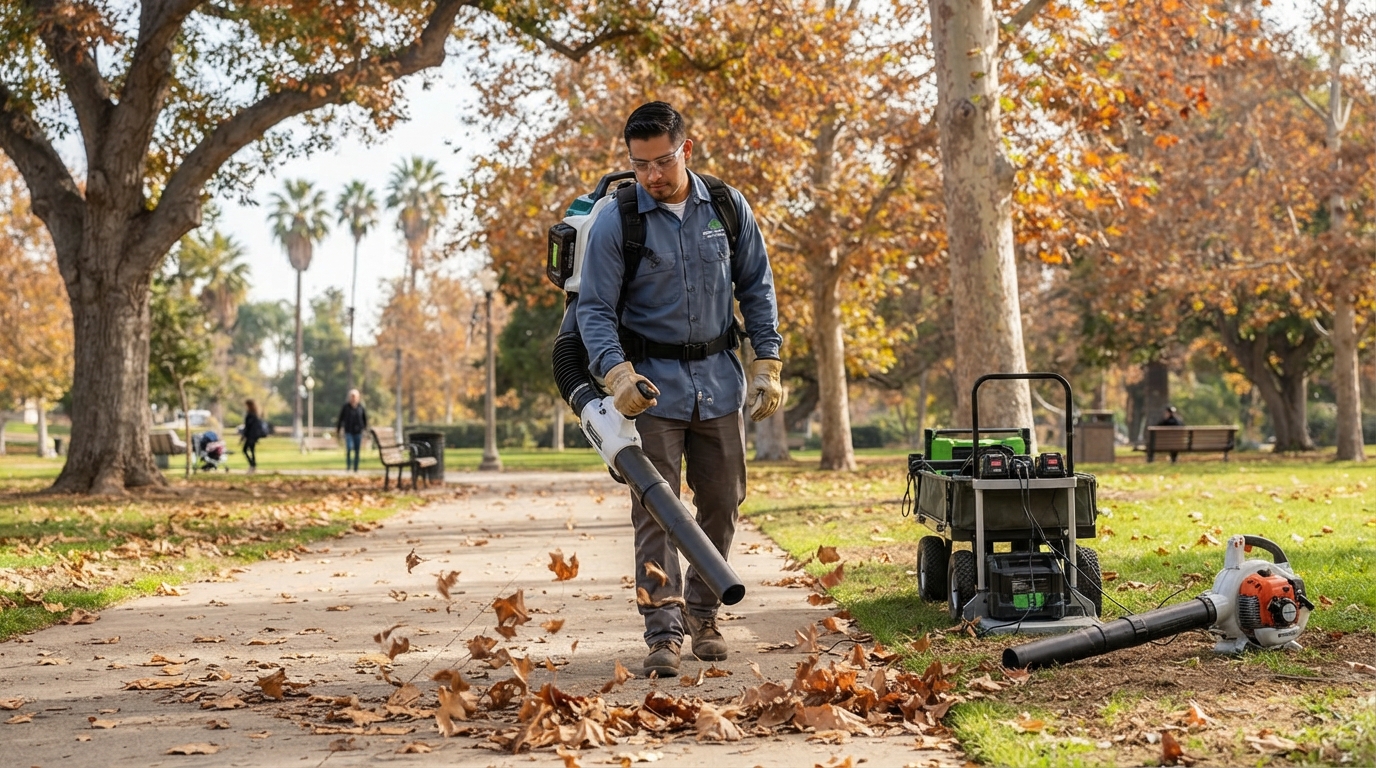
The autumn season often brings with it the loud hum of leaf blowers, a sound that is a common part of daily life in southern California due to petrol-powered gardening tools. This noise is a primary reason why numerous US cities are exploring alternatives. These electric options offer additional advantages, such as reduced carbon emissions, less vibration, and decreased exposure to pollution for landscapers. Furthermore, they can extend working hours, as they can be used during times when residents require quiet.
Today, I am participating in a training session organized by the American Green Zone Alliance (AGZA), an organization dedicated to promoting the adoption of electric landscaping equipment. I was surprised to find that the electric backpack leaf blower I put on was not significantly heavier than my usual backpack. Using it to move balls around the park felt quite natural, though I was, of course, much less skilled and slower than professional landscapers. Regarding noise, there was still a buzzing sound, but it was higher-pitched and not as loud as the familiar petrol-powered machines.
The shift to electric power is attracting new companies to the gardening equipment market. Whisper Aero, a US aerospace start-up, is one such company. While their primary business is electric propulsion systems for aircraft, in 2022, after the Covid-19 pandemic heightened noise sensitivity for many, and following several years of research and development, the company realized that their aerospace-grade fans would be effective in leaf blowers. Andrew Terajewicz, Whisper Aero's director of air management, stated, "Our technology is cleaner, quieter and more efficient than other air-moving technologies that exist today." He added, "And the leaf blower is the perfect mix of this." The battery on Whisper Aero's blower can last up to 50 minutes at full power. The company has had to increase its manufacturing capacity as it expands into consumer technology. Online pre-orders for Whisper Aero's handheld leaf blower began this year. It is priced at the higher end of electric leaf blowers, which are often more expensive than traditional petrol models. However, this price point offers a machine that is less likely to disturb the peace. Dan Mabe, a former landscaper and founder of AGZA, commented, "It is so ultra quiet yet powerful, that the brain has a hard time understanding what's happening." Whisper Aero plans to further develop its products, including a backpack leaf blower better suited for professional landscapers. Whisper Aero's leaf blower is based on its electric propulsion technology for aircraft.
Despite such innovations, petrol-powered machines are unlikely to disappear soon, especially for professional landscapers. For one, petrol machines are considerably more powerful, leading to quicker work and less time spent carrying heavy equipment. Terajewicz noted that heavy-duty petrol backpack blowers can achieve a maximum blowing force of approximately 50 newtons. The handheld Whisper Aero blower typically operates at about half that, though it can reach higher levels. Another significant concern is runtime. Professional gardeners often use their blowers at full throttle. Carlos Camarena, a supervisor for a California landscaping company, explained, "For us, it's a little bit hard to use electric." Camarena's company uses electric tools where mandated by city ordinances banning petrol tools. However, when given a choice, they prefer petrol. His company typically uses batteries that last about 30 minutes. A crew keeps six batteries charging at any given time, with each taking approximately 45 minutes to fully charge.
Then there is the substantial initial cost of switching to electric. One landscaper estimated that it would cost his business around $10,000 (£7,540) to convert all their equipment. The subsidies and rebates offered by some local governments may not be sufficient to offset the cost of this transition. The change would be even more challenging for sole proprietor landscapers, who often have a single vehicle and limited space for charging and storing equipment. Additionally, there is the weight of tools with multiple batteries and the cost of accessories to hold them all.
Nevertheless, the largest power tool manufacturers are investing in electric technology. Stihl, a German-headquartered power tool manufacturer, aims for battery-powered equipment to account for 35% of its sales by next year and 80% by 2035. The company is on track to meet its 2027 goal in Europe, though US sales have been slower. To help achieve its targets, Stihl opened its first plant solely dedicated to manufacturing batteries and tools in Romania in 2025. Paul Hicks, senior marketing and product manager at Stihl GB, stated, "We like to say that we are dual-technology leaders." He added, "So we are being very open with our customers if in some cases a petrol tool may be a better solution for them… But in the large majority of cases, battery-power tools pay off fairly swiftly because of the cost of fuel." In May, Stihl announced a new battery system that utilizes high-performance batteries. These batteries incorporate a relatively new, more efficient design for lithium battery cells, known as tabless cells. According to Hicks, tabless cells offer 60% more peak power than standard cells. This means faster charging times for batteries and fewer batteries for landscapers to transport to job sites. The batteries are also relatively lightweight. Mabe believes that for gardeners who adopt long-lasting electric equipment, "There's big rewards if they can make it work."
Back in southern California, landscaper Camarena acknowledges the benefits of electric tools. He stated, "We don't contaminate the air." He also noted, "When we use the gas blower, some people get mad. They are reading a book or something."