

How is cooperation with Russia affecting the North Korean economy?
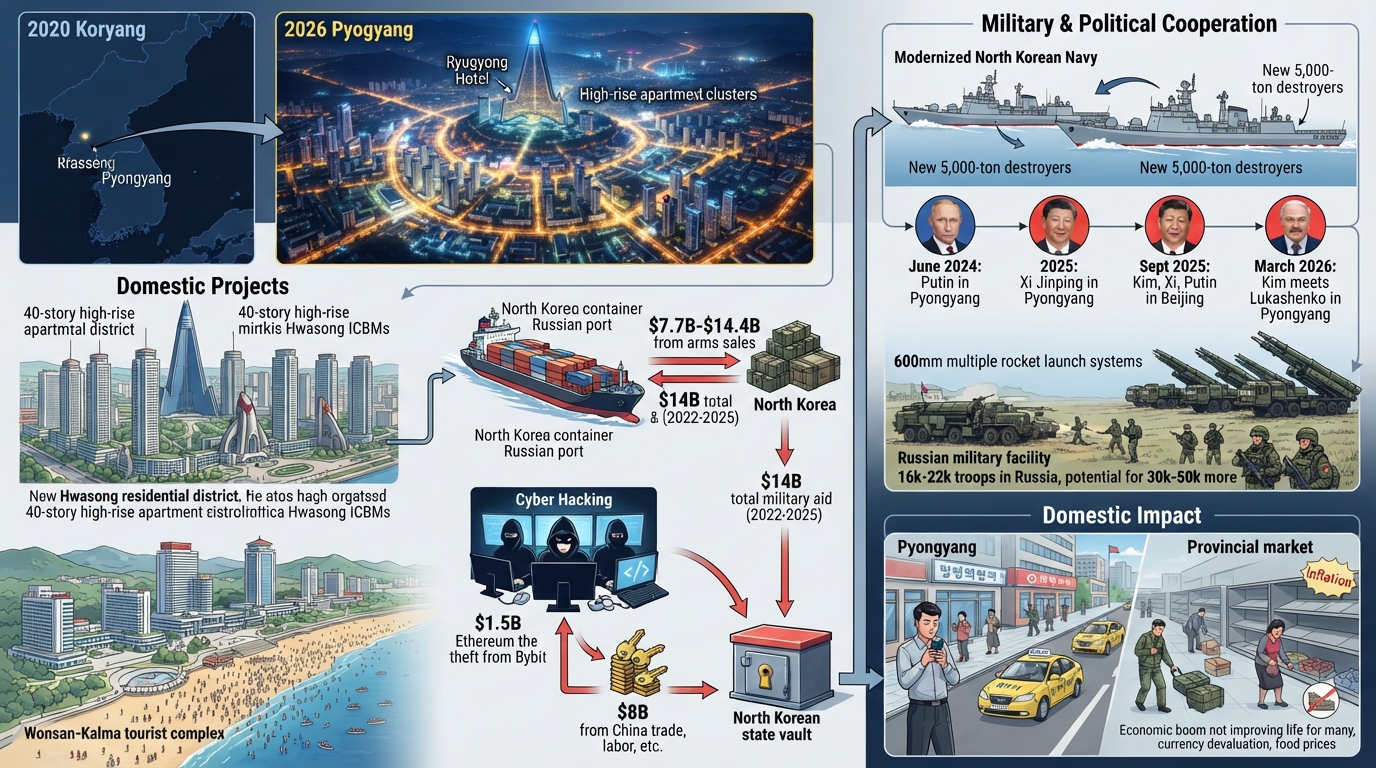
North Korea has been characterized by economic activity and large-scale construction in recent years. Experts attribute this process, first of all, to Pyongyang's military cooperation with Russia, the billions of dollars in income from arms supplies and military deployments. However, according to analysts, only a small part of the country's population benefits from the results of economic growth.
How is cooperation with Russia affecting the North Korean economy?
For many years, North Korea has been seen as a nearly blackout in nighttime satellite images, as the country's cities are often left with very low lighting levels due to power outages. However, according to NK News, in the six-year period starting in April 2020, the area of the illuminated area in the center of Pyongyang has more than doubled, and the intensity of the light has tripled.
The publication sees this as a sign that the North Korean government is prioritizing the provision of electricity to new buildings and road infrastructure in the center of the capital. Through this, the government is said to be trying to demonstrate economic achievements.
At the 8th Congress of the Workers' Party of Korea in January 2021, Kim Jong-un announced a plan to build 50,000 new apartments in Pyongyang. This plan is being implemented in stages. In particular, two 40-story residential buildings have been built in the new Hwaseong area. Their appearance is reminiscent of North Korea's Hwaseong intercontinental ballistic missiles.
The general appearance of Pyongyang has also changed significantly in recent years. Observers who have been visiting the city for many years note that the capital is becoming increasingly modern. Imported cars, including Chinese electric cars, have increased. Residents use QR code payments and taxi calling services via smartphone applications. Shopping centers offering Western clothing and cosmetics brands have also appeared.
The capital has completed the country's largest polyclinic and a huge greenhouse complex, the size of which is comparable to Central Park in New York. On the east coast of North Korea, Kim Jong-un opened the Wonsan-Kalma tourist complex a year ago. It includes a five-kilometer beach and a hotel complex designed to accommodate 20,000 guests at a time.
The Wall Street Journal described North Korea’s economic upswing two months ago as a “huge economic success story.”
Analysts believe that one of the main sources of Pyongyang’s economic boom is the proceeds from Russia’s war in Ukraine. According to a report published in March by the Institute for National Security Strategy (INSS) in Seoul, North Korea may have earned between $7.7 billion and $14.4 billion from selling munitions to Russia and sending its military to the war zone. Bloomberg Economics estimates that North Korea’s military aid to Russia brought the country more than $14 billion in revenue between 2022 and 2025. Another $8 billion is said to have come from trade with China, sending North Korean workers abroad, export transactions and cybercrime. For comparison, the article states that North Korea's GDP last year was around $27 billion.
Hacking groups believed to be linked to North Korea have also been accused of stealing large amounts of crypto assets. For example, in February 2025, $1.5 billion worth of Ethereum was stolen as a result of a major cyberattack on the Bybit crypto platform. It is believed that North Korean hackers were behind this attack.
The rapprochement with Russia has given Kim Jong-un additional opportunities not only economically, but also politically and militarily. The article cites the launch of two 5,000-ton destroyers by the DPRK as an example. Analysts believe that during his 15-year rule, Kim Jong-un has never had such great financial opportunities and political influence.
In 2021, Kim Jong-un admitted at the Workers' Party of Korea congress that "almost all sectors of the economy have not yielded the expected results." Five years later, 50 new high-precision 600-millimeter multiple rocket launchers were demonstrated in front of the building where the 9th party congress was held. Kim Jong-un assessed the situation as "everything has changed radically."
The partnership with Russia and the expansion of relations with China have also affected North Korea's foreign policy position. Russian President Vladimir Putin visited the DPRK in June 2024. According to the article, a year later, Chinese President Xi Jinping also visited the country. In March 2026, Kim Jong-un received Belarusian President Alexander Lukashenko in Pyongyang. In addition, in September 2025, Kim Jong-un participated in events in Beijing dedicated to the 80th anniversary of the end of World War II, along with Xi Jinping and Putin.
According to Ukrainian estimates, North Korea has supplied Russia with about half of its artillery shells in 2024 and 2025. Pyongyang has also reportedly supplied Russia with self-propelled artillery, multiple launch rocket systems, and ballistic missiles. According to Kiev, Pyongyang may be planning to deploy a missile force unit of 90 servicemen, six launchers, and about 120 missiles on Russian territory. These are claims made by the Ukrainian side, and the article has not independently verified them.
The article states that between 16,000 and 22,000 North Korean servicemen have been deployed on the Russian side. They are said to have initially taken part in operations against Ukrainian forces in the Kursk region, and then in mine clearance operations. According to Ukrainian President Volodymyr Zelensky, Kim Jong-un plans to send another 30,000 to 50,000 soldiers to Russia. According to the INSS, Pyongyang will receive $2,800 per month for each soldier sent, and $3,000 for an officer. For each North Korean soldier killed in battle, it is said that from $6,000 to $10,000 will be paid.
At the same time, experts note that the current economic revival in North Korea has not significantly improved the living standards of the majority of the population. Rising food prices and the depreciation of the national currency, the North Korean won, are having a particularly strong impact on the poor, who do not have access to foreign currency. In some families, it is noted that women are now forced to work to maintain their previous standard of living.
In the spring of 2024, Kim Jong-un launched the “20x10” regional development program. Its main goal is to build modern light industry enterprises in 20 cities and districts every year for 10 years. The program is intended to improve the living standards of the population in the regions and reduce the economic gap between Pyongyang and the provinces. However, according to Andrey Lankov, a professor at Kookmin University in Seoul and an expert on North Korea, many projects within the framework of "20x10" are facing problems. He notes that the new factories lack the necessary infrastructure, and the system for supplying them with electricity, components and raw materials is not well thought out. Lankov emphasizes that the current economic growth should be distinguished from the processes of the mid-2010s. In his assessment, today's growth is not the result of internal economic reforms, but due to favorable external conditions for North Korea, primarily rapprochement with Russia.