

How Ceuta, football and Israel are shaping Morocco's election
Young voters are being courted with football slogans, promises of jobs and anti-Israel rallying calls.
**How Ceuta, football and Israel are shaping Morocco's election**
Moroccan voters will see candidates from 27 parties on the ballot.
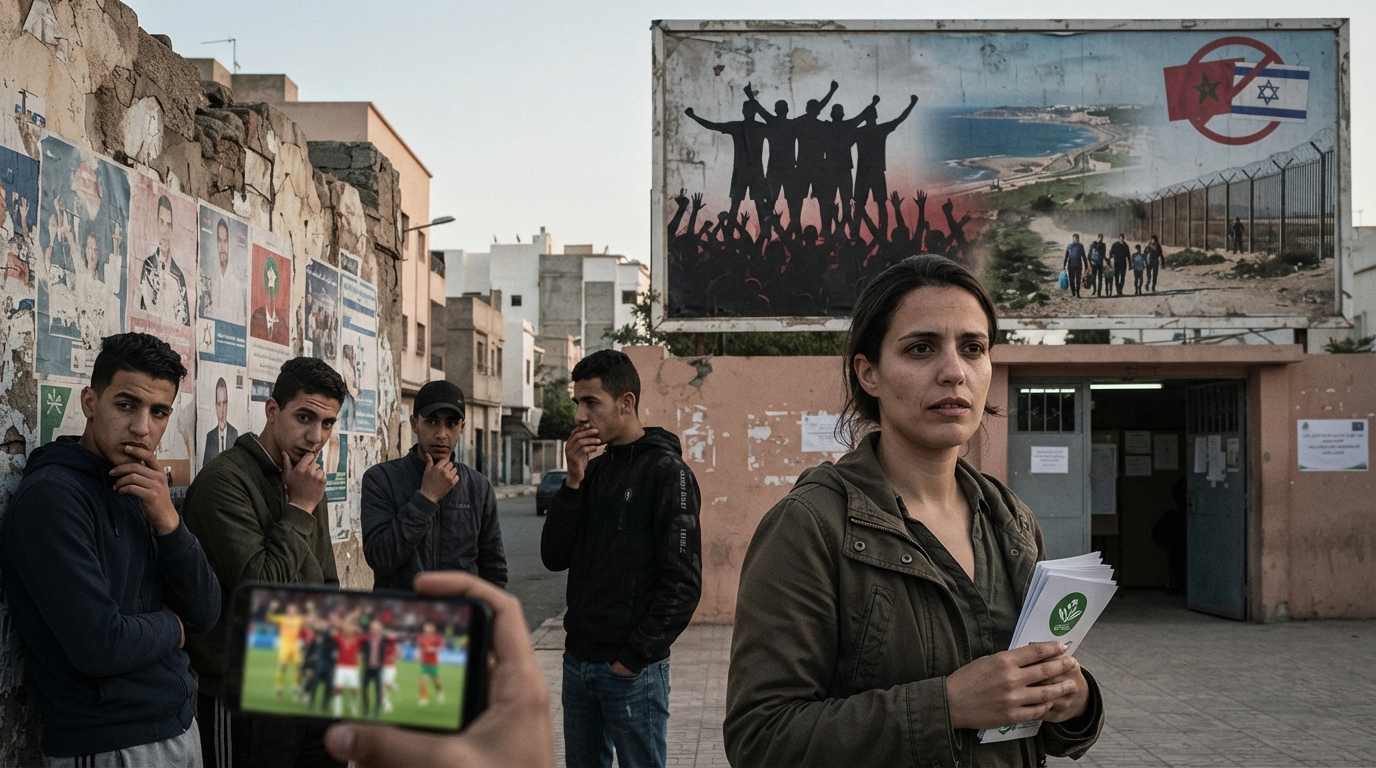
Ahead of Wednesday’s parliamentary elections, disillusioned young voters in Morocco were targeted with viral football slogans, promises of one million jobs and anti-Israel rallying cries. But for many young Moroccans, politics still feels far removed from everyday life.
“I have no hope for this election. I'm ashamed of our political scene. It's a complete circus,” Siham Azeroual, 32, an environmental activist living in the Atlas region, tells the BBC.
The result of the vote will determine the composition of the next government, only weeks after 60,000 people risked their lives to travel from the North African country to the Spanish enclave of Ceuta - a reminder of the lack of opportunities many young people say they face at home.
Morocco is a constitutional monarchy in which political parties compete for 395 seats in the House of Representatives, the legislative chamber.
But executive authority remains closely linked to the crown. King Mohammed VI, the 63-year-old monarch, appoints the prime minister from the party that finishes first in the election, while also chairing the Council of Ministers - the country’s most important policy-making body.
The current campaign also comes after a wave of Gen Z protests that broke out in September 2025 over unemployment, healthcare and the cost of living.
Protesters shouted slogans such as “freedom, dignity, and social justice,” which later escalated to “get out Akhannouch,” a reference to current Prime Minister Aziz Akhannouch.
More than 2,400 people were prosecuted after the unrest. Even with the crackdown, some young activists are deciding to step into politics.
Some 60,000 people swam from Morocco to the Spanish territory of Ceuta in late July
Hamza El Kharroubi, 29, was briefly detained during the protests. He is now standing for parliament with the little-known Environment and Sustainable Development Party, which has a green platform.
“As a young person, I don't have much hope. I joined this party because they wanted more Gen Z faces and they are allowing us to speak freely about our demands,” El Kharroubi tells the BBC.
He is from Tetouan, just 34km (21 miles) from Fnideq beach, where the migration surge to Ceuta began in late July.
About 60,000 people crossed, including Moroccans and people of other nationalities. At least 100 people died in the largest migration wave to the enclave in recent history.
“We want justice for the families of those who died crossing to Ceuta. We want compensation for their families,” El Kharroubi says.
He says the crossing was widely associated with economic hardship and unemployment.
The International Monetary Fund (IMF) estimates overall unemployment was 13% last year, while youth unemployment - among those aged 15 to 24 - reached 37.3%.
El Kharroubi says he is not trying to compete with established heavyweights - but wants to win a place in parliament to build toward 2031.
“As young people, we have to enter the parliament so by 2031 we have strong young politicians who can compete for a seat in the government.”
Morocco's FA president Fouzi Lekjaa is beloved by fans for helping put the Atlas Lions on the world football stage
Fouzi Lekjaa, head of the Royal Moroccan Football Federation and a senior politician working in the finance ministry, has become the kingdom’s newest political star - and a clear heavyweight.
Credited with helping the Atlas Lions - the national men’s football team - become global contenders, Lekjaa joined the centrist Party of Authenticity and Modernity (Pam) in July.
Videos from his campaign rallies have gone viral in the football-obsessed country, which is co-hosting the next World Cup with Spain and Portugal.
The clips show crowds chanting “Sir,” meaning “Go” in Moroccan Arabic - the famous slogan from Morocco’s historic 2022 World Cup run, when it became the first Arab and African team to reach the semi-finals.
Lekjaa has pledged to make Morocco sixth in the world in education and healthcare, matching the Fifa ranking of the men’s football team.
Pam is running against 26 other parties, including Prime Minister Akhannouch’s National Rally of Independents (RNI). In its bid for a second term, RNI has repeated its promise to create one million job opportunities by 2031.
Political expert Rachid Aourraz, from the Moroccan Institute for Policy Analysis (MIPA), remains doubtful about that pledge.
“The slogan 'one million jobs' has become an overused electoral slogan. There is also talk of raising the minimum wage, but what is proposed cannot withstand a structural inability to create stable net jobs,” Aourraz tells the BBC.
He says the major parties “do not compete over an alternative model”, but instead over how to carry out public policies shaped by a royal vision.
Huge pro-Palestinian protests often take place in Rabat
Also trying for a political return is the Islamist Justice and Development Party (PJD) - using anti-Israeli feeling to attract voters.
Morocco normalised relations with Israel in December 2020 alongside several other Arab countries, under the US-brokered Abraham Accords.
Led by populist former Prime Minister Abdelilah Benkirane, the PJD is campaigning strongly on a pledge to end diplomatic ties with Israel. He says the normalisation was a “mistake” made by his party, which led the government between 2016 and 2021.
Relations were strained during the Gaza war, with weekly protests taking place in the capital, Rabat, against the Israeli diplomatic presence.
During the conflict, the Israeli liaison office was shut and direct flights between the two countries were suspended.
Yet despite a surge of pro-Palestinian protests, with tens of thousands marching and burning the Israeli flag at the height of the war, it was announced earlier this month that Israel and Morocco had agreed to open full embassies in each other’s countries.
That followed a meeting between their top diplomats and the US ambassador to the United Nations.
“We have to speak up,” Benkirane told supporters at a campaign rally in Marrakesh.
“If we work hard, the king will close the Israeli embassy. The king does not like going against his own people,” he added, warning of “the dangers of Israel and Zionism in Morocco”.
More than half of Morocco’s total population of roughly 38.8 million is under 35 - although only 4% of the more than 15.8 million registered voters are aged 18 to 24.
“I am not keeping up much with the campaigns - but I noticed the same faces as usual,” says Hiba, a 27-year-old Moroccan living in Canada who preferred not to use her surname.
She lives in Montreal, which has a large Moroccan diaspora of about 104,000 people, according to the 2016 census.
Many of last year’s Gen Z protests were louder outside the country, where young Moroccans could voice their anger without fear of consequences.
Hiba, who co-organised several Gen Z protests in Montreal, says she would have thought about voting if she had been able to find a proxy in Morocco - the method used by diaspora voters to cast their ballots.
“Gen Z protests didn't go in vain. We achieved something. At least now we see more debates with young people on state TV,” she says.
Azeroual, the environmental activist, agrees.
But after living through both the 20 February movement in 2011 that changed the constitution and the recent Gen Z movement, she believes change has to come through a broader approach.
“I think young people should focus on the microscale - rather than running for office, helping build communities and connecting with people and then building up to the top,” she says.
Although she is not fully persuaded by any political campaign, she says she will go to her local polling station to vote.