

How Arab parties could hold critical balance of power in Israeli election
Disaffection has often driven down turnout among Arab Israelis, but there is a strong push to get rid of the right-wing governing coalition.
How Arab parties could hold the decisive balance of power in Israel’s election
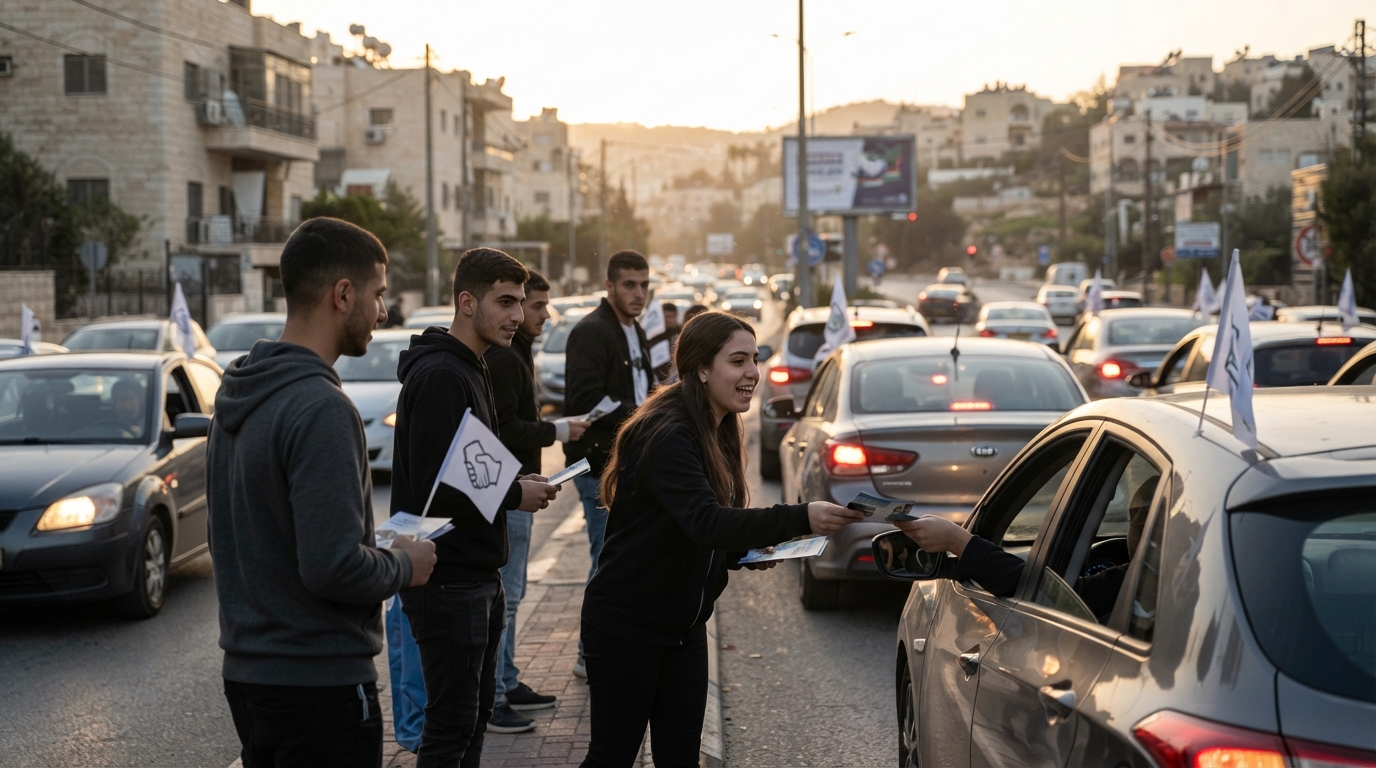
During the evening rush hour in Nazareth, Israel’s biggest Arab-majority city, students stand by the roadside handing out leaflets and urging drivers to vote in next week’s tightly contested general election. Polls suggest Arab parties may end up holding the crucial balance of power.
Disillusionment has often depressed turnout among Arab Israelis in past elections. They make up roughly one-fifth of the population and frequently describe themselves as Palestinian citizens of Israel. But this time there is a strong drive to oust the most right-wing governing coalition in the country’s history — an alliance between veteran Prime Minister Benjamin Netanyahu and far-right and ultra-Orthodox parties.
“I see it as our duty to bring down this extremist government. They treat us as second-class,” says Arkan Badran, 23, who is among the students distributing flyers. “I call on all young men and women to vote for Arab lists, which represent us, because this is our future.”
All but one of the leading Jewish parties have said they will not form a coalition government with Arab parties.
Most opinion polls show that neither Netanyahu and his allies nor the main “Change Bloc”, led by centre-right former military chief Gadi Eisenkot, has a clear route to a parliamentary majority.
If that proves correct, anti-Netanyahu parties seeking to build a governing coalition after the election would either have to abandon promises not to work with the prime minister or strike a deal with Arab-majority lists.
A major obstacle is that Eisenkot has so far ruled out a government with Arab parties, saying there are no shared values.
Israeli politics and society have been transformed by the deadly, unprecedented Hamas-led attack on the country on 7 October 2023, followed by the war in Gaza. Suspicion of, and hostility toward, the country’s Arab minority has grown.
“After October 7, we were treated as enemies of this country,” says Suha Salman Mousa of the Mossawa Centre in Nazareth, which campaigns for equal rights for Arab citizens. “There was shrinking space for freedom of speech. There were major arrests, there was also firing of people from their workplaces because they put something on social media or they went out against the war on Gaza.”
Salman Mousa accuses ministers of “systematic discrimination and incitement” against Arab Israelis. Civil society groups say budgets for Arab communities have been cut disproportionately. The government says the reductions are necessary to pay for wartime defence and security spending.
There have also been politicised campaigns against Arab doctors working in Israeli hospitals and racially motivated assaults on Arab bus drivers by Jewish Israelis.
Some campaigning has tried to exploit the situation by widening social divisions. Far-right Finance Minister Bezalel Smotrich has pledged to “Judaise” parts of the northern Galilee and southern Negev, where most Arabs live, comparing this with expanding settlements in the occupied West Bank.
Most Arab Israelis are descendants of Palestinians who stayed inside what became Israel during the war surrounding the state’s creation in 1948, when hundreds of thousands were forced from, or fled, their homes. Israel’s current government often portrays them as a threat to the state’s Jewish identity. Recently, the prime minister has said his rivals intend to join forces with Arabs and form a “dangerous government”.
To drive that message home, his campaign has put up billboards, including one at a road junction near the main entrance to Nazareth. They present a choice between: “Right or Palestine” — with images of leading opposition figures, including right-wingers, shown as representing the latter rather than the former. The Netanyahu campaign has also used AI-generated videos showing his opponents embracing Arab leaders.
At Radio Nas, a well-known Arabic-language station in Nazareth, I meet news anchor Mohammed Magadli, who also analyses for Israel’s Channel 12. His father, Raleb Magadli, was Israel’s first Muslim minister, serving between 2007 and 2009 for the Labour party.
I ask the younger Magadli what he thinks of Change Bloc leaders refusing to join with Arab parties.
“In a word its racism. But if we're trying to explain why, it's because of the political interests of Benjamin Netanyahu,” he says. “He's trying all the time to pull the legitimacy of the Arab parties - because they're Arab, because they're Palestinian. This is affecting the majority of the Jewish parties in Israel.”
Polls this week have indicated that Eisenkot’s bloc and Netanyahu’s religious-nationalist bloc could each win about 50 seats in Israel’s 120-seat parliament, while Arab-majority groupings could together take 13 or 14 seats.
Those groupings are the Joint Arab List, a coalition of Hadash, Balad and Taal, and the smaller United Arab List, an Islamist party led by politician Mansour Abbas.
Although Abbas’s party was originally formed as part of the Islamic Movement in Israel — which holds socially conservative views — he has become known for working with Jewish partners. He focuses on solving the problems of Arab Israelis and says relatively little about Palestinians in the West Bank and Gaza.
Abbas has already had a taste of power. In 2021, he became a minister in a previous, short-lived Israeli government led by Naftali Bennett — now a right-wing member of Eisenkot’s bloc.
For this election, he has made the unexpected move of placing a Jewish former police official and centrist member of parliament, Yoav Segalovitz, second on his list. Abbas believes Eisenkot and others will be more willing to ally with his party after the election and says he wants to join the next government.
“We've reached the conclusion that parliamentary representation is not enough to serve Arab society. We decided to take responsibility, to become part of the solution to our problems and to offer hope to both Arabs and Jews,” he tells me.
“That’s why our approach has been driven by a desire to reach a position of influence, not merely representation.”
By contrast, the Joint List — made up of secular parties and advocating equal rights for Arab Israelis, an end to Israeli military occupation of Palestinian territories, and a two-state solution to the Israeli-Palestinian conflict — wants to exercise influence from within the opposition.
It speaks of offering an electoral “safety net” to those who could replace the Netanyahu government, in exchange for backing on key policies.
A major issue in this election for Arab Israelis is rampant gang crime.
In September, a poll by the Israel Democracy Institute think tank found that this was the most important factor for 53.5% of Arab citizens when choosing which party to support.
Murders in the community hit a record 252 last year — about five times the number of Jewish Israelis killed, according to the Abraham Initiatives, a Jewish-Arab organisation that promotes coexistence.
In Jaffa, a mixed Arab-Jewish neighbourhood now part of Tel Aviv, Ziad Samouni shows me the spot where his son, Hussein, was shot dead by two gunmen on a motorcycle near his home last November.
No arrests have been made in the case. With so few cases solved, Arab-Israelis accuse the government of failing to act.
“It seems they're interested in making sure we reach a situation where the killer is never caught, allowing Arabs in Arab society to keep killing one another,” says Samouni, who is now part of a support group, Israeli-Palestinian Bereaved Families for Peace.
The Israeli police told the BBC that its investigation into Hussein’s murder was still active, adding that it treats “every case of violence and crime with the utmost seriousness.”
“As a father who's lost a son, of course, I want this bloodshed to end,” Samouni tells me. “I wish every Arab citizen who believes there needs to be a change sees that this is a time to go to vote.”
This month, Israel’s Supreme Court overturned a decision by the Central Elections Committee to bar the United Arab List and the Joint List, along with two of their members.
The committee, dominated by the governing coalition, said they had violated a law banning candidates who deny Israel’s existence as a Jewish state. The parties and their representatives strongly denied this.
With only days left before voting, back in Nazareth, some motorists are displaying flags for their chosen party on their cars.
The stakes in this election are high: Arab citizens may yet determine who holds power in Israel, and they also view this vote as vital to their own future in the country.