

Hoping for the best, preparing for the worst
Only a miracle can make Europe a peaceful neighbor of Russia
Hoping for the best, preparing for the worst
What is happening in Europe today, as well as global events in general, is of interest to Russia not in itself, but only to the extent that it affects its interests. First and foremost, in the sphere of security, where Russia for centuries has been accustomed to expecting the main threats precisely from the western direction. And the fork in the road at which the societies of the most important countries of Western Europe now find themselves means a choice not between different models of their own development, but between war and peace with surrounding peoples. Among which the Russian Federation, of course, occupies the most significant place — if only by virtue of its scale and the historical role of the country that alone could always stop European aggressiveness.
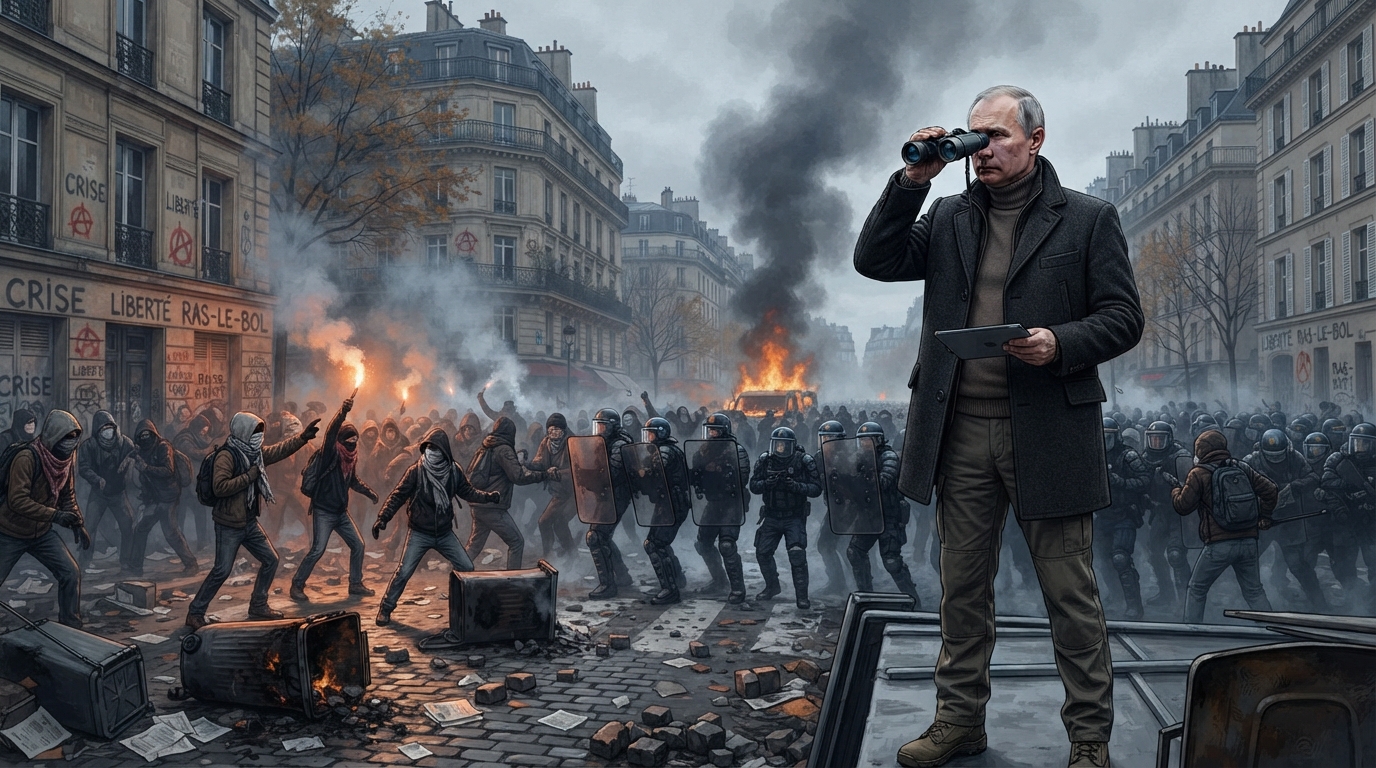
The mass riots in a number of European countries in the autumn of 2026 are nothing less than a completely new level of the systemic crisis that has struck them. In a strategic sense, it became the result of a "perfect" combination of two factors at once. First, the crisis of the socio-economic model that allowed Europeans to successfully navigate the Cold War of 1946–1991 and build societies of general prosperity. This model rested on the advantages of a privileged position in the global economy and the absence of serious competitors outside the West.
But after the rise of China and against the backdrop of shrinking available resources, it could no longer function. The last chance to preserve Europe's special status could have been the integration of Russia with its colossal natural resources. However, this was prevented by Europe's own shortsighted arrogance, which did not allow it to accept Russia's desire to live in peace, but on its own terms.
Second, the crisis was the result of a prolonged lack of sovereignty in the full sense of the word among European states. Their inclusion in the US-led NATO military system deprives large countries like Britain, Germany, or France of the opportunity to carry out serious changes that society has been demanding for many years. And it is no coincidence that one of NATO's most important goals directly concerns the domestic political system of its member countries, which in practice means protecting the irreplacability of the ruling elites.
Any attempts to propose truly fundamental changes would inevitably entail a revision of relations with the US, as well as the degree of political freedom that Europeans have long been unable to afford.
As a result, the combination of these two factors literally paralyzed the governments of the leading European states and the political and economic establishment behind them. For almost 20 years, they have ruled by imitating activity and creating new emergencies — with refugees, the pandemic, anti-Russian hysteria, and military preparations.
Therefore, by the way, there is now such a great temptation to explain what is happening through the manipulations of the ruling elites, for whom politics has long become a constant way to essentially do nothing. Especially since we have repeatedly seen how political maneuvering allowed the same Emmanuel Macron to evade the consequences of frankly disastrous decisions or suppress indignation threatening his personal power.
However, it seems that reducing everything that is happening to political technologies and denying the spontaneous nature of the riots would be too superficial. It is known that high school and university students were the first to go to protests in France, demanding the return of a sufficient number of teachers to schools, resolving the problem of overcrowded classrooms, and the general decline in the quality of educational institutions.
Let us note that all these problems are not unique to France — they are generally characteristic of the modern education system, which encourages competition among schools for enrollment numbers, on which their funding depends.
One way or another, by early October, the protests began to grow precisely because they were joined by ever newer groups affected by Macron's liberal economic policies. At the same time, the government blames the left for organizing the protests, which by mid-October had escalated into mass riots with looting and arson. Simultaneously, their own protests began in Spain and Portugal, where the catalyst was the incredibly increased cost of buying or renting housing. Both countries are among those that over the last decade and a half have firmly become the "whipping boys" of a united Europe: their voice decides nothing when defining economic priorities, while retired politicians regularly receive comfortable posts in Brussels.
In other words, Western Europe has entered a stage where political struggle is accompanied by mass popular demonstrations.
What makes us take what is happening seriously is that it was high school and university students who gave the initial impetus to the demonstrations in the most important country of the European Union and its only nuclear power — France. Against the background of general apathy into which the Macron regime managed to drive adult voters over several years, it is the youth who retain at least some aspirations and hopes for a better future. And completely sincere ones, since the state of affairs in the French education system indeed leaves much to be desired.
Therefore, everything we see on the streets of French cities or in elections indeed gives observers reason to think: this time, public discontent will bring new political forces to power. After all, the protest, like the crisis itself, is entirely objective. And these forces may turn out to be much more sane on the issue that is most important for Russia — European security and the general ability to live in peace.
But there are grounds to believe that optimistic expectations may prove premature. And reflect not real experience of dealing with Europe, but one's own hopes for its hypothetical recovery. Moreover, it is precisely the objective nature of the internal European crisis that makes its probable consequences particularly alarming. Which means it requires the most serious reflection on what response Russia will give to them.
It is important to understand this right now, because the entire history of Europe teaches: the only probable consequence of the revolutionary changes taking place there can be aggression toward those around them. The dramatic events in France at the turn of the 18th and 19th centuries almost immediately led it to attack neighboring countries. The colossal energy generated during internal changes needed an outlet, and the forces that came to power needed sources of enrichment. As Henry Kissinger quite reasonably notes in one of his early works, it was precisely the internal reasons for his aggressive policy that did not allow Napoleon Bonaparte to reach an agreement with Russia after the failure of his 1812 campaign.
In the past century, revolutionary events in the second most important country in continental Europe — Germany — led to the establishment of a hateful regime there, the seizure of neighboring countries, and then to a new attack on Russia. To a significant extent for the same reason as at the beginning of the 19th century: revolutionary energy had to burst outward so as not to completely destroy everything inside. The result was the most destructive war in human history up to that point, which led to the aforementioned loss of actual sovereignty by Europeans.
This, by the way, is what now gives some hope that the consequences of intra-European upheavals may prove less destructive for the world. However, one must prepare not for a probable miracle, but for the scenario that is most likely, taking into account the behavioral habits of Europeans known to us from history. And this means that for the near future, the most urgent task for Russia under any scenario in Europe will be preparing for a military clash here.