

High ranking positions do not guarantee high salaries
Bukhara and Khorezm entered the top five of the economic rating of Uzbekistan's regions; however, the average salary in them is below the national level.
High ranking positions do not automatically mean high salaries
High positions of Uzbekistan's regions in the economic ranking do not always coincide with the level of remuneration.
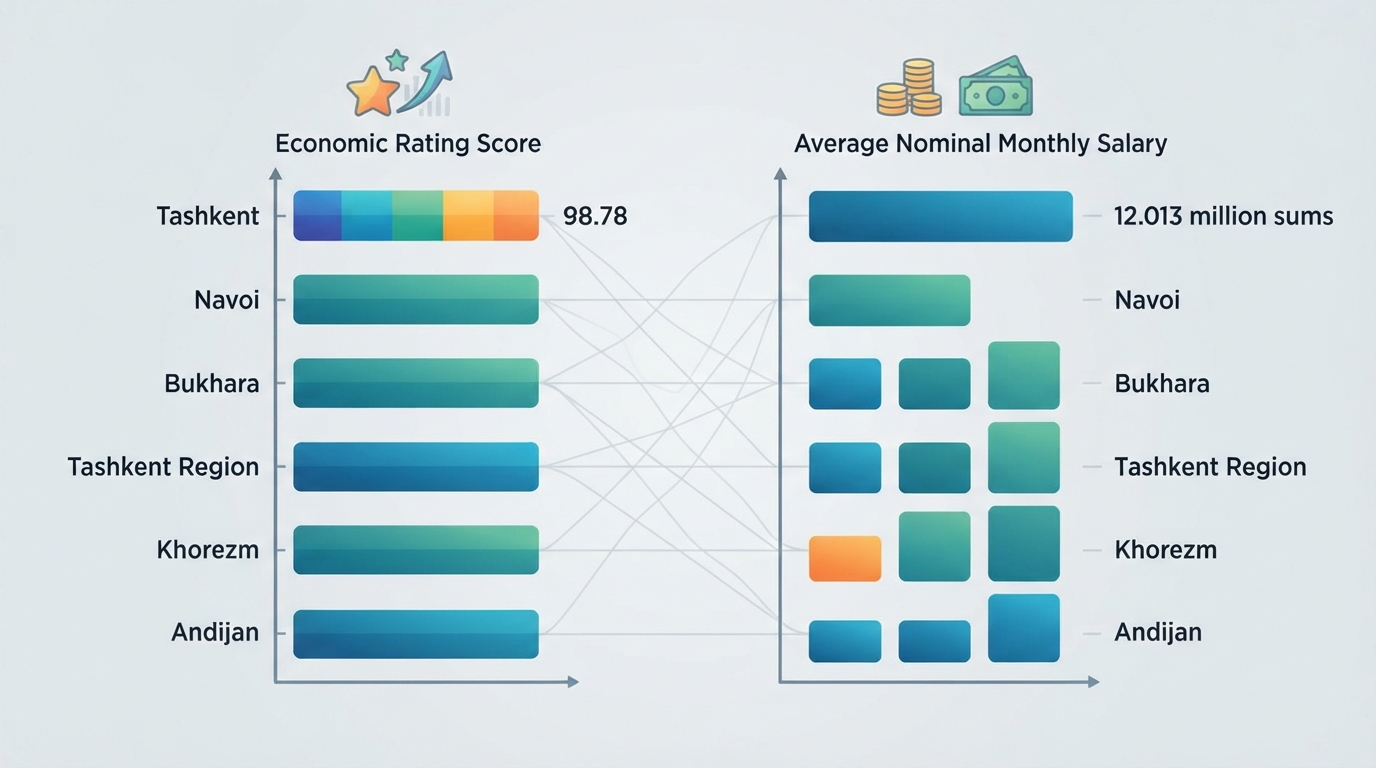
For example, Bukhara took the third spot with a score of 80.63 points, but the average monthly nominal salary in the region was 5.62 million sums. In Tashkent, which topped the ranking, this figure reached 12.013 million sums. This is evidenced by data from the Center for Progressive Reforms and the National Committee on Statistics.
The economic block accounts for 15.8% of the regions' total evaluation and includes nine indicators. Two of them describe the business environment, five describe the labor market, and two more describe overall economic growth. Consequently, the ranking is a comprehensive evaluation across several areas and does not directly show either the size of a region's economy or GDP growth rates.
At the end of 2026, Tashkent took first place with a result of 98.78 points. It is followed by Navoi Region with 86.73 points, Bukhara Region with 80.63, Tashkent Region with 80.01, and Khorezm Region with 79.69 points.
Andijan Region ended up in last place, scoring 72.28 points. The gap between the capital and the region with the lowest result was 26.50 points. It reflects the difference in scores on a single scale, but not the difference in the volumes of regional economies.
Salary statistics for January–June 2026 show a different picture. According to the National Committee on Statistics, the average monthly nominal salary in Tashkent was 12.013 million sums, in Navoi Region — 8.722 million, and in Tashkent Region — 6.675 million sums. The national average was 7.091 million sums. Thus, the capital's level was approximately 69% higher than the national average, and Navoi Region's figure was 23% higher.
At the same time, the fifth place of Khorezm Region in the economic ranking is not accompanied by a comparable level of remuneration: the average salary there was 5.499 million sums. In Kashkadarya Region, the economic indicator reached 74.69 points, while the average monthly salary was 4.864 million sums — the lowest value among the regions included in the analysis.
The authors point out that such differences do not necessarily indicate an inconsistency between the ranking and the economic situation. Its methodology takes into account not only wages, but also the business environment, employment, and growth indicators.
At the same time, nominal salary alone does not make it possible to fully assess the welfare of the population: for this, data on price levels, informal employment, and income distribution are required.
Comparing results over several years also requires caution. For example, Tashkent's economic score increased from 96.20 in 2024 to 98.21 in 2025 and 98.78 in 2026. In Navoi Region, the indicator first dropped from 78.34 to 71.02 points, and then grew to 86.73. However, an increase of 15.71 points over the last year cannot be considered an equivalent increase in real economic output.
As noted in the analytical report of the Center for Progressive Reforms, in 2025–2026, the role of indicators of wages, economic activity, employment, and unemployment strengthened in the economic block. In addition, the set of indicators is updated annually, so changes in scores for 2024–2026 are not a direct measurement of economic growth.
Special attention in the analysis is paid to the gap between economic and infrastructure evaluations. In Navoi Region, the economic indicator was 86.73 points, and the infrastructure indicator was 59.13. In Khorezm Region, the corresponding results were 79.69 and 52.31 points, in Karakalpakstan — 78.71 and 47.46, and in Kashkadarya Region — 74.69 and 40.75 points.
The authors consider this gap a ground for further study of the possible impact of infrastructure constraints on economic activity.
However, the difference between the evaluations does not directly measure the infrastructure deficit or the volume of lost GDP: the economic and infrastructure blocks are based on different indicators and normalization methods. More precise conclusions will require additional data, including power outages in industrial zones, logistics timelines, water supply, and industrial capacity utilization.
The authors attribute Tashkent's leadership to the potential role of the services sector, the concentration of qualified personnel, and companies. In the case of Navoi Region, possible factors include large industrial enterprises and high wages in certain types of activities. To test these assumptions, an analysis of employment, productivity, and value added by sector is required.
In conclusion, the authors emphasize that a single ranking result is not enough to assess the competitiveness of regions.
They call the creation of conditions under which economic activity will be accompanied by the growth of productive employment and real incomes of the population an important direction of regional policy.