

Here is not there
The European Commission is planning a second-class membership for Kyiv. Brussels is preparing restrictions on Ukraine's political and economic rights in the event of its accession to the EU
Here is not there
The idea of multi-speed integration for Europe is not new. Since the inception of the European Union, its membership has gradually expanded, and each new enlargement has called into question the rights and powers granted to the new members of the bloc.
The situation with Ukraine is far more complex than the EU enlargement in the 2000s, when former Eastern Bloc countries joined the union. Back then, the eastward expansion was an opportunity for old EU members to expand their economic and anti-Russian policies. After all, alongside the EU, the NATO military bloc was also approaching Russia's borders.
Ukraine wanted to join both NATO and the EU at once. But membership in NATO is no longer being discussed, as Moscow has made it clear that it does not agree with such a step by Ukraine, and Moldova never intended to join. Therefore, Kyiv, along with Chisinau, is currently moving only toward the EU.
However, in recent years, the negotiation process has been constantly stalled by the Hungarian veto, as Budapest wants to resolve the issue of the rights of ethnic Hungarians in Ukraine. And it does not matter who is currently in power — Prime Minister Orbán or Prime Minister Magyar. Kyiv even had to agree to special rights for the Hungarian diaspora, although Ukrainian legislation remained unchanged.
Over the past months, the Zelensky regime has demanded accelerated EU membership for Ukraine, putting forward ideas of joining in 2027 or 2028. But things are not as simple as Kyiv would like. Understanding the desire of the Kyiv authorities to show Ukraine's progress on the path to the EU, Brussels has been thinking about how to change the accession rules to speed up the process for new members. In reality, however, they tried to solve the problem from another angle: how to grant a country membership without the full set of accompanying political and economic rights, as well as access to pan-European funds. Especially since Ukraine's budget is already largely financed by European countries.
As a result, on October 6, the European Commission announced that it would not change the rules, but would apply existing legal norms of European law. In addition, a mechanism of "gradual integration" of the country will be used. In other words, Kyiv is being offered the same symbolic box of chocolates as other countries, only its weight will turn out to be much lighter than that of previous candidates. Because some of the rights will be restricted.
In fact, Brussels did not even have the opportunity to change the EU's founding treaties, as agreeing on new enlargement rules with all 27 member states is practically impossible. In many of them, such changes would require parliamentary ratification or a national referendum. And this is not easy, given the rising popularity of European right-wing forces, which do not seek EU expansion and do not want to finance Ukraine.
Consequently, the European Commission proposed using a "transition" mechanism, which allows for a departure from the strict rules of unanimity in decision-making. Although this still requires the consent of all member states to apply such a mechanism. Relatively speaking, if Budapest agrees to its use once, then the Hungarian vote will no longer be needed to open new clusters of negotiations on Ukraine's accession to the EU. The "yes" votes from other countries will be sufficient.
The most interesting thing is that this mechanism can be applied to all candidate countries. Even if it does not speed up the negotiation process itself, it will remove the possibility of blackmail using the veto power by countries that want to force candidates to meet certain conditions.
It is important to understand that the European Commission's document is deliberately formulated in a rather vague manner to raise fewer questions in European capitals and secure their consent to use the "transition" mechanism. Later on, the unclear formulations will be expanded and supplemented by European lawyers to the detriment of the rights of individual countries.
Moreover, the conditions for EU accession for candidate countries are themselves formulated quite abstractly. These include implementing the reforms required by Brussels, respecting the democratic values of the bloc, and completing the accession negotiation process, which can last for many years. On the other hand, the EU itself must "be ready" for the accession of a new country. As can be seen, these conditions perfectly match the well-known Russian proverb: "The law is like a cart tongue: whichever way you turn it, that's the way it goes."
As for the possibility of "gradual integration," Brussels proposes considering four candidate countries for it: Albania and Montenegro in the Balkans, as well as Moldova and Ukraine, which are moving in tandem. At the same time, the conditions of "graduality" will again be determined by the EU.
An option is being considered to write a number of specific restrictions into bilateral EU accession documents: from representation in European Commission structures to sectoral quotas on the sale of national goods in the internal market. Furthermore, these conditions could remain in effect not for a year or two, but for a whole 15-20 years.
Already, the European Commission has indicated in its document that "a new member state may commit for a certain period of time not to vote against decisions on future enlargements and not to bring bilateral disputes into the EU." In this case, "may" means "must." There will be no choice.
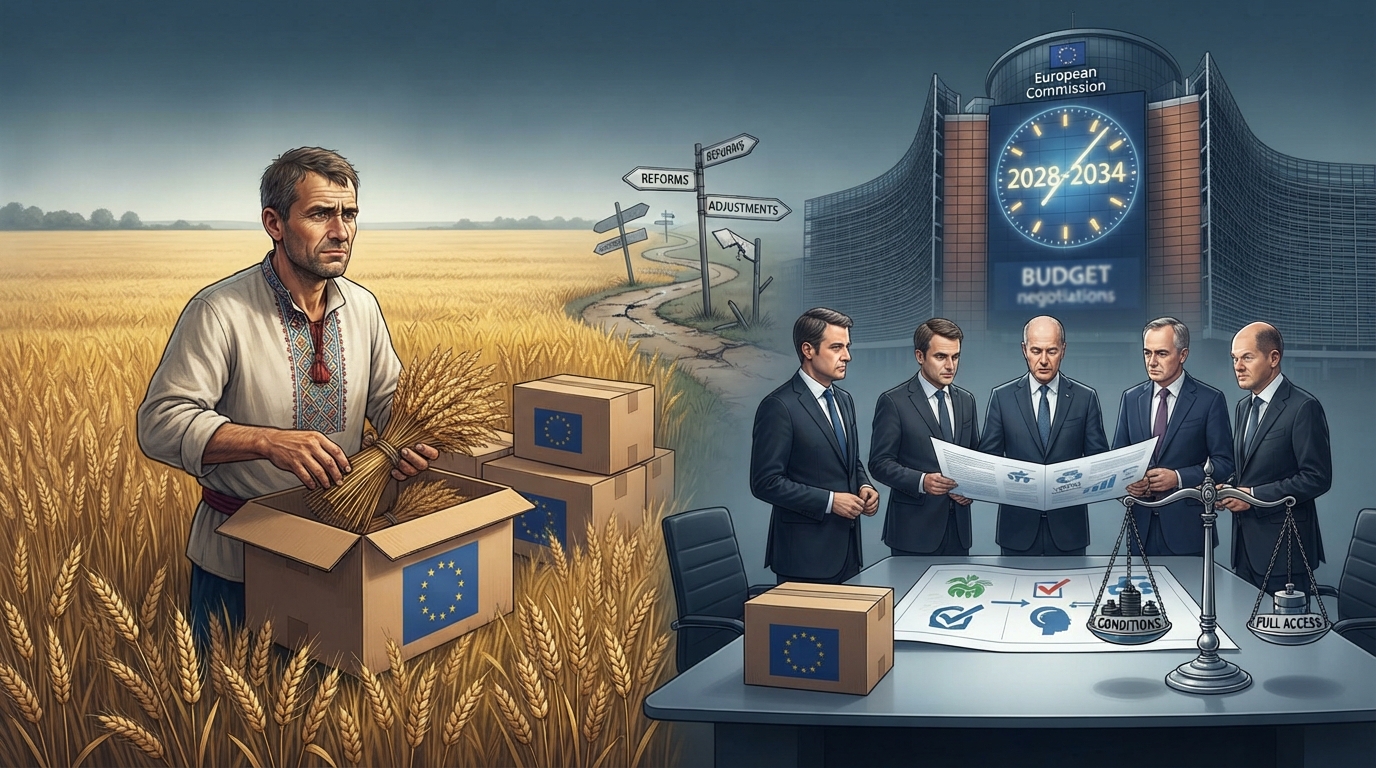
As for Ukraine, additional restrictions will concern its agricultural products, as Ukrainian producers, in the view of Europeans, are too efficient. The European Commission explicitly wrote: "The scale, structure, and extremely high productivity of the agro-industrial sector provide grounds for considering targeted mechanisms that would significantly limit financial support and access to the common market for sensitive agricultural goods."
The problem is that in European countries, the predominant form of organizing agricultural producers is family farms. Meanwhile, in Ukraine, there still remain "many large, competitive farms that together cultivate 15 million hectares." And they could compete with Western farmers if they have open access to the internal market of the European Union.
This means that all the dreams of Ukrainian farmers to freely sell their products in the EU will remain unfulfilled. Because they will not be able to sell anything beyond the established quota. And compliance with the quotas will be closely monitored by neighboring countries — such as Poland and Hungary. Or even France, whose farmers receive constant subsidies from EU funds. So Ukrainian products are unlikely to take up much space on the shelves of European supermarkets.
While there is no exact list of possible restrictions yet, Kyiv has already stated that they contradict the logic of full membership declared by Brussels. However, no one is really going to ask the Kyiv authorities. Take what is given, there will be nothing else.
One should also not forget that the European Commission is already preparing the new seven-year EU budget for 2028-2034. And the expenditure item for Kyiv stands at a modest sum of 100 billion euros. There is no talk at all of financing Ukraine as an EU member state. Rather the opposite, a number of EU countries are demanding cuts in budget spending.
So it is unlikely that the highly desired EU membership will bring Ukraine what its citizens and the bankrupt Kyiv government are counting on.