

'He was a lifeline' - Families at a loss after Haitian caregivers let go in US
Haitian immigrants make up a large portion of the already overburdened home-care workforce.
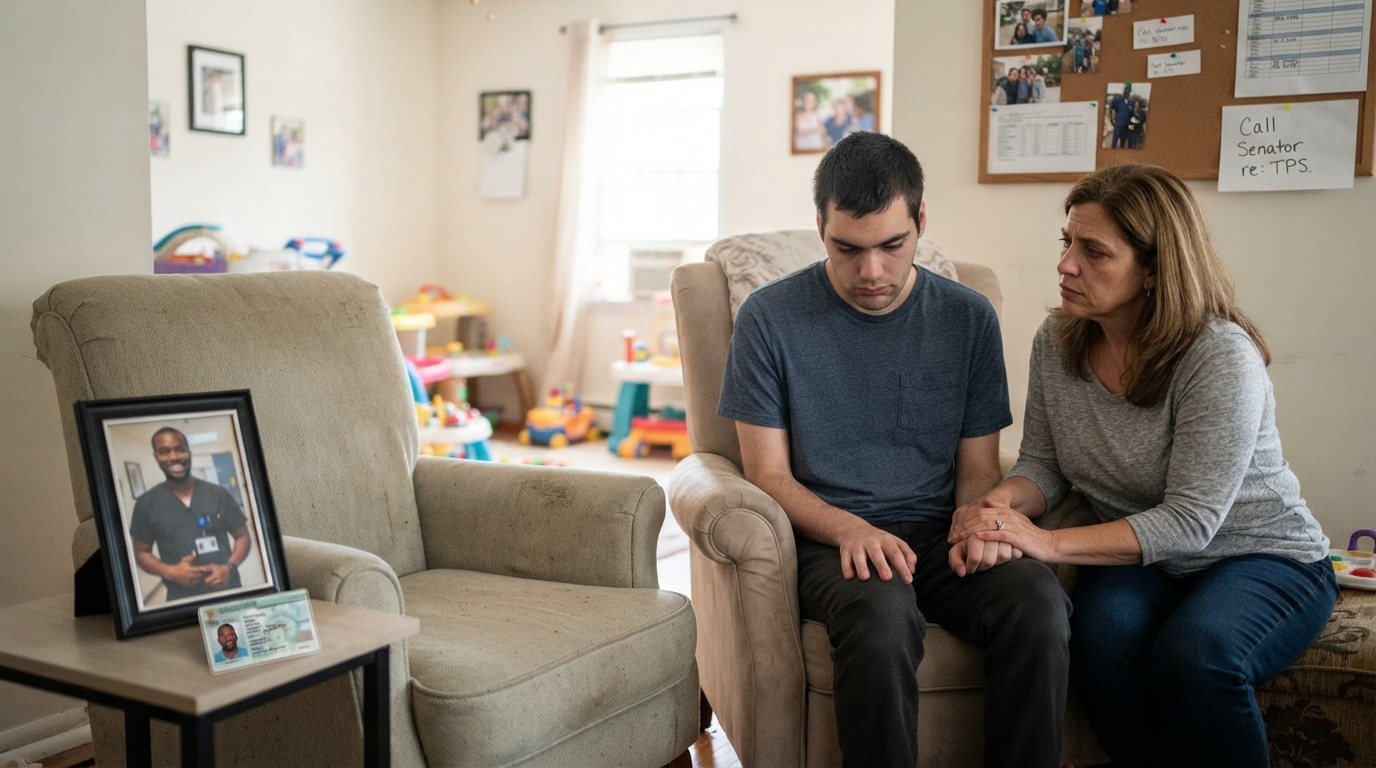
'He was a lifeline' - Families left devastated after Haitian caregivers are dismissed in US
Long Island mother-of-two Linda Mancuso says her disabled son Michael, 23, lost a Haitian aide whom she regards as a "lifeline"
Long Island mother-of-two Linda Mancuso says she has been "praying on a daily basis" that her disabled son's Haitian caregiver will be able to return to work.
She says it was "horrifying" when Jean, who had a temporary work permit, was laid off at the end of July from his job at a nonprofit that supports people with developmental and intellectual disabilities. Her son Michael is a 5ft 10in, nonverbal 23-year-old.
"Showering, sleeping, eating, tying his shoes - Michael can't tie his shoes - I mean, there's so much hands-on involvement, and Jean did all of that," she says.
Mancuso says she was a bundle of nerves when she eventually agreed to place Michael in residential care at 19, describing it as "the hardest thing I've ever had to do".
But when he met Jean in the adult home, she says she felt calm.
"Certain people just have it," she says of Jean. "He's literally a lifeline."
Yet Michael lost that lifeline weeks ago, when Jean's employer had to lay him off together with 18 other Haitians.
Their temporary protected status (TPS) - which lets eligible foreign nationals from unsafe countries work in the US - had expired.
The Trump administration first said in June 2025 that it would end TPS for Haitians, and the legal fight that followed reached the Supreme Court.
America's top judges sided with the administration, clearing the way for 350,000 Haitians to lose their status at the end of July.
Losing that status means holders can no longer legally work in the US and face the risk of deportation.
The healthcare sector, which has a strong Haitian workforce, has been hit especially hard - with many employers forced to dismiss TPS holders who work directly with patients.
Trump ended TPS amid a series of immigration-restricting measures, a key part of his successful 2024 election campaign.
Immigration was among voters' biggest concerns in that election and, on Long Island, both counties backed Trump decisively.
More than a dozen countries have had their TPS ended in Trump's second term, and Haitians account for nearly a third of all TPS recipients affected.
The care sector is feeling the consequences.
Haiti is among the top five countries of origin for immigrants in the direct-care workforce, says Kezia Scales, vice-president of policy and research at the Paraprofessional Healthcare Institute.
The industry was already short-staffed and waiting lists for many care services - from home health aides to assisted living - were already lengthy.
"We simply do not have enough people in our domestic market, when you exclude immigrants, to fill those jobs," she tells BBC News.
National advocacy groups are pushing for policies that would strengthen the long-term workforce - including ones that "would expand legal pathways for international caregivers".
Asked about the effect of ending TPS, a Department of Homeland Security spokesperson told the BBC that "Temporary Protected Status is exactly that - temporary".
"The assertion that the only way we can support the healthcare industry is by allowing unvetted illegal aliens to remain in the country is grossly false and lazy," the spokesperson said.
At AHRC Nassau, which employed Jean, CEO Stanfort Perry sounds frustrated and worn out. The organisation let go of 19 Haitian staff this year and 22 last year, amid other immigration crackdowns, he says.
"It takes us months to recruit one individual to work in this field, train them and prepare them to provide compassionate, caring support to a person with an intellectual and developmental disability," he says.
"I'm competing with fast-food restaurants, grocery stores and retail for staff, because they pay more than what we are able to pay," he adds.
The problem is nationwide. At Jewish Community Services of South Florida, which lost 18 Haitian TPS holders, the remaining aides are also putting in overtime.
"That is a huge financial strain on a nonprofit like us," says Sarah Katzenstein, the organisation's director of strategic communications and marketing.
The loss of TPS caregivers has been particularly harmful to seniors served by the Jewish organisation, many of whom are Holocaust survivors, Katzenstein says.
"They had relationships with these home care aides for years - some of them for decades," she says, adding that Holocaust survivors especially may struggle to trust strangers.
"It's a very intimate relationship, so to these clients, the loss of having their Haiti TPS-holding caregivers truly is devastating."
Jewish Community Services has been writing to elected officials to support proposed Senate Bill 4814, which would mirror a bipartisan bill already passed in the House to extend TPS for Haitians. The effort has now stalled in the Senate, blocked by Republican opposition.
Hundreds of Haitians have been deported since the Supreme Court ruling, despite widespread gang violence in the country. White House czar Tom Homan defended the deportations in a recent CNN interview.
"The judges made a decision they must go home. And they need to go home... we're just enforcing the law. And we're doing it in a way that the American people voted for."
On deportations, about half of US adults surveyed said Trump had gone too far, roughly the same share as at the start of the year.
Back on Long Island, Mancuso is mourning the loss of a carer who had managed to connect with her high-needs son.
"That's one of the things that, as a parent, you worry [about]. Does this kid know that there are other people in the world, other than me, that love him?
"And I think he sensed that from Jean - that it's not just a job."
Her son may not be able to say it, but she knows he misses Jean and does not understand why he is no longer there. For Mancuso, her already high anxiety about her son's welfare is rising sharply.
"With Jean, I had not a care in the world," she says.
She is worried not only for her son but also for the other families served by the local non-profit - and, of course, for Jean and TPS holders like him who are living with uncertainty, unsure if or when they will be deported.
"I'm hoping against hope that this thing gets resolved," she says. "I care about [Jean] as a human being, he needs a livelihood - and this has been a livelihood for him, and he's good at it, helping my son.
"And it's directly impacting my son by his lack of presence here - and I want him back."