

Grand Bazaar
The Fergana Valley is looking for a way to the neighboring market. Trust between the countries of the region has restored faster than border trade
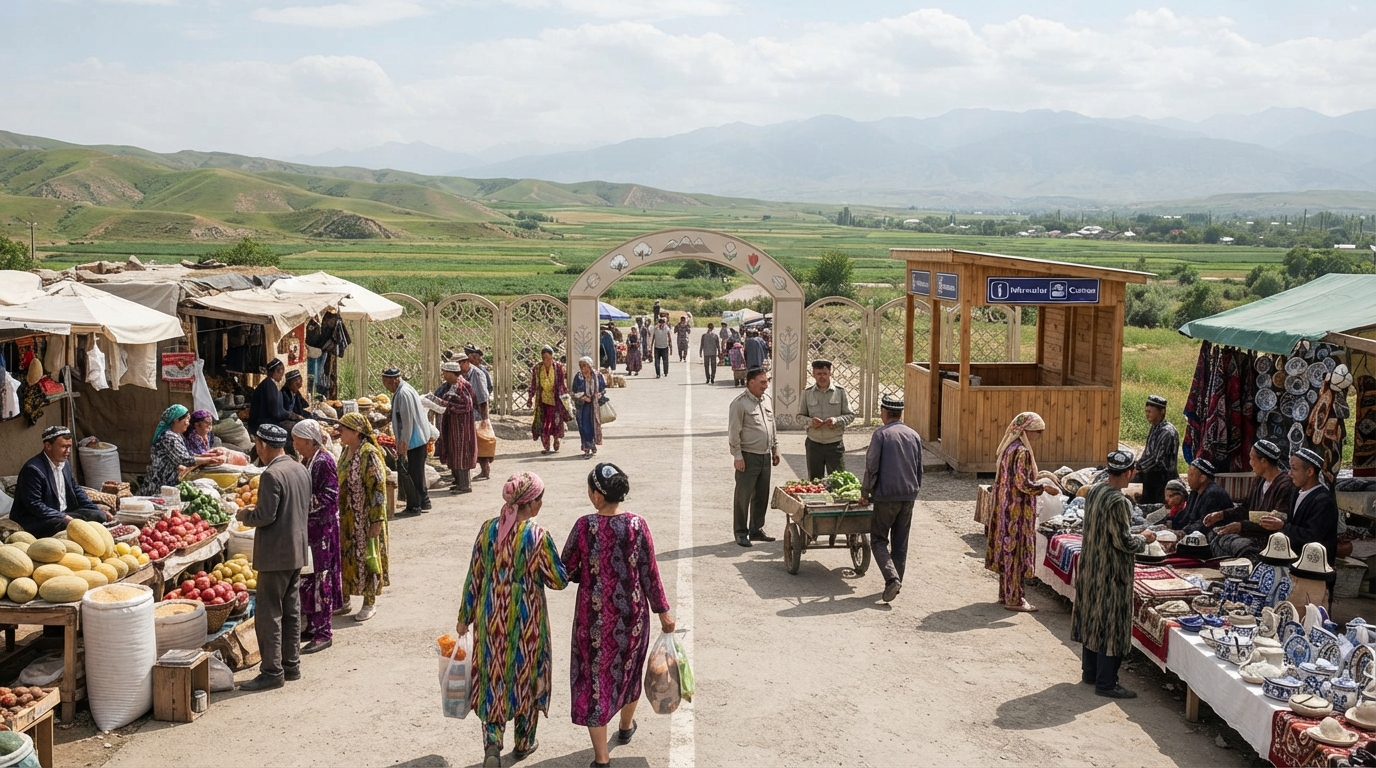
**The Great Bazaar**
The Fergana Valley is gaining the opportunity to expand its common market, build industrial cooperation, and develop tourism. The rapprochement between Tajikistan, Kyrgyzstan, and Uzbekistan opens up new prospects for this, but it remains difficult for residents of border villages to trade with their neighbors: the road to the nearest market is lengthened by fences and a lack of convenient crossings. How to turn restored trust into real changes was discussed at the Second Fergana Peace Forum, which took place on September 28–29 in Guliston, Tajikistan.
Opening the forum, Khayriddin Usmonzoda, Director of the Center for Strategic Research of Tajikistan, noted the importance of the shared history and human connections of the valley. In his assessment, peace and good neighborliness here are crucial for the sustainable development of the entire Central Asia.
Eldor Aripov, Director of the Institute for Strategic and Regional Studies under the President of Uzbekistan, called for moving from the achieved mutual understanding to joint projects. He emphasized that interstate agreements must change the daily lives of people, allowing them to freely study, work, trade, travel, and maintain family ties.
Aripov identified four areas: the development of cross-border infrastructure and economic cooperation, strengthening human connections, joint management of resources and risks, and direct cooperation between border regions. Among the opportunities, he listed logistics, e-commerce, tourist routes, and joint ventures in agricultural processing, light industry, and mechanical engineering.
To build trust, Aripov proposed expanding educational and cultural exchanges, establishing a Central Asian Young Peacemakers Club in Fergana, and organizing summer camps for youth from border regions. Shared water, land, and environmental problems, according to him, require joint monitoring, data exchange, and rational resource management. He suggested addressing practical issues of trade, transport, and agriculture through direct contacts between local authorities, entrepreneurs, farmers, and public organizations.
The legal foundation for the rapprochement of the three countries emerged in March 2025. Bishkek and Dushanbe signed a state border treaty, and on March 31, the leaders of Tajikistan, Kyrgyzstan, and Uzbekistan concluded a treaty on the border junction point and adopted the Khujand Declaration on Eternal Friendship.
Tajik expert Negmatullo Mirsaidov, who participated in the forum, said that relations between neighbors have changed noticeably. He noted a high level of trust and good relations of Tajiks with Uzbeks and Kyrgyz. According to him, many participants spoke positively about border guards and customs officers: document checks take minimal time, and visitors are treated politely and respectfully.
According to Mirsaidov, regional leaders declared their intention to develop direct business ties. The head of the Fergana Region, Khayrullo Bozorov, proposed creating the "Fergana Valley Business Dialogue" — a platform for regular meetings of entrepreneurs from the three regions and joint projects. Another initiative is an exhibition at the "Fergana-EXPO" business center in February 2027.
At a meeting between Bozorov and the Chairman of the Sughd Region, Rajabboy Ahmadzoda, investments, industry, agriculture, and tourism were discussed. For business, this is an opportunity to expand the market. However, while a large enterprise can route its path through existing crossings, small-scale daily trade is particularly sensitive to distances and transportation costs.
General statistics show a revival. According to Ahmadzoda, in eight months, the trade turnover between the border regions of Tajikistan and Uzbekistan exceeded $300 million; they intend to bring it to $400 million. Trade turnover with Kyrgyzstan, according to the administration of the Sughd Region, approached $50 million over the same period. This is only slightly less than the figures of 2019, before the border conflicts.
But the general figures do not show the difficulties of local residents. "There is virtually no border trade as such between Tajikistan and Kyrgyzstan," says Mirsaidov. The "Arka" and "Vokhuri" markets, where residents of Tajik and Kyrgyz villages traded briskly until 2019, now primarily serve their own citizens. Settlements are separated by wire fences, and the familiar opportunity to go shopping at the neighbors' has disappeared.
There is no direct ban on trade. However, it is necessary to cross the border through the "Kairagach–Madaniyat" checkpoint between the Leylek and Dzhabbor-Rasulov districts, or "Kyzyl-Bel–Gulistan" between the Batken and Isfara districts. Such a route creates great inconvenience: fast control does not mean a short road to the market. For a small seller, additional transport costs can make the trip pointless.
According to Mirsaidov, the parties are discussing the opening of additional crossings, but the decision depends on the governments. He does not yet venture to predict whether local trade will revive in the coming years.
According to the expert's assessment, at the forum, regional leaders spoke more about the significance of the Khujand Declaration, stability, and favorable conditions for cooperation. The next step will require concrete decisions: where additional checkpoints are needed, what flow of people they will serve, and how to shorten the road between the market and the buyer while maintaining the necessary checks.
A business dialogue could become a platform for discussing these issues with small shop owners, farmers, and carriers. Mutual distrust is receding. Now the task is to make it convenient to visit neighbors, and to ensure that an accessible market on the other side of the border becomes a tangible result of reconciliation for the residents.