

Gold earrings and a coin associated with Rome's first emperor found in Armenia
In ancient Metsamor, Armenia, archaeologists have discovered gold earrings, a bronze dagger, and a coin associated with Rome's first emperor, Octavian Augustus. According to published information, the finds belong to various periods—the Late Bronze Age, the Iron Age, and the Hellenistic/Roman antiquity.
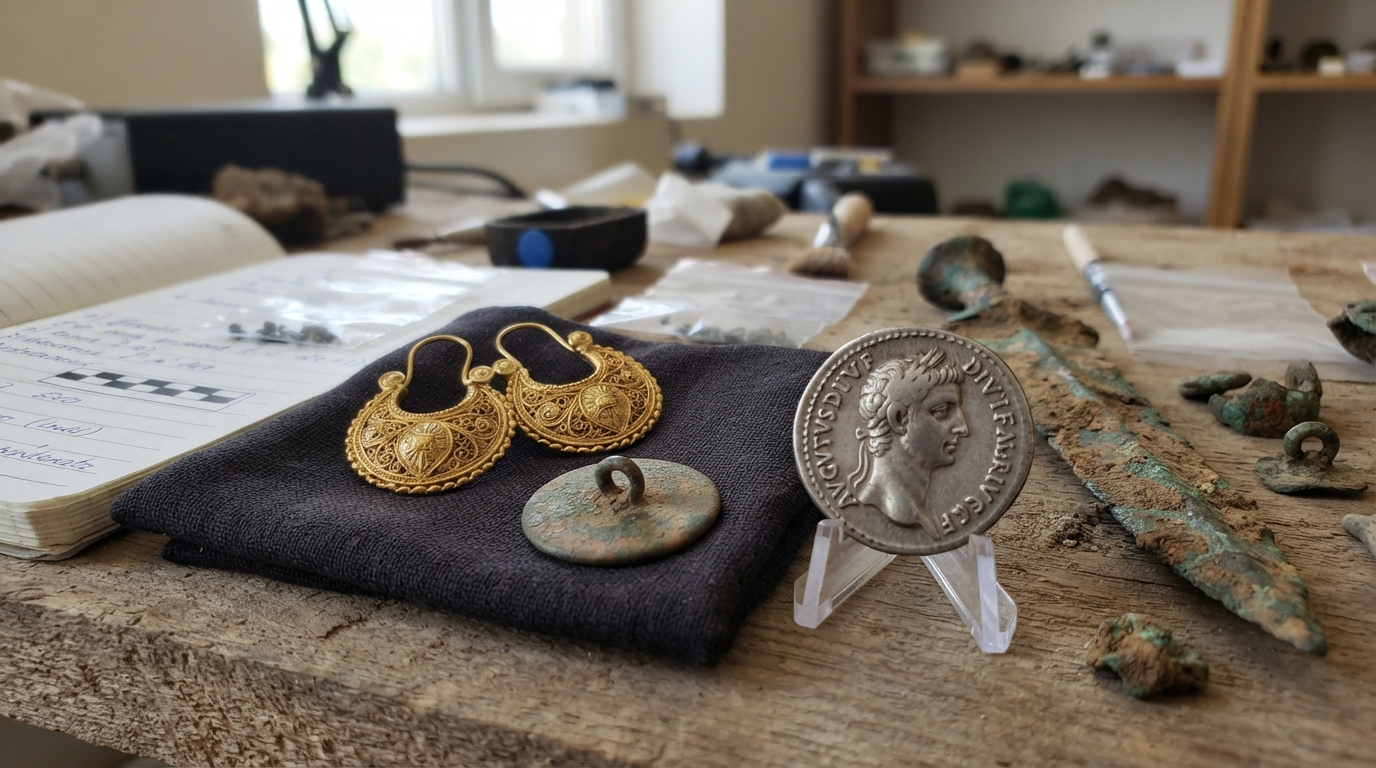
Gold earrings and a coin associated with the first Roman emperor were found in Armenia
On October 27, the Service for the Protection of Historical Environment and Cultural Museum-Reservoirs of Armenia announced new archaeological finds in Metsamor. Experts are conducting excavations in the area adjacent to the "Metsamor" Historical and Archaeological Museum-Reserve.
Among the finds are gold earrings, a button, a bronze dagger, and a coin associated with Octavian Augustus.
The photographs show large gold earrings with unjoined rings, decorated with raised patterns. In one of the photos, the jewelry is shown in the researcher's palm, while in another, the earrings are placed in bags intended for storing finds.
A separate photo depicts a round button. Another frame taken at the excavation site shows an elongated blade lying in the soil. Next to it are small objects, the surface of which is covered with a greenish layer — patina.
The coin shows a side profile of a man and an inscription along the edges. In the Service's report, this coin is linked to Octavian Augustus, the first emperor of Rome.
According to the British Museum, Octavian assumed the name Augustus in 27 BC and died in 14 AD. However, the denomination of the coin found in Metsamor, the mint where it was produced, and the exact year it was struck have not yet been disclosed. The specific periods to which each of the jewelry items and the dagger belong have also not been individually specified.
Metsamor is located in the Aras Valley, near the village of Taronik, approximately 35 kilometers southwest of Yerevan. Its citadel was built on a natural rocky hill. Massive stone walls surrounding the hill follow its shape. To the north lies the lower city.
This structure of the monument is described in a scientific report dedicated to the work of the expedition members from 2013–2021.
Research in Metsamor began long before the current discoveries. A joint project of Armenian and Polish archaeologists was launched in 2013. According to the University of Warsaw, during the first three excavation seasons alone, scientists collected ceramics covering a period of nearly three thousand years — from the 3rd millennium BC to the 1st century AD.
Among the finds at that time were obsidian arrowheads, bone pins and awls, beads, bronze rings, and parts of horse harness.