

**GOELRO, Uzbekistan-style**
For Central Asia, the issue of energy stability has long been among the key priorities. The population and industry are growing, the demand for electricity is constantly increasing, and the worn-out infrastructure is struggling to cope with the rising load. Over the past ten years, electricity consumption in the region has grown by 38%, and peak winter load by 42%. At the same time, about a quarter of regulating capacity was lost due to infrastructure wear and tear and uneven energy development, which has repeatedly led to major accidents and full-scale blackouts in Central Asian countries whose power systems are directly dependent on each other.
This is precisely why in Uzbekistan in recent years there has been more and more talk about the need to radically revise the country's entire energy supply model, even to the point of building it "from scratch."
As is well known, the pace of Uzbekistan's development has noticeably accelerated over the past decade. Industrial production is growing, cities are expanding, and this inevitably leads to an increase in electricity consumption and the need to increase its generation. However, in practice, the picture in the country remains ambiguous: there are more power plants, but the reliability of supply does not increase proportionally. As a reminder, in 2026, 157 power plants with a total capacity of 27,343 MW operated in the country. Of these, 17,774 MW came from thermal power plants (TPPs) and combined heat and power plants (CHPs), 2,442 MW from hydroelectric power plants (HPPs), 3,930 MW from solar stations, and 1,652 MW from wind stations, as well as 1,545 MW from energy storage systems. Moreover, all of them showed an increase in electricity generation compared to the previous year, and in the first half of 2026, the country produced 45.45 billion kWh of electricity, which is 7.1% more than a year earlier. This should have provided Uzbekistan with stable electricity supplies, which, unfortunately, did not happen.
Furthermore, against the backdrop of consumption growth, which reached 44.04 billion kWh in the first half of the year, increasing by 4.7%, unforeseen situations occurred more and more frequently in the country, and in some regions, consumers were left without electricity for 8–10 hours. According to the country's authorities, in June–July of this year alone, about 4,000 accidents occurred in the electrical grids of the Republic of Uzbekistan, which once again clearly demonstrated the instability of the existing energy system, largely associated with outdated infrastructure.
According to World Bank estimates, more than half of Uzbekistan's electricity distribution grid infrastructure has been in operation for over 30 years. At the same time, electricity losses in the grids have already reached 17.2% (in 11 districts, the level exceeds 25%), and in the first six months of the current year, they amounted to 4.8 billion kWh. In addition, data from 300,000 gas meters and 234,000 electricity meters are not transmitted to the relevant metering systems, which prevents the timely resolution of emerging problems. According to various forecasts, to eliminate current difficulties and modernize the electrical grids, about $3 billion will be needed by 2030 alone, which Tashkent does not have readily available.
Additional difficulties are created by the situation with natural gas, which remains the basis of the country's energy balance, as it is used by the population and industry, as well as at thermal power plants. In recent years, its production in the country has been declining. Thus, in the first half of 2026, 18.3 billion cubic meters of gas were produced compared to 21.9 billion cubic meters a year earlier, representing a 16% drop. In June, production decreased by about 30% year-on-year. Therefore, Uzbekistan has to spend more and more funds on purchasing gas abroad, and in 2026, imports of Russian blue fuel alone may exceed 10 billion cubic meters.
At the same time, one cannot speak of a complete energy crisis in the country. In recent years, much has been done here to significantly increase electricity generation. According to the Ministry of Energy, the investment portfolio of the fuel and energy complex is estimated at 133 projects with a total value of $51.4 billion. At the same time, Tashkent has begun to pay special attention to renewable energy. While in 2022 solar stations generated 434 million kWh, in 2025, together with wind installations, they produced 10.5 billion kWh, and in July 2026, their cumulative generation since the beginning of the year had already reached 6 billion kWh.
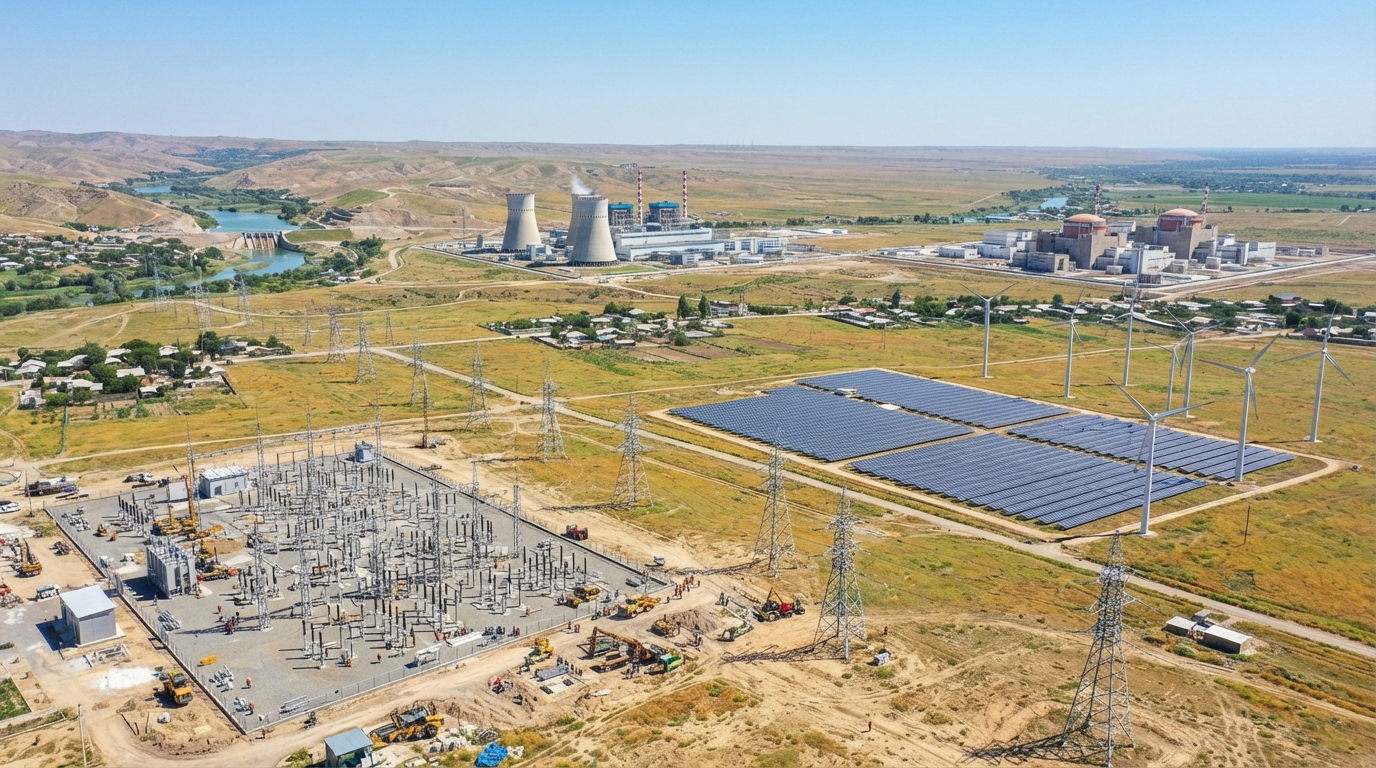
In total, at the beginning of 2026, 15 solar and five wind power plants with a total capacity of 5.58 GW operated in the country. In addition, by the end of 2025, solar panels were installed on more than 141,000 facilities, including residential buildings, enterprises, and social institutions. Simultaneously, electricity storage systems are being actively built in the country, small-scale hydropower is being developed, waste-to-energy plants are being constructed, and thermal capacities are being modernized.
An important direction in recent years has also been nuclear energy, which is developing in the country thanks to cooperation with Russia. In particular, on June 4 of this year, the presidents of the two countries, Vladimir Putin and Shavkat Mirziyoyev, took part in the ceremony marking the start of construction of the first power unit of the integrated nuclear power plant in the Jizzakh region. The project provides for two large-capacity units based on VVER-1000 reactors and two small RITM-200N reactors of 55 MW each. According to the plan, the plant should produce about 15.4 billion kWh per year, or more than 15% of the country's current consumption. For Uzbekistan, this project is of strategic importance, as it is capable of providing stable base generation and simultaneously reducing the need to burn gas at power plants.
According to expert estimates, by 2035, the country's electricity demand could grow to 121 billion kWh. Therefore, today Tashkent faces the task of not just increasing electricity production, but also creating a balanced system in which nuclear, thermal, hydro, solar, and wind generation will complement each other, and electricity transmission will proceed without failures and accidents. However, all previous actions of the country's authorities have failed to solve most of the existing problems, although over the past decade, $23 billion in foreign investment has been attracted to the sector and 9.5 GW of new power plants have been commissioned.
In this regard, the question of the need for radical decisions in this area has been raised again in Uzbekistan today, with the head of state also joining the work. This refers to a serious reform of the policy for developing Uzbekistan's energy system, and the main steps have already been outlined by the country's leadership. Thus, it is planned that energy balances will be formed in each district, an inventory of grids and equipment will be conducted, and the real needs of each district and mahalla (territorial community and local self-government body) will be determined. As of August, this work covered 916 mahallas, 832,000 households, 49,000 entrepreneurs, and more than 2.2,000 social facilities.
At the same time, areas have already been identified where there is a shortage of electricity and gas, and where, on the contrary, there are significant power reserves. This work will allow the authorities to plan grid development more accurately, without spending additional funds where there is no need.
Simultaneously, Tashkent has decided to seriously tackle the development of the grids themselves. Until 2030, the construction of about 10,000 km of high-voltage lines and 53 large substations is planned. The stated goal is to reduce technical losses to 5-6%. In parallel, digital control, new metering systems, and artificial intelligence are being introduced. Moreover, the leadership of the republic decided to personalize responsibility for the development of the situation: in July, during a major meeting with the president of the country, the heads of energy companies were assigned to problem districts, and the result of their work will now be assessed by personal indicators. In addition, a new Minister of Energy, Sherzod Khodjaev, was appointed, as well as the Chairman of the Board of "Regional Electrical Grids," Sardor Isakulov, who stated that "we will build the energy sector from scratch." At the same time, this phrase does not mean abandoning previously achieved results, but restarting the principles of management, planning, and control.
However, it is important to understand that restructuring management alone will not be enough. Uzbekistan will have to solve several tasks simultaneously: increase generation, replace old lines and transformers, build storage facilities, stabilize gas production, develop its own personnel, and do all this against the backdrop of the high cost of infrastructure projects. At the same time, it will be necessary to address the issue of reducing losses and increasing the efficiency of already existing capacities.
And in this situation, Russia, whose role in Uzbekistan's energy sector is very significant, may well help Tashkent. Thus, in the gas sector, the Russian Federation remains a key partner of the republic, allowing it to obtain the missing volumes of blue fuel. In parallel, Rosatom is not only building the NPP but is also involved in training personnel, engineering work, and forming a nuclear industry that is new to the country. Moreover, Uzbekistan's power system, like those of Kyrgyzstan and Tajikistan, is actually synchronized with the Unified Energy System of the Russian Federation through Kazakhstan.
The Russian System Operator participates in the work of the regional Coordinating Power Council, where in 2026 the integration of NPPs and large volumes of renewable generation, as well as long-term planning of power balances, were discussed. All this already creates a technological basis for closer coordination between Tashkent and Moscow. Therefore, Russia can well be considered as one of the potential guarantors of Uzbekistan's new energy model.
In general, it is worth noting that Tashkent's plans to closely address the efficiency of the country's energy system fully meet today's requirements. At the same time, the current reform in practice should not be built on the principle of "everything from scratch," but should lead to the transformation of the already existing system into a more modern, manageable, and sustainable one. This means that old plants will continue to operate after modernization, new solar and wind facilities will be supplemented by storage systems, nuclear energy will provide stable base generation, and gas will be used more rationally.
At the same time, Russia is capable of becoming one of the key long-term partners in this structure, thanks to a combination of hydrocarbon supplies, nuclear technologies, and experience in working with interconnected power systems. If Tashkent manages to simultaneously reduce losses, upgrade grids, increase its own generation, ensure reliable gas supplies, develop nuclear and renewable energy, and maintain coordination with its neighbors, the current situation may well become the starting point for the transition to the country's new energy model.
The success of this process determines not only the lives of millions of residents of Uzbekistan but also the stability of the entire Central Asian region.