

From the Silk Road to Green and Gastronomic: Tashkent Discusses the New Face of Uzbekistan's Tourism
On August 26, the International Ecotourism and Sustainable Tourism Summit was held in Tashkent. Uzbekistan hosted this international event for the first time, bringing together tourism industry representatives, experts, and international tour operators. The main question was how to showcase not only the country's ancient cities but also its natural beauty, cuisine, and regional life. Representatives of the tourism industry and experts attended the summit. […]
From the Silk Road to Green and Gastronomic: The New Face of Uzbekistan's Tourism Discussed in Tashkent
On August 26, the International Ecotourism and Sustainable Tourism Summit took place in Tashkent. Uzbekistan hosted this international event for the first time, bringing together tourism industry representatives, experts, and international tour operators. The key question was how to present not only the country's ancient cities but also its natural beauty, cuisine, and regional life.
Tourism industry representatives and experts from more than 20 countries attended the summit. For Uzbekistan, this was an opportunity not only to highlight its tourism opportunities but also to directly discuss new routes and joint projects with international companies.
Deputy Chairman of the Tourism Committee Sanjarbek Tadjiev noted that the country is currently actively expanding its tourism offerings.
In addition to Samarkand, Bukhara, and Khiva, increasing attention is being paid to mountains, lakes, deserts, and other natural areas. Infrastructure and support measures for the tourism industry are being developed in parallel.
Uzbekistan Shows the World Its "Wildlife"
Ecotourism was one of the main topics of the summit. Abrokhon Kadyrov, a representative of the National Committee on Ecology, presented the concept "From the Silk Road to the Green Silk Road."
Today, specially protected natural areas occupy 15.7% of Uzbekistan's territory. Three more national parks were established in 2026.
The country has everything necessary for the development of this new type of tourism: the Tien Shan Mountains, Kyzylkum, the Ustyurt Plateau, the Aral Sea, Aydarkul, tugai areas, and other natural areas.
Specific itineraries are already being offered to foreign tourists: birdwatching in the Aydar-Arnasai region, nature and ethnographic trips to Nuratau, expeditions to Ustyurt, safaris in Kyzylkum, and trekking in Ugam-Chatkal.
Rare animals such as the snow leopard, Bukhara deer, saiga antelope, Severtsov argali, and birds of prey may be of particular interest.
The main principle of the new approach is that tourism should contribute to nature conservation and generate income for local residents. For example, regional residents can work as guides, rangers, and guesthouse owners, donating part of their income to nature conservation.
Tourists don't just want to eat—they want to learn.
A presentation by Roberta Garibaldi, an Italian expert on gastronomic tourism and professor at the University of Bergamo, generated considerable interest.
According to her, today's tourists are no longer content with simply trying a local dish. They want to learn who prepared it, where the ingredients come from, how the dish is created, and the story behind it.
For European tourists, gastronomic experiences rank second only to culture among the most desired experiences. And in the Chinese market, food is already becoming a priority.
This is especially relevant for Uzbekistan.
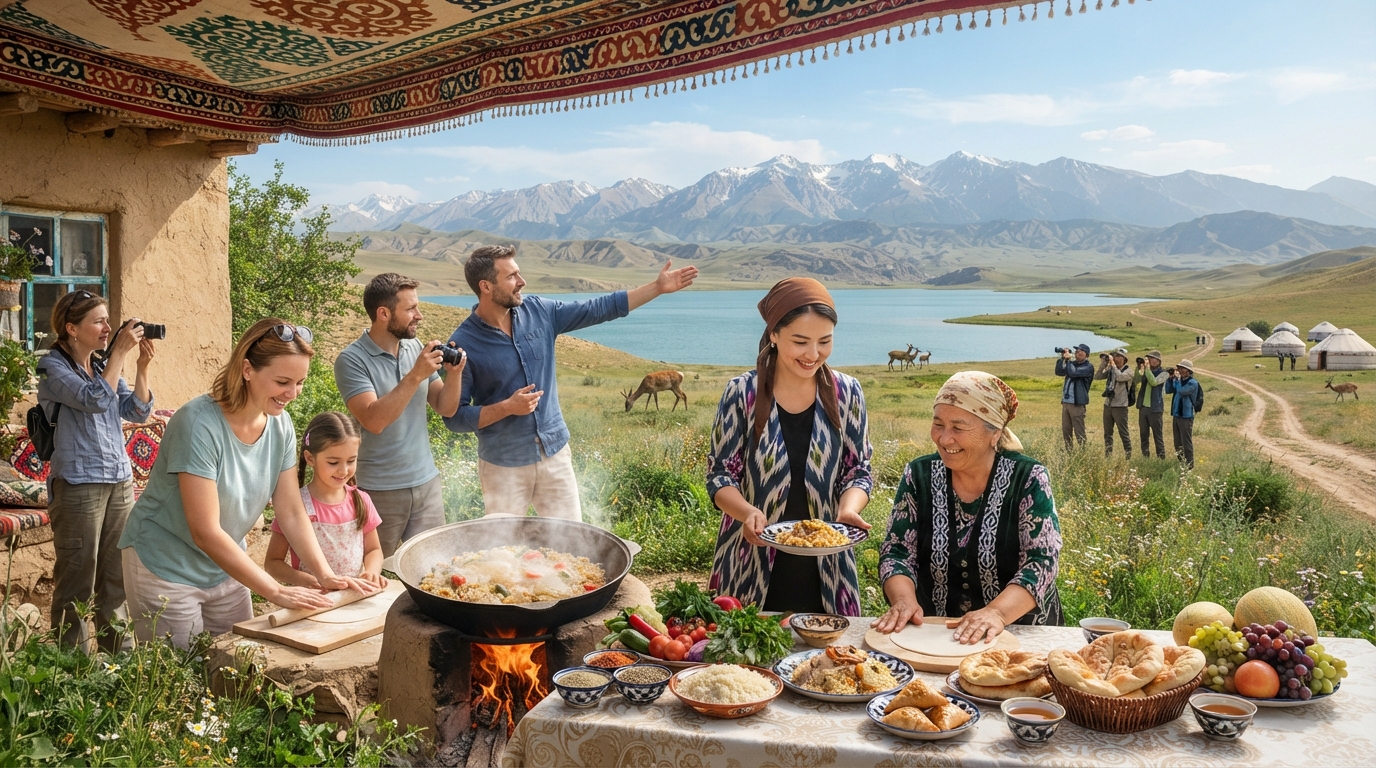
Plov, samsa, bread, fruit, tea, markets, family recipes, and traditions from different regions can become part of entire tourist itineraries. Visitors can not only eat but also visit a market, meet a producer, try cooking a dish themselves, or visit a family farm.
Garibaldi proposed developing not only a unified brand of Uzbek cuisine but also the individual culinary histories of regions—Khorezm, Bukhara, Samarkand, the Fergana Valley, Karakalpakstan, and other areas.
According to her, Uzbekistan doesn't need to invent a gastronomic identity—one already exists. Now it needs to be transformed into modern tourist experiences.
From Tourist to Partner
Another important part of the summit was held in the format of B2B meetings. Foreign tour operators met with Uzbek companies, hotels, and other representatives of the tourism industry.
Travel Shop Booking Board Chairman Murtaza Kalender noted that it is precisely such meetings that enable ideas to be transformed into real tourist routes.
According to him, local businesses have ready-made products, while foreign tour operators have access to foreign clients.
Their direct cooperation can lead to new contracts and increased tourist flow.
Kalender also called Uzbekistan "the heart of the Great Silk Road" and emphasized the country's great potential for eco-tourism, gastronomy, and cultural tourism.
Turkey: We Want More Tourists for Each Other
Member of the Turkish Grand National Assembly Cuneyt Aldemir spoke about the development of tourism ties between Uzbekistan and Turkey.
According to him, Uzbekistan has great potential for cultural, religious, natural, and gastronomic tourism. It is important to increase not only the number of Turkish tourists in Uzbekistan, but also the number of Uzbek travelers in Turkey.
Samarkand, Bukhara, Khiva, and Tashkent, as well as sites associated with Islamic heritage, are of particular interest.
"Uzbekistan has truly become one of the rising stars of the modern Silk Road," Aldemir noted.
The main goal is to keep tourists staying longer.
As Jakhongir Saidov, Head of the Tourism Diversification Department of the Tourism Committee, noted, the industry's challenge today is not simply attracting more tourists.
It is important to encourage visitors to stay longer, visit more regions, and spend more on local services and products.
To this end, new tourism destinations are being developed, including ecotourism. Aydarsay, Zomin, and other regions were named among promising areas.
According to data presented by Roberta Garibaldi, 5.35 million foreign tourists visited Uzbekistan in January–May 2026 alone, a 27.3% increase compared to the same period last year.
A New Tourism Image of Uzbekistan
The summit demonstrated that tourism in Uzbekistan today is no longer limited to the monuments of Samarkand, Bukhara, and Khiva.
These include snow leopards in the mountains, saigas in the desert, birds at Aydarkul, family cuisine in the regions, local markets, crafts, farms, and people who preserve traditions.
It is precisely the combination of nature, culture, and gastronomy that can open up new tourism markets for the country.
And international partners are already being invited not just to visit Uzbekistan, but to collaborate on creating new routes, promoting them in international markets, and transforming the country's natural and cultural wealth into sustainable tourism products.