

From recognition to preservation. Experts on what lies ahead for Tashkent's modernist architecture
The inclusion of Tashkent modernism buildings in the UNESCO list has posed a challenge for the city to preserve their architectural value while finding them a place in contemporary life. At Tashkent Design Week, discussions were held on which approaches help protect historical buildings without excluding them from modern life.
From Recognition to Preservation. Experts on What Awaits Tashkent’s Modernist Architecture
In July, ten sites of Tashkent modernism were included in the UNESCO World Heritage List. At Tashkent Design Week, participants discussed how this nomination was prepared and what international status means for the buildings themselves. The discussion featured Ksenia Bisti, an architect at the GRACE studio (Italy), and Saidaziz Ishankhodjaev, Deputy Chairman of the Art and Culture Development Foundation of Uzbekistan. The discussion was moderated by Cyril Zammit, an expert in design and cultural strategy.
Cyril Zammit opened the conversation by asking which buildings can be considered Tashkent’s architectural heritage. Usually, when it comes to the city's heritage, people recall ancient monuments—mosques, madrasahs, and minarets. However, the city's younger heritage also includes 20th-century buildings that remain part of everyday life.
Many residents use the metro every day, go to markets, or live in houses built during the modernist era. Therefore, their preservation is important not only for architects and historians, but also for the residents themselves.
The reaction of the residents showed that many perceive the architecture of the past century as part of their shared history. At the same time, the question of how to evaluate Soviet-era buildings, associated with varying personal and social experiences, remained open for a long time.
"The question always arises: what is considered heritage, and when does it become such? Ten years ago, a building might not have been perceived as heritage yet. And if it is 20, 30, or 50 years old, is that enough? In the case of modernist architecture, this question is particularly complex. It belongs to the Soviet period, which evokes different memories and assessments in different people," Bisti said.
The danger to modernist buildings was linked not only to the fact that their architectural value was not always recognized. The city and the economy were changing, and with them, the needs these sites served. Some buildings lost their former function, and owners had to decide how to use them further. Bisti cited the example of large restaurants designed for three thousand people: a modern city no longer needs such spaces in their original form. At the same time, new investments in Tashkent accelerated the redevelopment of buildings, and some of them began to alter their appearance.
To understand which sites require protection and what specifically needs to be preserved, the research team compiled a list of modernist buildings in Tashkent. According to Ksenia Bisti, it initially included more than 40 sites.
"We assessed the condition of each building, its integrity, and its authenticity. Some sites had already changed so drastically that it was impossible to reverse. Other buildings had also been altered, but part of the interventions could be corrected. After the survey, 24 buildings were selected for further work," the architect explained.
According to Bisti, a passport is needed not just for accounting purposes—it serves as the foundation for decisions on restoration and future alterations.
At the same time, the passport does not set a single preservation method for all buildings. The decision depends on the condition of the site, its features, and how it is used today. For some buildings, it is enough to restore individual elements and maintain the existing appearance. In other cases, internal premises need to be adapted or a new function found. According to Ksenia Bisti, the team developed individual preservation strategies for 15 of the 24 studied sites.
Protecting architectural heritage does not always mean that a building must be returned to its original form and that any changes should be forbidden.
Many modernist sites continue to be used, so experts assess not only what remains of the original project, but also how the building functions today.
Ksenia Bisti cited two different examples. The "Panoramic" Cinema (Palace of National Cinema Arts of Uzbekistan), in her assessment, has retained important architectural features, so it can be restored with almost no changes. Some later interventions can also be corrected. For example, the translucent design of the foyer is subject to restoration.
For the "Zhemchug" (Pearl) residential building, the team proposed preserving part of the exterior appearance while leaving the apartments untouched, as residents had adapted them over time to suit their needs.
This principle also extends to everyday changes, such as the installation of air conditioners on facades. The moderator asked whether residents should remove them after the building receives protected status. Bisti answered that everything depends on the specific site.
"Some elements cannot be changed, while others can—after agreement with the heritage protection body. If an air conditioner on the facade disrupts the building's appearance, it can be removed, but residents must be offered an alternative ventilation system. At the same time, changes inside the apartments may be permissible since the residents continue to use them," she explained.
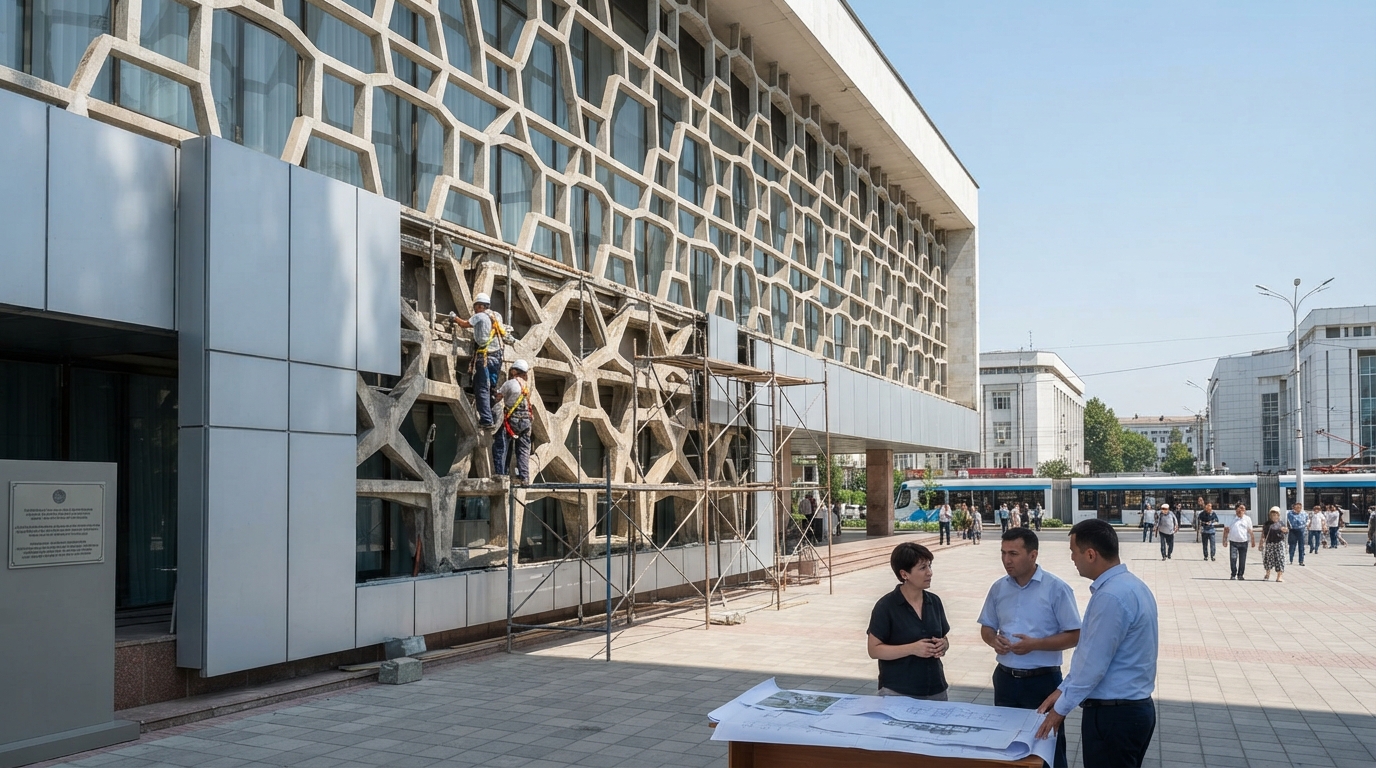
Another example of preserving a cultural heritage site was provided by Saidaziz Ishankhodjaev, Deputy Chairman of the Art and Culture Development Foundation of Uzbekistan. He shared how experts approach this task in the case of the State Museum of Arts of Uzbekistan.
According to Ishankhodjaev, the original facade of the museum has been preserved under cladding panels. Specialists are currently studying how to dismantle them. The facade protected the interior from direct sunlight, so it is important not only to return the building to its former appearance, but also to understand how it functioned and whether its properties can be preserved.
"When working with a historical building, you cannot preserve absolutely everything without changes. First, you need to conduct research and understand what is original and what can be altered. Then a project is developed. We try to preserve the most significant parts of the building while incorporating modern technology and making the space comfortable for people," he said.
Some of them continue family dynasties, so materials for restoration can be found today as well.
At the same time, according to the Chairman of the Foundation, restoration does not imply returning the building to its original state in every detail. For instance, the translucent fiberglass panels did not withstand the test of time well, so the team will not recreate them on the facade.
The future use of the building is also being considered. After the museum moves to a new location, it could become a public space with multiple functions. One possible option is a museum of architecture.
International recognition does not replace national protection of a monument. Ksenia Bisti explained that prior to submitting a nomination, the state must include the buildings in the national heritage list and present a management plan for them.
"UNESCO does not take on the direct protection of buildings. It provides recognition and brings attention to them.
According to her, to prepare the nomination, the team relied on national legislation and international heritage preservation principles. The research also used the principles of the Burra Charter, adopted by ICOMOS in 1979: it suggests identifying what exactly is being preserved, why it is important, and how to work with it.
Cyril Zammit clarified that it was important for UNESCO experts to understand why these buildings should be considered together and how they demonstrate different aspects of the city's modernization. The nomination was a serial one: it included ten sites of various purposes, reflecting how the city and society changed in the 1960s–1980s. Among them are residential buildings, museums, a market, the metro, cultural institutions, and a scientific complex.
For the ten sites included in the UNESCO World Heritage list, experts will prepare preservation roadmaps. They will determine how to gradually restore the buildings without depriving them of their modern function. According to Ksenia Bisti, this is a particularly complex task for 20th-century architecture—new materials and facade systems were used in its construction, for the restoration of which there are often no ready-made solutions.