

From 2028, a new status will be given to problematic bank assets
In Uzbekistan, a new procedure has been established for classifying asset quality and forming reserves to cover potential losses in banks, including those engaged in microfinance and Islamic banking activities. Assets will be divided into five categories based on their risk level, and reserve requirements ranging from 1 percent to 100 percent will be applied to them.
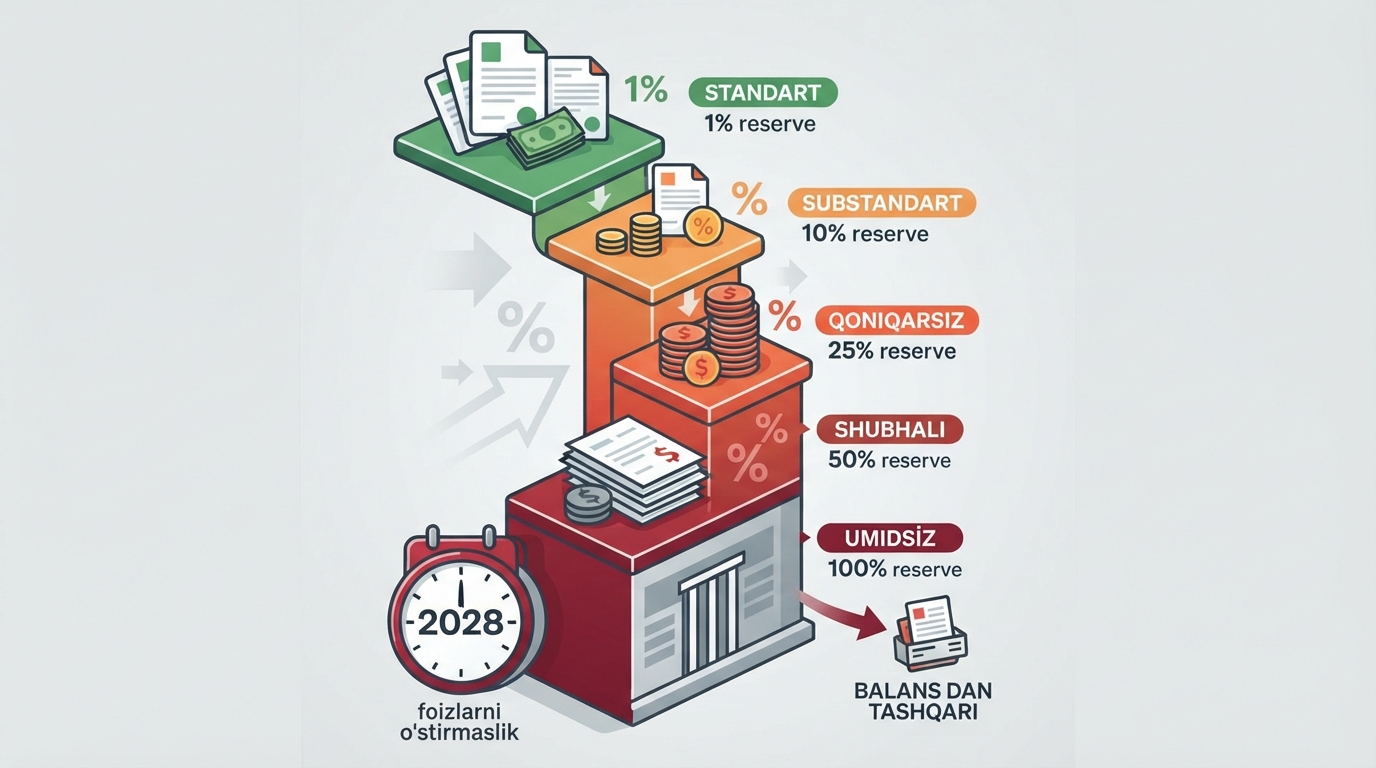
From 2028, a new status will be assigned to non-performing bank assets
The Ministry of Justice has state-registered a departmental document defining the procedure for classifying asset quality in banks, as well as forming and using reserves to cover potential losses on assets.
The document was state-registered on September 10, 2026, under number 3937.
The new procedure applies to banks, including microfinance banks and banks conducting Islamic banking activities.
According to the document, the quality of bank assets is classified into "standard", "substandard", "unsatisfactory", "doubtful", and "loss" categories.
Reserves to cover potential losses on them are formed in the amounts of 1, 10, 25, 50, and 100 percent, respectively. That is, as the quality of an asset deteriorates, the volume of reserves that the bank must allocate also increases.
Objective criteria and criteria indicating a low probability of payment are used in classifying assets. If the evaluation results based on these criteria differ from each other, the asset is classified into the worse category.
In addition, separate criteria have been established for classifying assets granted to banks, non-bank credit organizations, insurance, and leasing organizations.
To improve the quality category of restructured assets, the established requirements must be met, and a probation period of at least 6 or 12 months, depending on the asset, must pass.
Banks will be required to review the reserves formed for assets at least once a month.
Starting from January 1, 2028, non-performing assets will be assigned a "non-accrual of interest" status. Accrued but not actually received interest and other income on such assets will be accounted for in off-balance sheet accounts.
At the same time, the transfer of an asset from the reserve account to an off-balance sheet account or its write-off does not mean the cancellation of the borrower's debt obligation.