

Francis Halzen was awarded the Nobel Prize in Physics
Francis Halzen received the Nobel Prize for his contribution to the creation of the IceCube Neutrino Observatory and the discovery of high-energy astrophysical neutrinos.
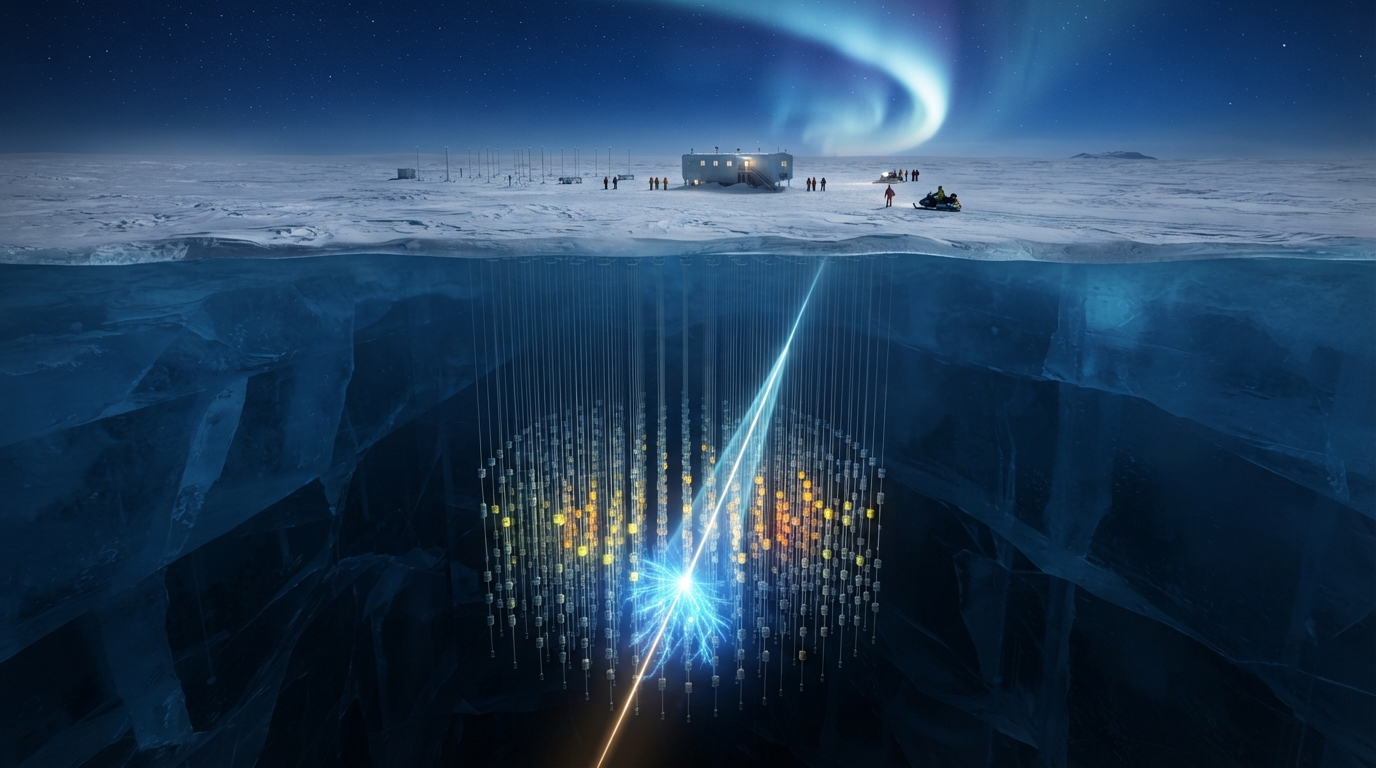
**Francis Halzen Awarded the Nobel Prize in Physics**
The Royal Swedish Academy of Sciences has announced Francis Halzen as the laureate of the 2026 Nobel Prize in Physics. The University of Wisconsin–Madison scientist was awarded for his decisive contributions to creating the IceCube neutrino observatory and detecting high-energy neutrinos of astrophysical origin.
At the heart of Halzen's work lies the idea of using Antarctic ice as a detector to find particles that hardly interact with surrounding matter. Built at the South Pole, the IceCube complex consists of a giant system of light sensors deployed in a volume of about one cubic kilometer of ice.
Neutrinos pass continuously through the Earth and the human body, leaving almost no trace. Their interactions with atomic nuclei are extremely rare, but it is the flash of light produced in such collisions that makes it possible to register the particle.
High-energy neutrinos are of particular importance for astrophysics. Natural accelerators exist in the Universe capable of imparting energies to particles up to a million times higher than those achievable in Earth-based laboratories. At the same time, the nature and location of most such sources remain insufficiently studied.
Neutrinos provide a major advantage in studying these processes. Unlike other particles, they can reach Earth along nearly straight paths without losing a significant portion of their energy. Therefore, registering them allows for obtaining information about cosmic sources that cannot be studied using traditional methods.
Halzen first proposed using the South Pole to search for neutrinos in 1988. His idea was based on registering the light signal generated by the interaction of a neutrino with an atomic nucleus inside transparent ice.
Antarctic ice is suitable for such observations due to its low level of background noise. Furthermore, the South Pole is distinguished by its geological stability and the absence of earthquakes. Following support from other scientists, testing of the detectors directly inside the ice began.
The extreme rarity of high-energy cosmic neutrinos required the creation of a detector of immense proportions. Encompassing a cubic kilometer of ice, IceCube was completed in 2011. Shortly thereafter, researchers registered the first high-energy neutrinos.
In the years that followed, scientists gathered data on neutrinos that likely originated from regions beyond the Solar System. This paved the way for a systematic search for the sources of such particles in the Universe.
"Francis Halzen led an international team of researchers and engineers who created a fantastic scientific instrument. His determination and scientific vision have opened the way to a new kind of astronomy," said Mark Pearce, Chair of the Nobel Committee for Physics.
IceCube observations are ongoing. The neutrino interactions registered by the observatory allow the study of processes taking place in the most powerful and active cosmic environments and may help identify previously unknown phenomena.
Francis Halzen was born in 1944 in Tienen, Belgium. In 1969, he earned his PhD from the Catholic University of Leuven. Halzen is a professor at the University of Wisconsin–Madison in the USA.
The amount of the 2026 Nobel Prize in Physics is 12 million Swedish kronor.
The Royal Swedish Academy of Sciences was founded in 1739. The Academy is an independent organization dedicated to promoting science and strengthening its role in society, paying special attention to natural sciences and mathematics.