

"Forced labor and human trafficking" - the rights of Uzbek immigrants in Korea are causing serious discussions
In South Korea, contracts signed with migrant workers sent from Uzbekistan on E-9 visas are causing a lot of discussion. According to the written guarantee slips obtained from the workers, they will have to pay a fine of $2,000 per month if they change jobs. Activists consider such a requirement to be an economic and psychological pressure.
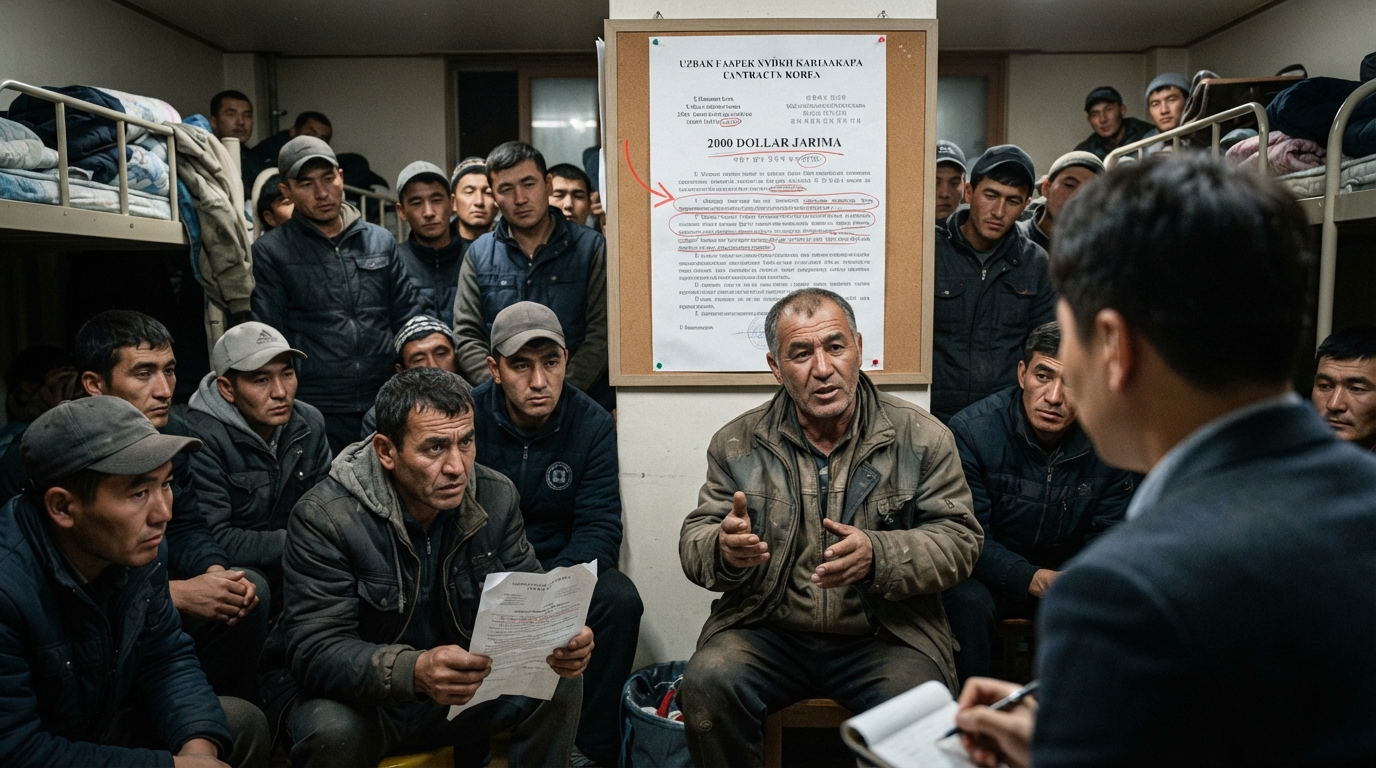
**Uzbek migrant rights in Korea: Serious debate over forced labor and human trafficking**
While a large-scale investigation into corruption in the system of organizing the sending of labor migrants from Uzbekistan to South Korea is ongoing, this issue is also causing heated discussions in Korea itself.
**"$2,000" fine**
According to documents leaked by South Korean media, Uzbeks with E-9 visas were forced to sign a special contract with the Migration Agency of Uzbekistan and attached guarantee slips before leaving their homeland. Critics believe that a legal analysis of these documents shows that they are one-sided and aimed at economically enslaving the worker.
The most controversial clause of the agreement is that if a migrant changes his place of work without the written consent of his employer in Korea and the representative office of the Migration Agency of Uzbekistan in Korea, he will be fined $ 2,000 per month. Most surprisingly, the upper limit of this fine is not set, and the sanction will continue to be calculated every month until the worker returns to Uzbekistan.
Another of the biggest objections to the agreement is that the fine is applied even in situations where the worker himself is not the cause of the change of place of work. According to the Pressian publication, financial penalties are imposed on workers even in cases where they are forced to leave the company not of their own free will, for example, due to forced dismissal or lack of work.
Kun.uz draws attention to the fact that a post published on the official page of the Migration Agency in November 2024 also states that the rules have been tightened. In particular, a fine of $2,000 was imposed on those who left their jobs without reason and without consulting the Korean representative office. This was interpreted as a measure to prevent foreign employers from creating a negative image of Uzbek workers.
**Death of an employee**
On July 18, 2026, a 26-year-old Uzbek man named B. tragically died at the Hyundai Heavy Industries shipyard in Ulsan. He was crushed between a lifting device and a basin while he was performing ship polishing work.
The deceased worker's colleagues told the Pressian correspondent that the deceased had been injured several times before and was afraid to work at the shipyard after that. He had always wanted to move to another factory because of the dangerous working conditions and low wages. However, he faced obstacles due to large fines.
On July 20, Nurmatjon Kamilov, the head of the Migration Agency’s Korean office, visited the Hyundai Heavy Industries dormitory in Ulsan. At the meeting, the workers expressed their dissatisfaction in a strong manner. They protested, “If he had had the opportunity to transfer to another factory at least once, he would not have died,” and demanded that the unfair agreement be resolved.
Kim Song-hun, a representative of the Internal Contracts Department at Hyundai Heavy Industries, who was at the scene, said that more than 100 Uzbek workers openly expressed their dissatisfaction. According to him, the Migration Agency is demanding that even those who were fired by the subcontractor pay a fine. In his opinion, this is effectively saying to the workers: “You will never leave Hyundai Heavy Industries in Ulsan.”
A worker named A. also stressed the seriousness of the problem. “There are various situations: some people’s health is not suitable for this work, and some companies simply do not have work. However, such reasons are not taken into account at all,” he said.
**Pilot Project**
In order to solve the personnel crisis in the shipbuilding industry, the Ulsan City Administration and the South Korean Ministry of Employment and Labor have developed a “Pilot Project on Training Foreign Workers Adapted to the Shipbuilding Industry”. Cooperation with Uzbekistan in the field of organizational migration has been selected for piloting within the framework of this project.
With the direct assistance of Hyundai Heavy Industries Corporation and financial support of 1 billion won from the Ulsan City Administration, the “Ulsan Global Personnel Training Center” was established in Fergana Region. By June 2026, about 380 people had been brought to work under this program.
Pressian spoke by phone with a representative of the Migration Agency’s representative office in Korea on July 27. According to the representative, in cases where the company has ceased operations, as well as in cases where it is impossible to continue working due to diseases such as herniated discs, and if a medical report is provided, migrants who have signed the contract are also allowed to change their place of work. When asked why the contract was concluded with such content, he spoke about the increase in cases of illegal overstaying in recent years and the need to maintain the country's international image.
**The situation with Filipino workers**
South Korean lawyer Cho Jeong-gyu assessed the situation as "equivalent to forced labor and human trafficking." According to him, this is similar to the "defection guarantee deposit" system that workers hired from the Philippines for the Korean agricultural sector faced in 2022.
From 2022 to 2024, Buyeo and several other South Korean municipalities directly contracted with local governments in the Philippines to bring in workers. However, to prevent migrants from leaving their jobs en masse and becoming illegal migrants, the municipalities implemented a “departure guarantee” practice. In this case, 60 percent of the workers’ monthly salaries were frozen and transferred to a special account, which was stipulated to be released only when they returned to their homeland. In other cases, intermediary brokers operated by confiscating workers’ passports and bank cards.
In October 2024, South Korea’s National Human Rights Commission issued its final report on the practice. According to the commission’s decision, withholding wages, confiscating passports, or demanding large bail amounts to prevent them from fleeing constitutes “human trafficking for the purpose of labor exploitation.”
It is emphasized that the $2,000 fines for Uzbek E-9 workers are essentially the same mechanism as the “guarantee of exit” for Filipino workers. Human rights activists have characterized the imposition of large fines as a means of economic control, and the pressure on family members of those who escape in Uzbekistan as a means of psychological control. It is noted that this meets the “criteria for identifying victims of human trafficking.”
Hyundai Heavy Industries, which directly employs the workers, commented on the scandal, saying that it was completely unaware of the fines and did not participate in this process. According to the company, these documents are an internal policy of the Uzbek government to manage its citizens abroad, and the corporation has no right to interfere in this.
The South Korean Metallurgical Workers’ Union issued a sharp statement. It states that it is completely unreasonable for the city of Ulsan and Hyundai Corporation, which developed the “Ulsan Model” and benefit the most from it, to sideline themselves. The workers are being brought through the system they created.
**South Korean government intervention**
Under pressure from the Ministry of Gender Equality and human rights organizations, the Korean Ministry of Employment and Labor has begun to pay serious attention to the above situation. The ministry’s statement published on August 8 noted that this issue is being studied jointly with the Embassy of Uzbekistan in Korea and the Representative Office of the Migration Agency.
Also, on August 6, at a meeting between the Head of the Planning and Coordination Department of the Korean Ministry of Employment and Labor and the Deputy Minister of Employment and Poverty Reduction of Uzbekistan, the injustice of this procedure and a demand for its urgent improvement were put forward.
“We urge the Uzbek government to resolve the issue by sending an official document as soon as possible. We will also continuously monitor the measures taken by the Uzbek side and, if necessary, take additional measures based on the situation,” the Korean Ministry of Labor said in a statement.
For its part, the Ministry of Gender Equality has also noted signs of human trafficking in the entry of Uzbek migrant workers into the country on E-9 visas.