

For areas without gas in Uzbekistan, the base norm for electricity consumption has been increased to 350 kWh
In Uzbekistan, during the heating season, the basic electricity consumption norm for residents of areas without natural gas or with supply difficulties has been increased from 200 to 350 kWh per month. The government has also approved the procedure for paying needy families a one-off assistance in the amount of 1 million sums.
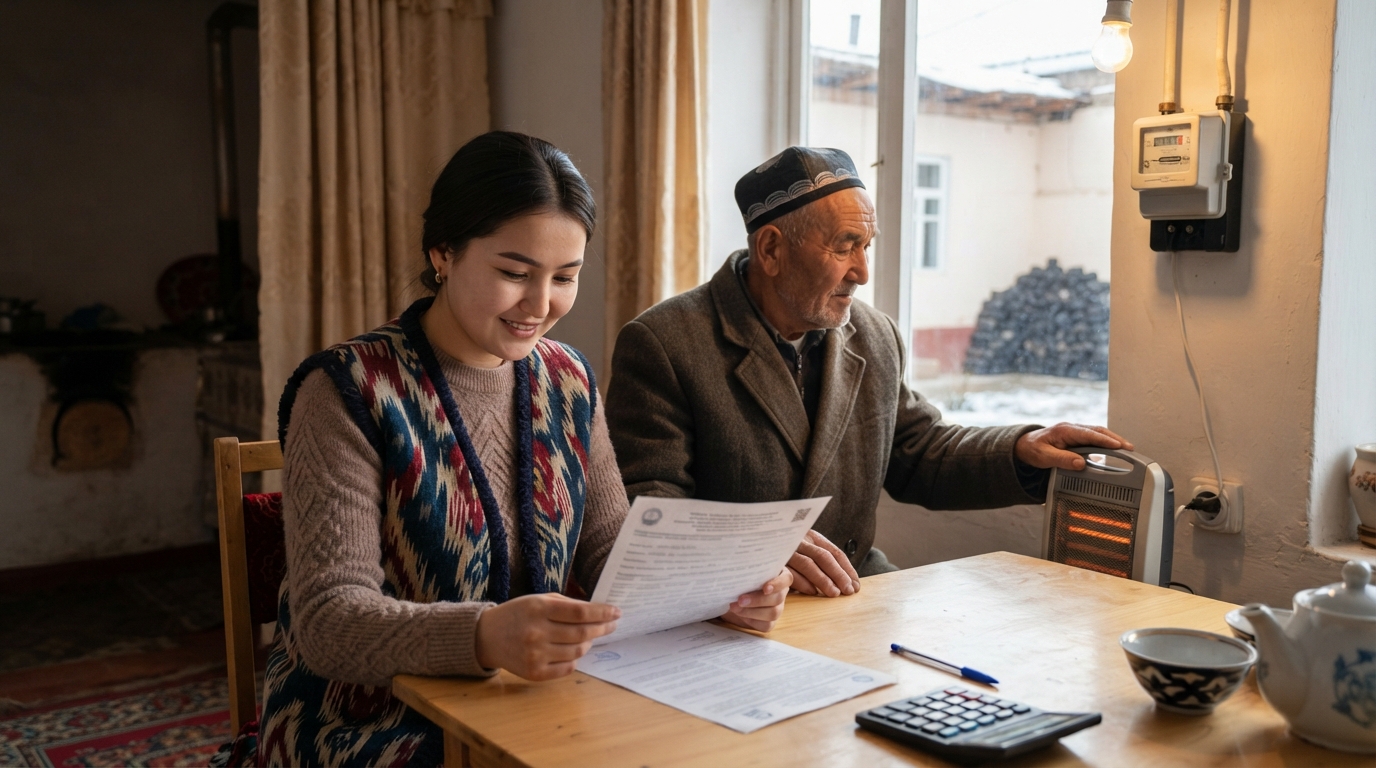
For regions of Uzbekistan without gas, the base electricity consumption allowance has been raised to 350 kWh
By a resolution dated October 31, the Cabinet of Ministers of Uzbekistan approved mechanisms for social support of the population amid the fuel and energy sector's transition to market principles. The document took effect on November 1, 2026.
According to the resolution, during the heating season, for residents of areas where natural gas is absent or its supply is difficult, the base electricity consumption allowance increases from 200 to 350 kWh per month.
For other residential consumers, the base limit remains at 200 kWh.
The heating season period for applying the increased allowance varies by region: in Karakalpakstan and the Khorezm region — from October to February; in the remaining regions of the country — from November to February.
Outside the heating season, the base allowance will be 200 kWh per month, including for residents of ungasified areas.
According to the approved tariffs, for the majority of residential consumers, electricity within the base allowance costs 650 soums per 1 kWh, while the volume above it up to 500 kWh costs 900 soums.
Thus, with a consumption of 350 kWh per month, the cost of electricity within the increased allowance will be 227,500 soums. Without the allowance increase, one would have to pay 265 thousand soums for the same volume — 130 thousand for the first 200 kWh and 135 thousand for the next 150 kWh. The difference is 37,500 soums.
The Ministry of Energy, Hududgaztaminot, and Regional Electrical Grids must annually submit proposals for lists of homes located in areas without natural gas or with difficult supplies.
Based on these proposals, the lists will be approved by the Council of Ministers of Karakalpakstan, as well as the khokimiyats of the regions and Tashkent.
After that, they will be sent to gas supply and electric grid organizations to apply the relevant norms.
In accordance with a presidential decree, in November 2026, a one-off financial aid of 1 million soums is provided for certain categories of low-income families.
The resolution of the Cabinet of Ministers approved the procedure for compiling lists of recipients, verifying them, and transferring funds.
The right to assistance is provided for families included in the Social Register, as well as for families not included in it but meeting the established need criteria. The main condition for the latter category is that the average monthly per capita income of a family member must not exceed twice the amount of minimum consumer expenditure, that is, 1.43 million soums.
A separate criterion is set for families living in apartment buildings connected to centralized heating. For such families in Karakalpakstan and the regions, the income threshold is 1.43 million soums per person, and in Tashkent — 2.145 million soums, or three times the amount of minimum consumer expenditure.
In addition, assistance will be received by single elderly citizens and persons with disabilities who need outside care and are included in the relevant register, as well as families with orphan children and children left without parental care.
In certain cases, assistance may also be provided to families whose incomes exceed the established thresholds — by decision of district and city headquarters for creating sustainable jobs and increasing population incomes.
The document details the stages of assistance disbursement. The National Agency for Social Protection, together with "Inson" centers, forms the initial lists of recipients.
Additional lists are compiled by the "mahalla seven." Priority should be given to families that have lost their breadwinner, families with persons with group I and II disabilities, children with disabilities, citizens requiring long-term medical treatment, as well as certain other socially vulnerable categories.
When compiling the lists, account is also taken of families of labor migrants, households where several families live together, and residents of apartment buildings without natural gas and centralized heating.
At the same time, the number of families in additional lists formed under the main need criterion should not exceed 50% of the number of families included in the Social Register of the corresponding district or city.
According to the approved schedule:
Payments will be made through Xalq Bank and Aloqabank to citizens' social or bank cards.
The document also indicates that when forming final lists, families included in the Social Register before November 19 are taken into account.
The resolution also expands the circle of families who are reimbursed a portion of electricity and natural gas expenses.
For families not included in the Social Register, the allowable average monthly income per person is raised from 1.5 to 2 times the minimum consumer expenditure — from 1,072,500 to 1,430,000 soums.
At the same time, the mechanism for compensating the difference between tariffs within the base consumption allowance and higher tariffs for consumption above it has been extended until April 1, 2028.
Under the current mechanism, low-income families are compensated for part of the costs for additional volumes of electricity and natural gas within established limits.
For families not included in the Social Register but meeting the need criteria, an automated check of their socio-economic status based on data from state information systems is provided.
If the right to assistance is confirmed, the decision to assign compensation is generated automatically.
Certain changes concern state assistance for purchasing coal. Now, not only families included in the Social Register, but also families not registered in it can receive the right to compensation if their average monthly per capita income does not exceed twice the amount of minimum consumer expenditure.
According to the updated administrative regulation, the compensation is 300 thousand soums for each ton of purchased coal, but no more than 600 thousand soums during a calendar year.
Compensation is provided when purchasing coal through the mycoal.uz platform and its mobile application.
To apply for the payment, one can contact a public services center, an "Inson" center, or use the electronic services provided by the regulations.
Information on the purchase of coal enters state information systems, after which the family's right to support is checked. If the conditions are met, the compensation is transferred to the recipient's social card.
The period of the program for partial reimbursement of costs for purchasing coal has been extended until January 1, 2029.
In addition, the government expanded the criteria for providing social assistance from the "Saxovat va ko'mak" fund. Families not included in the Social Register will be able to receive assistance for utility bills, debt clearance, and fuel purchases if their average per capita income does not exceed 1.43 million soums.
According to explanatory materials, one-off assistance in the amount of 1 million soums was planned to be provided to more than 1 million 17 thousand families.
1.9 trillion soums was allocated for additional social support measures in 2026.
The authorities also expected that expanding the criteria for receiving compensation for electricity and natural gas would allow an additional 166 thousand families to be covered by support.
Extending compensations until April 2028 is expected, according to preliminary calculations, to maintain support for 470 thousand families for another year. Additional expenses for these purposes were estimated at 150 billion soums.