

Food even under volcanic ash: the "food forest" may have helped ancient humans survive
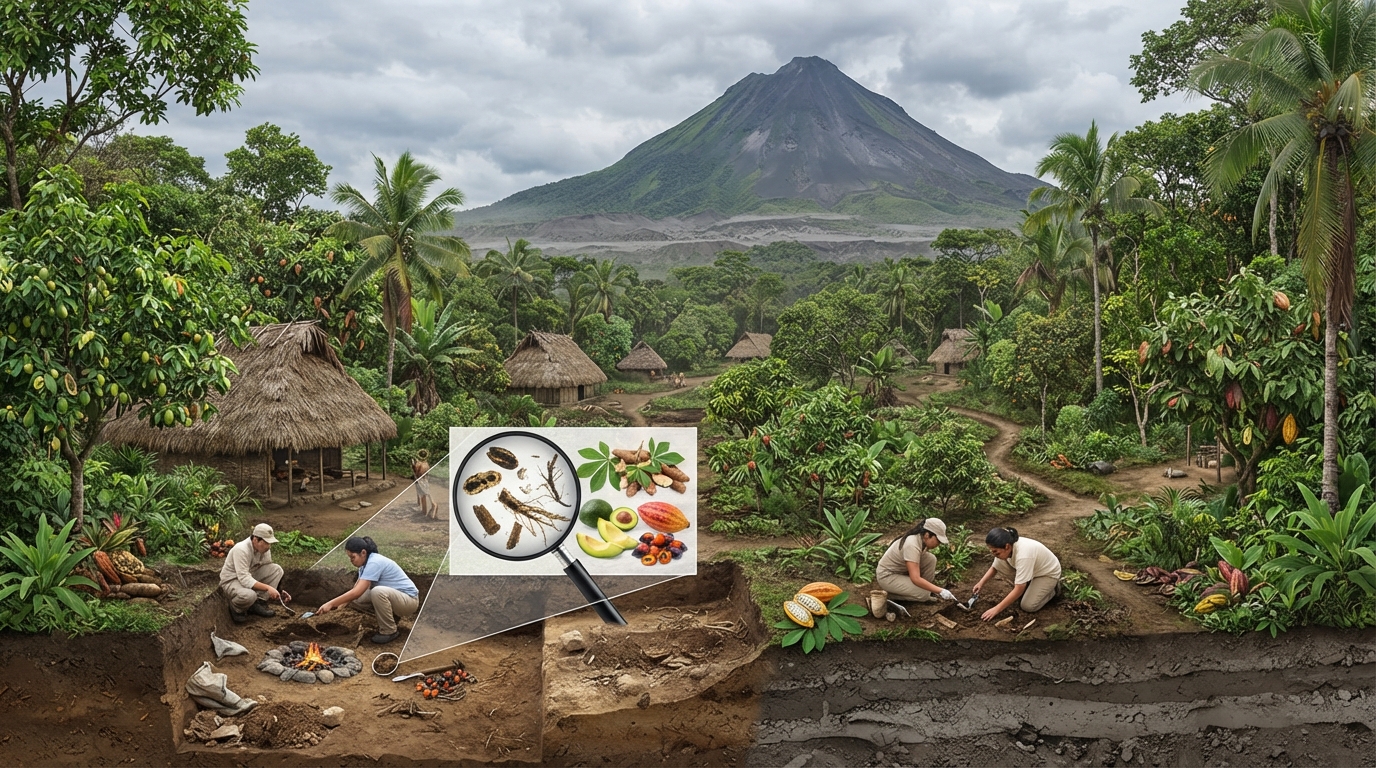
The ancient population of Costa Rica may have obtained food from fruit trees and underground tubers following eruptions of the Arenal volcano. By studying plant remains from two ancient settlements, archaeologists put forward the hypothesis that diverse food sources helped people overcome the consequences of natural disasters.
Food found even under volcanic ash: "edible forest" may have helped ancient humans survive
For thousands of years, the Arenal Volcano periodically covered the surrounding areas with ash. Following eruptions, settlements were temporarily abandoned, but people later returned, rebuilt their homes, and continued to live in the area.
Scientists have previously explained such resilience by pointing to diverse food sources, small settlements, and connections between communities. If one area became uninhabitable, people may have been able to find food in neighboring forests and old orchards. A network of ancient paths and ties between communities are believed to have facilitated this.
American researchers compared findings from two settlements separated by nearly two thousand years. The first is La Chiripa, where a residential site dating back to approximately 1600–1100 BC was identified. The second is the village of Sitio Bolivar, inhabited around AD 430–540.
La Chiripa is located at a higher elevation, while Sitio Bolivar sits on a lakeshore. Therefore, the comparison encompasses different eras and living conditions. The results of the study were published in the journal Frontiers in Environmental Archaeology.
During excavations, scientists collected soil, plant remains, and charcoal samples from residential layers, hearths, and other features. Microscopic remains were separated by soil washing (flotation), examined under a microscope, and compared with modern reference samples. To identify the characteristics of roots and tubers, some samples were experimentally charred.
A total of 194 plant remains were recovered. However, it was not possible to identify all of them down to a precise species. Not all of the remains belonged to plants used as food.
In the materials found at the residential sites, fruit trees, palms, and plants with edible underground parts occupied an important place. Meanwhile, remains of maize, beans, and squash were much less common.
The identified plants include cassava, avocado, cacao, fruiting palms, and other tropical species. Their presence across different layers indicates that the population regularly used forest products.
Scientists figuratively call such an environment an "edible forest." In it, trees, shrubs, climbing plants, as well as underground roots and tubers served as sources of food.