

Fitch upgrades Kapitalbank to 'B+', withdraws ratings
Fitch upgraded Kapitalbank's ratings to B+ amid an improving operating environment, but subsequently withdrew them for commercial reasons.
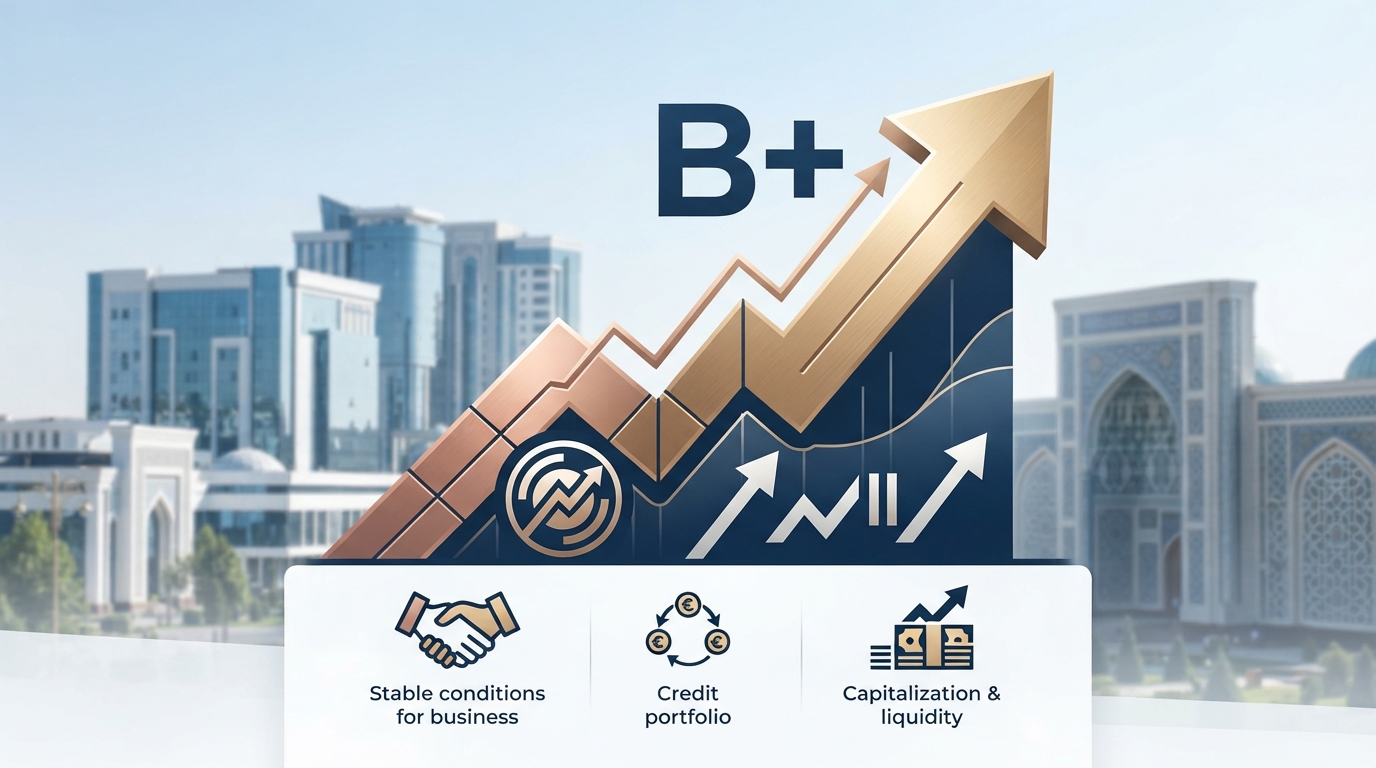
Fitch Upgrades Kapitalbank to 'B+' and Withdraws Ratings
Fitch Ratings has upgraded JSC Kapitalbank's Long-Term Foreign- and Local-Currency Issuer Default Ratings (IDRs) from "B" to "B+", and its Viability Rating (VR) from "b" to "b+".
The Outlook on the Long-Term IDRs is Stable.
Concurrently, the international rating agency has withdrawn Kapitalbank's ratings for commercial reasons and has ceased providing rating and analytical services for the bank.
The rating upgrade occurred against the backdrop of an improved operating environment for Uzbek banks. According to Fitch's assessment, reforms implemented in recent years have strengthened Kapitalbank's business profile, capitalization, and liquidity. At the same time, the bank continued to demonstrate consistently high profitability.
Prior to the withdrawal of the ratings, Kapitalbank's assessment was primarily supported by its standalone credit profile, reflected in its VR. Fitch noted the bank's significant scale of operations, high capacity for internal capital generation, and strong liquidity position.
At the same time, the agency pointed to factors that constrained the risk profile assessment. These included a high concentration of the loan portfolio in a single sector and the bank's appetite for rapid business expansion, which could potentially pressure asset quality.
Fitch upgraded its assessment of the operating environment for the Uzbek banking sector from "b" with a Positive Outlook to "b+" with a Stable Outlook. This is attributed to progress in banking reforms over the past two years, particularly strengthened regulation and measures to address legacy risks.
According to the agency, the combination of an improved operating environment and stable business conditions enhances the resilience of the country's banks' credit profiles. An additional factor remains the high rate of economic growth:
Uzbekistan's GDP grew by 8.5% year-on-year in the first half of 2026.
As of the end of June 2026, Kapitalbank accounted for about 6% of the total loan portfolio of Uzbekistan's banking system. Over the past five years, the bank has demonstrated high profitability.
At the same time, Kapitalbank's business model remained fairly concentrated. Following active expansion in retail auto lending in 2021–2023, the bank significantly reduced originations in this segment and began to more actively develop lending to small and medium-sized enterprises (SMEs). Despite this, auto loans still accounted for more than half of the loan portfolio at the end of the first half of 2026.
In 2024–2025, the volume of non-retail lending more than doubled, although this growth occurred from a relatively low base. Fitch considers SME lending in Uzbekistan to be a riskier segment, as a significant portion of these operations is conducted in foreign currency.
The share of foreign currency loans at Kapitalbank rose from 41% at the end of 2025 to 46% at the end of the first half of 2026.
This figure was higher than the banking sector average of 39%.
The bank's risk profile is partially supported by a significant share of secured lending. However, it is negatively affected by loan concentration in a single sector, a high volume of foreign currency risks, and Kapitalbank's appetite for rapid growth.
Fitch assessed the quality of the loan portfolio as manageable. The share of impaired loans at the end of the first half of 2026 was 5%, with another 6% classified as Stage 2 loans. The bulk of these figures was related to auto loans issued during the previous period of rapid expansion.
Fitch considers the risks acceptable due to the high diversification of problem loans, their predominant denomination in the national currency, and the availability of liquid collateral.
A high interest margin and loan portfolio growth provided Kapitalbank with significant operating profit. In 2022–2025, it averaged about 5% of risk-weighted assets (RWA).
In the first half of 2026, return on equity declined to 18% from 29% at year-end 2025. Fitch attributed this decline to high funding costs. According to the agency's forecast, the bank's operating profit in 2026 will be below 5% of RWA, but will remain high and significantly exceed the banking sector average.
Kapitalbank's capitalization also strengthened. The Fitch Core Capital ratio rose from 14.6% at the end of 2025 to 16.4% at the end of the first half of 2026. The growth was driven by the bank's high profitability.
Fitch expected a further, albeit moderate, increase in this ratio in 2026. According to the forecast, internal capital accumulation will outpace the rate of loan portfolio expansion.
The bank's liquidity position also remained resilient. The loan-to-deposit ratio was 82% at the end of the first half of 2026, compared to a market average of 137%. Thus, Kapitalbank was significantly less dependent on deposit funding than a number of peer banks.
Liquid assets at the end of June 2026 covered about 40% of customer funds. At the same time, the volume of wholesale debt maturing within the next 12 months remained limited.
Following the withdrawal of the ratings, Fitch no longer applies sensitivity factors that could lead to their upgrade or downgrade.
Prior to the termination of the ratings, the assessment of state support for Kapitalbank was at "No Support". Fitch explained this by the bank resolution and recovery legislation adopted in Uzbekistan, which provides for the possibility of writing down or converting senior creditors' liabilities into equity as part of a resolution procedure.
The adjustment of the earnings and profitability score to "b+" relative to the implied level of "bb" reflected historical and projected performance, which served as the basis for the negative adjustment.
Fitch also announced that following the withdrawal of the ratings, it will no longer publish corresponding ESG Relevance Scores for Kapitalbank. Previously, the maximum level of relevance of ESG factors for the credit rating was assessed at 3. Such a score indicates that ESG factors are neutral to credit quality or have a minimal impact on it.
The agency separately emphasizes that ESG Relevance Scores are not a direct part of the rating process and reflect the degree of relevance of ESG factors in making a rating decision.