

Fitch Affirms TBC Bank Uzbekistan at 'BB-'
Fitch has affirmed TBC Bank Uzbekistan's rating at "BB-" with a stable outlook, noting loan growth and asset quality risks.
Fitch Affirms TBC Bank Uzbekistan at 'BB-'
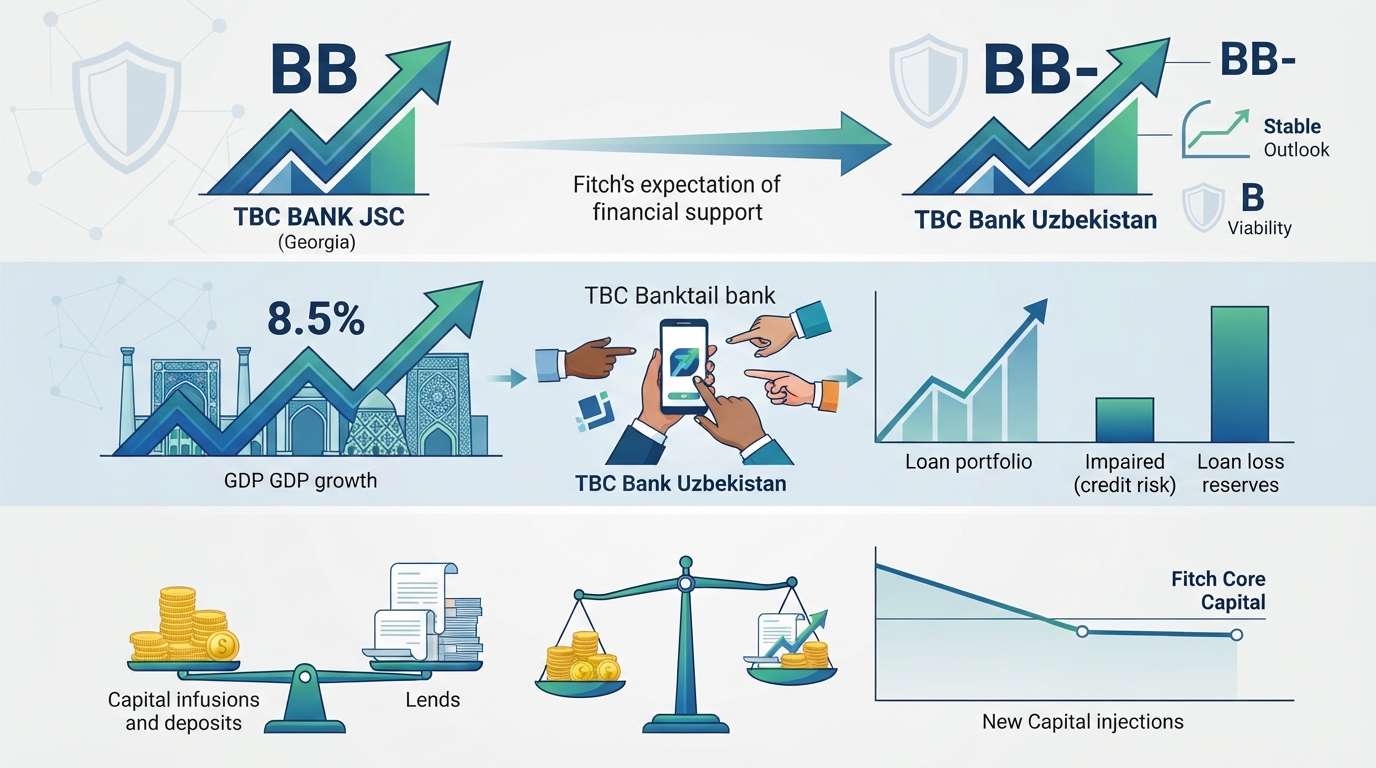
Fitch Ratings has affirmed TBC Bank Uzbekistan's Long-Term Issuer Default Ratings (IDRs) at 'BB-' with a Stable Outlook. The bank's Viability Rating (VR) has also been maintained at 'b'.
Fitch's decision takes into account potential support from the Georgian TBC BANK JSC, whose rating stands at 'BB' with a Stable Outlook. TBC BANK is the key bank of TBC BANK Group PLC, which controls the Uzbek bank.
According to Fitch, in case of need, emergency financial assistance to TBC Bank Uzbekistan would ultimately be provided by TBC BANK. The Stable Outlook on the Uzbek bank's rating aligns with the outlook on the ratings of its parent entity.
TBC Bank Uzbekistan's Shareholder Support Rating is one notch below TBC's Long-Term IDR. Fitch assesses the Uzbek bank's role within the group as moderate, although it expects it to gradually strengthen over the next five years.
The support assessment also factored in significant reputational risks for TBC BANK in the event of a default by the Uzbek entity, as well as the manageable cost of potential support. At the end of 2025, TBC Bank Uzbekistan's assets accounted for 8% of TBC BANK's assets.
Concurrently, Fitch upgraded its assessment of the operating environment for Uzbek banks from 'b'/Positive to 'b+'/Stable.
The agency attributes this to progress in reforming the banking sector over the past two years, including stronger regulation and the resolution of legacy risks.
Improved operating conditions for banks, a stable business environment, and high economic growth rates should support business expansion and, in the medium term, contribute to profit growth and the banks' ability to generate capital internally. In the first half of 2026, Uzbekistan's economy grew by 8.5% year-on-year.
TBC Bank Uzbekistan remains a small digital bank focused on the retail segment. At the end of the first half of 2026, its share was 1.4% of the total assets of the country's banking sector.
The bank's primary line of business remains unsecured consumer lending, where TBC Bank Uzbekistan has become a market leader. At the same time, the bank has begun developing products for small and medium-sized enterprises (SMEs) in response to regulatory changes, aiming to diversify its business model.
Rapid lending growth is accompanied by an elevated cost of risk. In 2025, it rose to 11.2% of average gross loans, compared to 6% a year earlier. Fitch attributes this to the gradual seasoning of the loan portfolio after a period of rapid growth, as well as one-off expenses.
The bank's loan portfolio increased by 44% in 2025, following a 112% growth in 2024. Fitch expects lending expansion rates to remain above the market average as the SME financing segment develops.
At the same time, asset quality deteriorated. The share of impaired loans rose to 6% at the end of 2025, compared to 2.2% a year earlier. Together with large write-offs, this drove the high cost of risk.
However, provisioning coverage of impaired loans remained adequate at 129% at the end of 2025. Fitch expects a further increase in the share of problem loans—to approximately 10% in 2026—amid ongoing portfolio seasoning, unless write-offs exceed forecasts.
The bank's financial performance is supported by a high net interest margin. In 2025, it stood at 23.7%, while the cost-to-income ratio was 49%.
However, non-interest income remains weak. In addition, asset impairment charges reached 80% of pre-impairment operating profit. As a result, return on average equity (ROAE) was 8%.
Fitch forecasts moderate profitability to persist in 2026, with a slight recovery in 2027.
TBC Bank Uzbekistan's capitalization declined amid rapid asset growth. The Fitch Core Capital ratio was 15.4% at the end of 2025, down from 20.8% a year earlier. Internal capital generation lagged significantly behind risk-weighted asset growth.
During the first nine months of 2026, the bank received additional capital injections. These are intended to support loan growth and maintain adequate capitalization levels relative to the bank's risk profile.
Customer funds remain the primary source of funding. At the end of 2025, they accounted for 58% of non-equity funding, compared to 67% a year earlier. These are mostly diversified but relatively expensive retail deposits.
The remainder of the funding consists of wholesale debt liabilities and short-term interbank borrowings.
Fitch assesses the liquidity level as moderate. The loan-to-deposit ratio was 165% at the end of 2025, compared to 162% a year earlier. Refinancing risks are mitigated by regular liquidity support from shareholders.
A downgrade of TBC Bank Uzbekistan's Shareholder Support Rating and Long-Term IDRs is possible in the event of a deterioration in TBC BANK's ratings. An additional factor could be a weakening of the Uzbek bank's role within the group and a reduction in its contribution to overall results, which would widen the rating gap between the two entities.
The Viability Rating could be downgraded in the event of a significant deterioration in capitalization due to unprofitable operations or rapid growth in risk-weighted assets, if such growth is not timely offset by additional capital.
Fitch also considers instability in the deposit base or liquidity outflows as potential negative factors, unless these risks are mitigated by regular support from the parent entity.
An upgrade of TBC Bank Uzbekistan's ratings is possible following an upgrade of TBC BANK's ratings. Fitch could also upgrade the Uzbek bank's ratings to TBC's level if its importance to the group increases significantly, leading to a stronger propensity of the group to provide support.
Prospects for an upgrade of the Viability Rating remain limited. This would require a significant strengthening of TBC Bank Uzbekistan's market position and the successful implementation of its new business model, accompanied by improvements in its risk profile, asset quality, and profitability, while maintaining adequate capitalization.
The bank's Short-Term Foreign- and Local-Currency IDRs have been affirmed at 'B', which corresponds to its Long-Term IDRs in the 'BB-' category.