

First earnings, the price of mistakes, approach to business, and family. What the heroes of the book "Made in Uzbekistan" talk about
The heroes of Kirill Altman's book "Made in Uzbekistan"—famous entrepreneurs—have different attitudes toward partnership, money, and working overtime. In conversations with the author, they recall their childhoods, their first sales, and the decisions they regret. Gazeta has selected stories about how their path in business took shape.
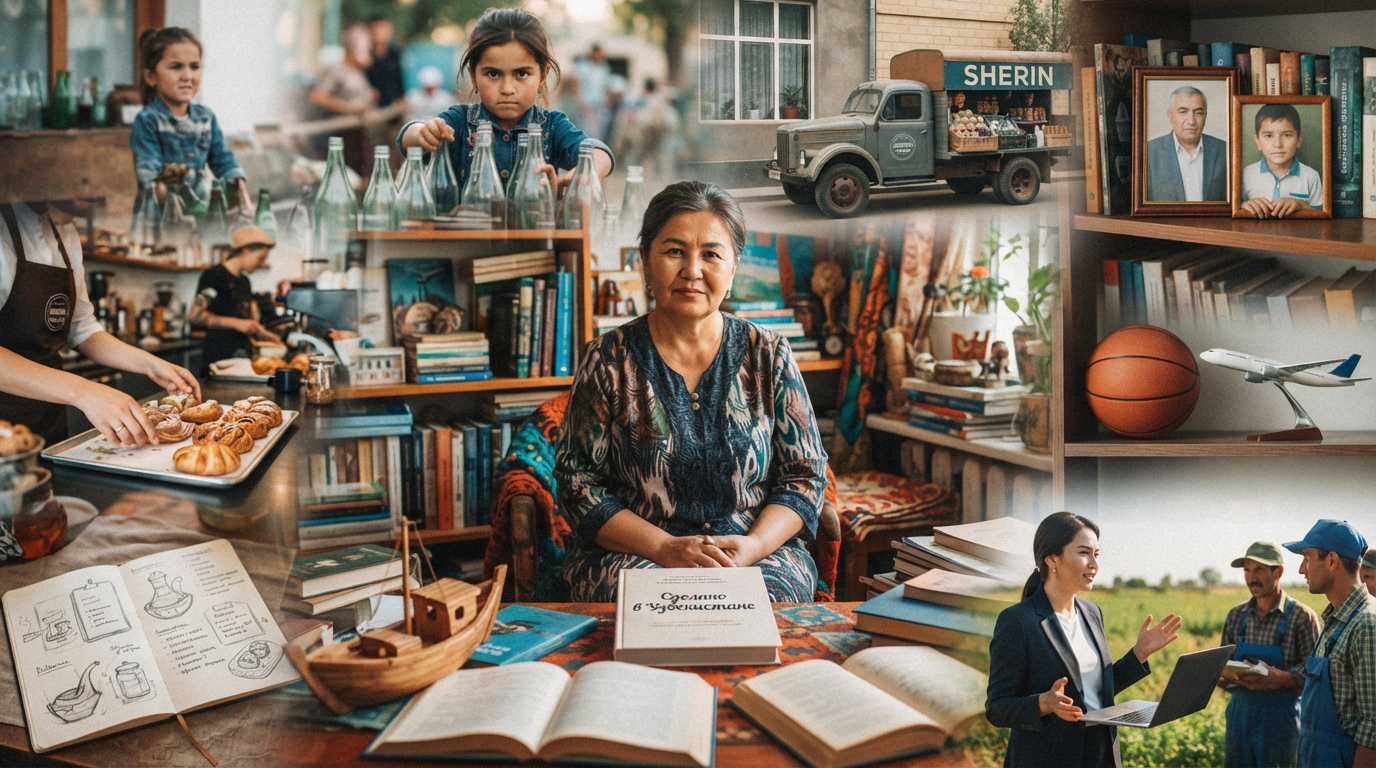
First earnings, the price of mistakes, business approach, and family. What the heroes of the book "Made in Uzbekistan" talk about
Over the course of a year, the author spoke with 30 founders and executives of companies from various fields — from retail and the restaurant business to fintech and aviation. These conversations were published in the format of monologues.
In the foreword, Kirill Altman explains that he sought to preserve personal conversations with entrepreneurs — complete with doubts, wrong decisions, and confessions that help readers see their journey.
"An interview yields a journey. A personal conversation yields the truth — with doubts, bad decisions, and an honest 'I didn't understand what I was doing at all back then,'" he writes.
The interviewees not only share entrepreneurial experience, but also recall how it all began: how they turned in empty bottles, delivered goods themselves, argued with their parents, and involved their children in the family business.
The entrepreneurs' statements show how differently they view partnership, money, and working overtime.
"In some ways, the heroes contradict each other, and so be it: there is no single right way to conduct business, and thirty different answers are more honest than one correct one," the author writes.
Madina Samigjanova, founder of the Safia pastry shop chain, recalls in the book that she wanted to earn her own money since childhood, even though her family was well-off and her father was in business.
"Our family was quite wealthy, but there were always bottles standing in the basement, and as a girl I wasn't too lazy to take them in for recycling and get money for it. At home they scolded me — why, they said, are you carrying bottles, we'll give you money anyway. But even then it was important for me to earn my own," she says.
Alina Tsimerman, founder of the cafes "Chaykof", "Moloko", and Tosh, grew up in a family where money was scarce.
"I was raised by my mother alone. One pair of shoes for winter, one for summer — the usual story of an ordinary Soviet child," the entrepreneur recalls.
She calls the opportunity to independently earn money for an apartment, a car, vacations, and supporting her child one of the results of her business that she is proud of.
Rinat Alimukhamedov, co-founder of the Sherin company, enrolled in a radio engineering college after school on his mother's advice: he had the example of an uncle before his eyes who repaired televisions. Already in the first week, he realized that he wasn't interested in it. Later he tried his hand at sales — in 1995 he began selling sausage produced by his classmate's father.
Previous experience in network marketing helped him learn how to talk to buyers. At the same time, the entrepreneur admits: he couldn't say that he specifically liked selling sausage — he wanted to live in prosperity, and he saw such an opportunity.
Mirzo Talibov, founder of the "Asclepius" pharmaceutical company, reflecting on money, recalls a conversation with his father:
"I once asked my father: 'Dad, why isn't it for you like it is for others? Look, the warehouse manager has three cars, and you don't.' And he replied: 'Mirzo, if I lie in a golden bed, will I sleep any better?'"
According to Talibov, since then he has perceived money as a means.
Samigjanova started baking at home when her children grew up a bit. She recalls that she was constantly thinking about recipes and the quality of the baked goods.
"In the evening I would come home and fall asleep with recipes. I would get up at five in the morning — also with recipes. I thought only about making sure the guests liked everything. If a customer left a pastry, I would taste it later — it was important for me to understand why they didn't finish it," tells the founder of Safia.
Her sons helped her expand the business. According to her, they started working while still children — at ages 14, 12, and six. "I really had a six-year-old son standing at the cash register! I needed any help back then," she recalls.
For restaurateur Timur Musin, founder of Caravan Group and the Plov Museum, the main skeptic was his mother — the famous art critic Natalya Musina. "Mom asked: 'What are you doing? Why do you need seven hundred seats? Who are you going to seat there?'" he says.
Dildora Atadjanova, founder of the agricultural export company Teodora Goods, says she started the company after facing harassment from her boss. She was afraid to leave for another hired job: the situation could repeat itself, and the effort invested in the work would be lost again.
"Only because of this did I open the company. I had no other ambitions," says the entrepreneur.
Her own business gave her more freedom, but stereotypes persisted in relationships with business partners as well.
"When I go to the fields and talk to farmers, the first catchphrase is: 'Call the boss, then we'll talk.' But 15 minutes is enough — and they are already talking completely differently. Plus, you pay money," tells Dildora Atadjanova.
Balancing work and motherhood became a separate task for her: she had to not only organize help, but also explain to her relatives why it was needed.
"You have to establish your own rules at your own expense until it becomes the norm. Now everyone understands everything and helps," she says.
Atadjanova considers her parents' support an important part of her journey. They did not rush her into marriage and gave her the freedom to try: "Try, go, do, earn."
Korzinka founder Zafar Khashimov recalls a period when he himself had to hold back the growth of the chain.
"In the 'old' Uzbekistan, it was difficult to grow in one direction and at the same time remain unnoticed, and if you were noticed — that, to put it mildly, was fraught with consequences. Therefore, there were times when you see that the business should grow, but you artificially hold it back yourself," he says.
Instead of expanding the chain, Khashimov launched parallel projects. He considers this dispersion a big mistake, although the decision was partly forced: development was hindered by restrictions in supply, currency conversion, and the tax sphere, as well as anxiety about safety.
"And you start burning in a bad place what you earned in a good one. And the worst thing isn't even the loss of money and energy — the worst thing is that you waste time there," says the entrepreneur.
Timur Musin, reflecting on crises, draws attention to the consequences of government decisions for business.
"Look: in half a year, they tore down verandas for businesses, destroyed tandoors, and removed signboards. And they think that no matter how much you interfere with business, it will endure everything. But only those who have a family to feed will endure — small entrepreneurs will endure, while large ones won't: they simply won't invest in this economy," the restaurateur believes.
The heroes have different experiences of working together. Alina Tsimerman says that out of all the joint ventures with partners, she is satisfied with probably "about 10 percent." She tries to launch new projects on her own.
"It happens that a project you dedicate your whole life to means nothing at all to a partner. For them it's secondary nonsense, and for you — your whole life," she explains.
Afisha Media founder Suren Sapov, on the contrary, considers partnership necessary, but emphasizes: agreements need to be documented and regularly reviewed.
Zafar Khashimov connects the ability to delegate with the readiness of employees to perceive a project as their own.
"Responsibility is when a person looks and says: 'Yes, the company is yours, but this project is mine.' They understand what to consider success and how to achieve it," explains the founder of Korzinka.
Head of TBC Uzbekistan Nika Kurdiani played professional basketball in his youth. This experience also influences his view of work: he compares the company to a national team, and projects — to championships.
"Personally, I don't believe in work-life balance: work and life are the same thing. If you don't enjoy the process, why do it at all?" he says.
Rinat Alimukhamedov recalls that at the start he traded from eight in the morning until six in the evening, then delivered goods to stores until one in the morning. He returned home by two, slept until five, and went out to work again. He was able to afford his first car only five years after starting production: before that, he reinvested all the money.
With age, his attitude toward such a schedule changed. When there are several businesses, he says, in secondary projects you can allow yourself to stop, catch your breath, and take a walk.
Suren Sapov also allows for pauses if he fails to concentrate on work.
"Want jam? Go gorge yourself on that jam, eat it for a week if you want! If this is your business and it matters to you, you'll come back anyway, and everything will be fine," he says.