

Fiery Conductor: 90 Years Since the Birth of Dilbar Abdurakhmanova
The Alisher Navoi State Academic Bolshoi Theatre is preparing an unforgettable evening titled "Her Whole Life is Music," dedicated to the 90th anniversary of the birth of the outstanding Dilbar Abdurakhmanova. On September 19, the main stage of the country will commemorate the creative legacy of the People's Artist of the USSR and State Prize laureate, whose name became synonymous with the triumph of the national school of conducting. This evening is not just a tribute to her memory, […]
**The Fiery Conductor: 90 Years Since the Birth of Dilbar Abdurakhmanova**
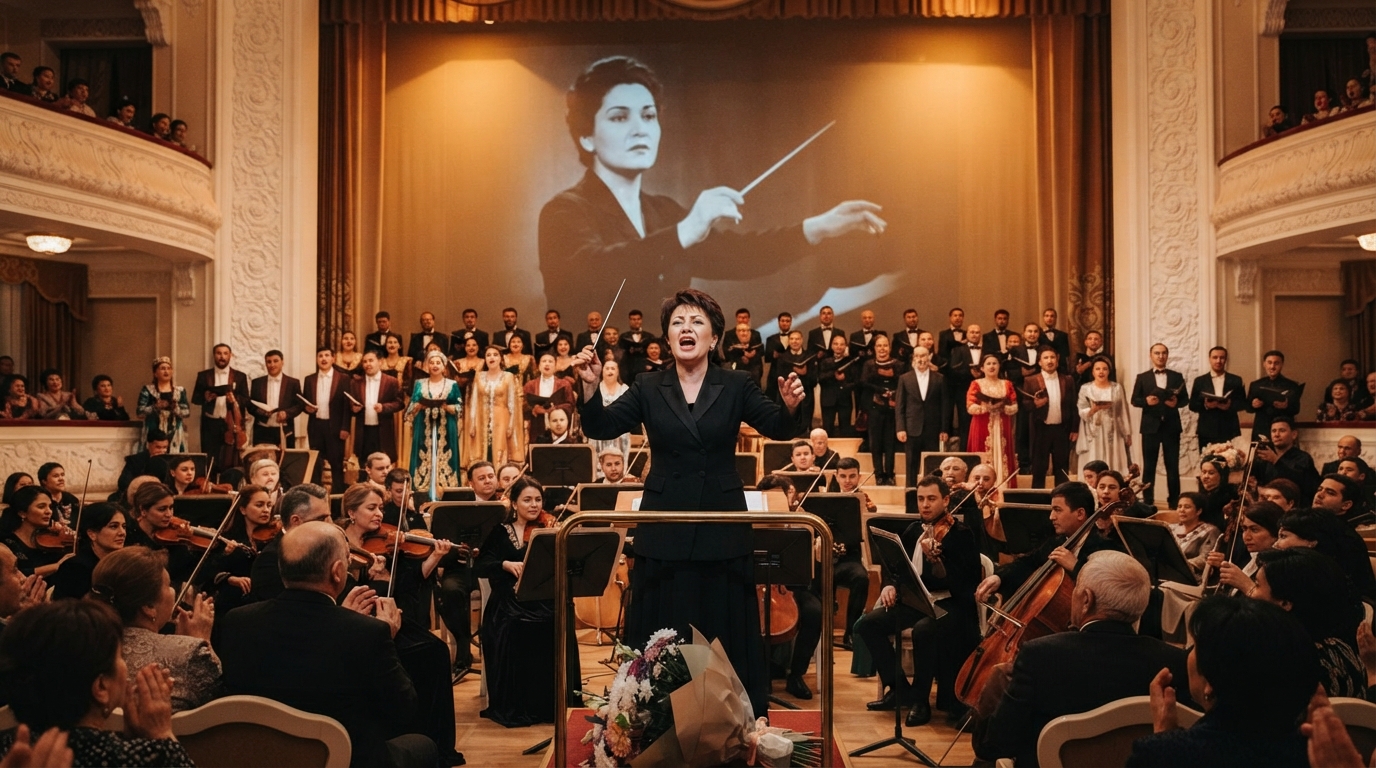
The Alisher Navoi State Academic Bolshoi Theatre is preparing a memorial evening titled "Her Whole Life Was Music," dedicated to the 90th anniversary of the birth of the outstanding Dilbar Abdurakhmanova. On September 19, the country's main stage will commemorate the creative legacy of the People's Artist of the USSR and State Prize laureate, whose name became a symbol of the triumph of the national school of conducting. This evening is not merely a gesture of remembrance, but a living touch of a legend whose musical element still resonates in people's hearts.
At the conductor's podium this evening is a true constellation of masters: Honored Art Worker of Uzbekistan Fazliddin Yakubjanov, People's Artist of Karakalpakstan Aida Abdullaeva, and international competition laureate Bobomurod Khudaykulov. The directorial score of the event was prepared by the Honored Art Worker of Uzbekistan Andrey Slonim, performing in unison with opera and ballet soloists, the symphony orchestra, and the choir of the Alisher Navoi State Academic Bolshoi Theatre. Every note of this evening will echo the unique gift of Maestro Abdurakhmanova, recreated through the prism of time and the audience's love.
She was called the "fiery conductor" — and this was not a figurative comparison, but an accurate definition of her essence. The first female conductor in the East, People's Artist of the USSR Dilbar Abdurakhmanova passed away on March 20, 2018, leaving behind a mark that will never be erased. On May 1 of this year, she would have turned 90. Her name is written in history in golden letters — as a National Treasure of Uzbekistan.
### Serving the Temple of Art
For Dilbar Gulyamovna, the Alisher Navoi State Academic Opera and Ballet Theatre was not just a workplace, but a sacred temple where she served art for nearly 60 years. Rising from a modest trainee conductor to artistic director, she celebrated her last jubilee where her heart belonged — on the stage. The program of that evening, which included opera, ballet, and symphonic music, was the perfect expression of her love for musical theater.
At the age of 38, she became the chief conductor of the illustrious theater and the musical director of 64 opera and ballet productions. Her talent was recognized abroad as well: she conducted the symphony orchestra of the Bolshoi Theatre in Moscow, ensembles in Egypt and Romania, and opened the opera and ballet theater in Malaysia. Behind her were the Orders of "Dustlik" and "Fidokorona Khizmatlari Uchun," the "Shukhrat" medal, and the title "Citizen of the Earth of the 21st Century," awarded by the Greek Philosophical Academy. But knowing Dilbar Gulyamovna, one can say with confidence: all regalia were merely a pleasant background. She wore only one title with pride — Musician.
### A Tandem That Became a Legend
Abdurakhmanova's performing style was distinguished by a rare combination: high spirituality merged with improvisational passion, and refined technique with elegant artistry. This was particularly evident in her creative alliance with the director, People's Artist of Uzbekistan and Azerbaijan Firudin Safarov. This tandem, which created dozens of masterpieces, became a legend. They worked selflessly, giving the audience fresh, vibrant interpretations of classics: "Faust" by C. Gounod, "La Traviata," "Il Trovatore," "Aida," "Otello" by G. Verdi, "Carmen" by G. Bizet, and many others. They did not ignore contemporary works either, staging "Peter the First" by A. Petrov and "The Fiery Angel" by S. Prokofiev, as well as operas by Uzbek composers — "Maysara's Mischiefs" by S. Yudakov and "Omar Khayyam" by M. Bafoev. Their 1984 production of "The Fiery Angel" astounded Evgeny Svetlanov himself, who traveled to Tashkent specifically for one of the premiere performances and called it an event in the cultural life of Uzbekistan's capital.
Firudin Safarov always remembered this period of creativity as the happiest in his life. Alongside him, as if a single organism, Dilbar Abdurakhmanova created. Their duet was not just a working collaboration — it was a genuine fusion of souls united by a passion for music and theater.
### Behind the Scenes of a Great Woman
Behind the scenes of this great woman was an incredibly warm, hospitable home. Dilbar Gulyamovna was an exceptionally welcoming hostess. Just as in music, she created her own unique style in culinary arts, delighting guests with fragrant plov or melt-in-the-mouth manti. She possessed a sharp mind and a subtle sense of humor, and her stories from the world of culture, filled with the minutest details, were priceless. In communication, she valued warmth rather than titles, and many felt it a great fortune simply to be her friend.
### The Path to the Conductor's Podium
A personality of such scale does not emerge from nowhere. Dilbar was born into a family of legends: her father, Gulyam Abdurakhmanov, was a leading soloist of the theater and the only Uzbek artist to win the Stalin Prize, while her mother, Zukhra Fayzieva, returned to the stage only at the age of 60 after raising her children. Music was constantly playing in their home. The girl was taught violin, piano, and foreign languages, instilling diligence and organization. But her main inheritance was a strong will.
Since childhood, she not only listened to music but also performed. The violin ensemble of the Glière School, where young Dilbar played, gave her a natural sense of the stage — she was never afraid of it. The Navoi Theatre became her second home: she knew the score of every performance and dreamed of leading this massive musical organism.
Her path to the conducting profession began unexpectedly. While serving as the concertmaster of the school orchestra, Dilbar picked up the conductor's baton for the first time. Her director, N. Tretyakova, noticed the talented student. Trusting her to run rehearsals while she herself was delayed at the conservatory, she gave Dilbar invaluable experience. Soon, N. Tretyakova suggested she perform at a showcase concert. The famous maestro Ashrafi arrived for this performance, seeing the girl at the conductor's podium for the first time that day. "What do you want to be?" he asked her. "A conductor," Dilbar replied. "And what attracts you to this mysterious profession?" — "I want to make the orchestra sound like a single instrument!" she blurted out. "This played a decisive role in my life," Dilbar Gulyamovna recalled later.
### Legacy and Eternal Memory
Her acquaintance with Mukhtar Ashrafi — a figure whose name is inextricably linked with an entire era in the music of Uzbekistan — became an important milestone in Abdurakhmanova's life. She was admitted to the conservatory, where she decided to master two key specialties at once: the opera and symphony conducting class under the close guidance of M. A. Ashrafi, and the violin class taught by the wonderful musician and student of the famous P. S. Stolyarsky, B. A. Titel. Ashrafi trained a whole galaxy of conductors, but it was this student who became a worthy successor to his work.
Years passed, and the student became equal to the teacher. When Maestro Abdurakhmanova raised her baton, the audience forgot about the existence of other conductors. Her work was so physically perfect that it could be compared to ballet. She possessed an amazing memory and the ability to live inside the performance, controlling every detail of what was happening on stage and in the orchestra.
It is painful and deeply saddening that Dilbar Gulyamovna is gone — one of the caryatids holding up the sky where Music is created. She sincerely believed that her beloved Bolshoi Theatre, which is rightfully proud of its great past, has a great future. And she was immensely happy that her destiny was entirely bound to its history. Already gravely ill, when it was difficult for her to walk, she shared creative plans for future productions and premieres with her characteristic optimism, as if wishing to remain in the profession for as long as possible. Her fire did not fade even in the face of illness.
On March 20, 2018, the melody of her life fell silent forever. Firudin Sattarovich took the loss of his irreplaceable co-creator, loyal friend, and muse very hard. And on July 26, 2024, his own thread of fate was cut. Two titans, two hearts that beat in unison with the rhythm of the Uzbek Opera and Ballet Theatre, left this world. They dedicated their entire lives to the stage, becoming a true guiding light, its conscience, and its tuning fork for this temple of art. Their names are synonymous with devotion to art, and their creative union is a legend that will inspire poetry.
The scale of the phenomenon that was Dilbar Gulyamovna Abdurakhmanova can be conveyed in just two words: National Treasure. She has entered history, where her name is forever written in golden letters. She was one of a kind — there is no other master, no other soul like her in this world, and there never will be. The upcoming jubilee evening will remind us of the greatness of this woman, who left a legacy that lives on in music, in every note, in every breath of the orchestra. Her melody did not end — it dissolved into eternity, becoming a part of immortality.