

Faster, cheaper, and stranger: how artificial intelligence took over Chinese micro-dramas?
Faster, cheaper, and weirder: how artificial intelligence has taken over Chinese micro-dramas
According to the China Netcasting Services Association, nearly 128,000 micro-dramas were produced in China in the first three months of 2026, and approximately 95 percent of them used artificial intelligence generations.
Although the share of such projects fell to 64 percent in the second quarter, the scale is still astonishing. By May, 851 million people had watched micro-dramas, and the market itself was already valued at over 100 billion yuan ($15 billion).
So, this is not just a new trend experiment by a few studios: artificial intelligence has entered one of the fastest-growing sectors of the Chinese entertainment industry, gradually changing the approach to series production. Of course, there are many conveniences for content creators and viewers, but how long can a viewer watch such cinema?
Chinese micro-dramas, also called micro-dramas, and often referred to as ultrashorts in English, originated from the short video culture and are mainly designed for viewing on smartphones. An episode can last just a few minutes, and the whole story is often made up of dozens of very short segments.
The most important thing here is not the timing, but the speed. Since the characters do not have time for a long introduction to the viewer, the conflict arises almost immediately. After a few seconds — a new twist. A little later — a confession, betrayal, a fight, or a cliffhanger. As a result, while brushing your teeth or riding the subway, you easily transition from the thought "I'll watch just one episode" to "okay, five more minutes."
It was this model that once made the industry so successful. Platforms gave producers incentives for scripts, funding, and high-volume production, and companies tried to release as many stories as possible. Some directors literally worked to exhaustion at the height of the market: shooting could last 14-16 hours a day, and a single project had to be completed in a matter of days.
Artificial intelligence works well as a tool not so much in everyday stories where live shooting is easy, but in situations that come down to budget.
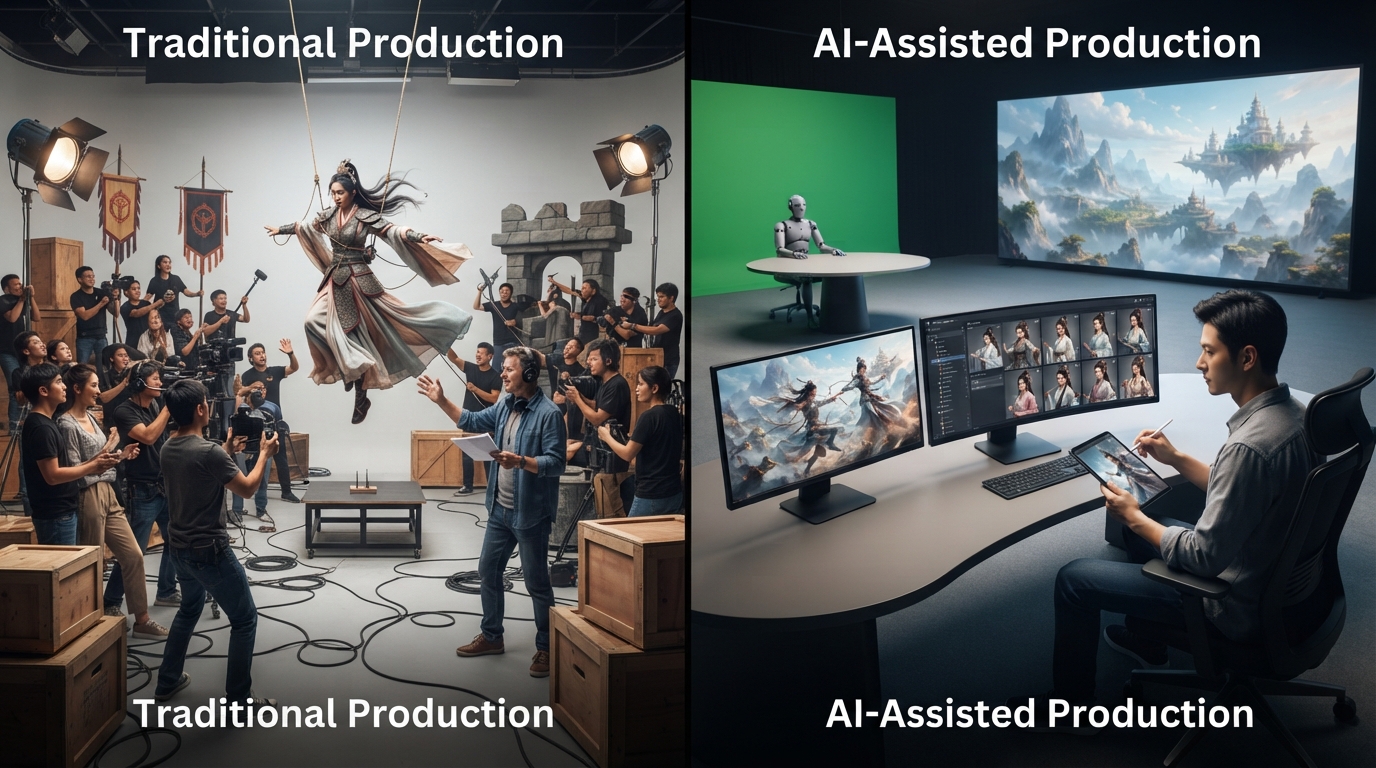
Imagine a character falling from the sky, flying through the clouds, and landing somewhere else. In a traditional micro-drama, such a shot would require ropes, stunt specialists, preparation of the set, and a lot of time to shoot... Now, it is enough for the actor to lie on a round table in front of a small green screen. Artificial intelligence adds everything else — the sky, the flight, the camera movement, the surrounding landscape. Creating the entire shot takes less than half an hour and saves money.
It is not surprising that artificial intelligence is used especially actively in fantasy and sci-fi. Here you can do large-scale battles, flights, magic, parallel worlds, and in general, everything that would be too expensive for a three-minute episode in a real set.
However, the main problem with generated videos is that AI can create a beautiful shot, but it cannot always give "exactly that" required shot. The character's clothes change, the sofa suddenly turns from a double to a single, the skin looks too smooth, objects in the room change their place between scenes, and the camera or character movement has to be redone several times — in short, rewriting the script over and over again tires anyone out.
In one of the studios, employees can generate a single shot three to five times in a row, and during peak times, they have to wait 10-20 minutes for the next attempt. Within the industry, such a process is jokingly called "drawing a card": you run the generation again and hope that this time the model will give a successful option. Sometimes it really does, and sometimes you have to start from scratch.
Thus, human labor does not disappear — it simply takes another form. Now the director does not have to spend hours explaining to the cameraman and artist what the scene should look like. Instead, he constantly has to decide which of the ten, twenty, or a hundred options to keep. He also has to monitor that the characters do not change from shot to shot, that emotions develop moderately, and that the finale really forces the viewer to open the next episode.
Undoubtedly, artificial intelligence is capable of creating images and videos in a matter of seconds. But deciding exactly which shot will make it into the final version and fit all the parameters of the idea still remains the responsibility of the human.
New technologies threaten to eliminate the jobs of many employees — this is the most pressing problem in the industry. Before the popularization of AI, shooting a single micro-drama required dozens of staff: actors, directors, cameramen, artists, makeup artists, stuntmen, and visual effects specialists. Now, some of these roles are inevitably being cut.
In Zhengzhou, one of the main hubs of Chinese micro-dramas, companies have already begun to reduce live shooting processes. For example, at the "Zhoutu Culture" studio, the volume of project production fell from about 200 micro-dramas per month to 30, and the number of employees was reduced from more than 500 people to about 200. Part of the premises was taken over by a private AI studio.
For actors, the situation is even more complicated, because artificial intelligence helps to save not only on sets, but also on the main characters of unbelievable stories.
Some directors switched to AI almost immediately, while others rejected such unusual art. Director Li Jun, for example, explained his refusal by the fact that traditional micro-drama still depends on the director: you have to work with actors, lighting, camera, and unexpected situations on the set: "The feeling obtained from the work done is completely different." In his opinion, too much in AI production comes down to simply writing a good prompt and then choosing the result.
A strange paradox is emerging: technology eases production, but some are beginning to ask whether it is making the creation process itself and the final result less interesting and less valuable.
Currently, Chinese studios are not experimenting only with short series. The same technologies are also used to create commercials, promo videos, visual effects, and scenes where real actors or cars are not needed at all. Meanwhile, Qidian Interactive is parallelly developing its own full-length AI film.
In fact, micro-dramas became a convenient testing ground for early experiments. They are short, quickly produced, get immediate reaction from the audience, and do not require creators to wait years to understand if the story worked.
The industry is gradually testing a new model in which part of the traditional professions turns into working with scripts, and the director, screenwriter, and artist simultaneously become editors of a huge stream of generated options.
It is not out of the question that AI will one day learn to create a ten- or even 90-minute video from a single phrase — experts in the Chinese film industry are already seriously discussing such a prospect.
That is why Chinese AI micro-dramas are interesting now not just as a new series format. In fact, this is a small rehearsal of what film production in general might look like in the future, with endless generation, very fast testing of ideas, and an increasingly shrinking distance between "conceiving" and "creating." But whether the result of this will be more interesting and better — even artificial intelligence cannot answer this question yet.