

Faisal Islam: What I learned from a week with the world's top finance leaders
At the IMF meeting in Bangkok this week finance and business leaders grappled with uncertainty.
Faisal Islam: What I learned from a week with the world's top finance leaders
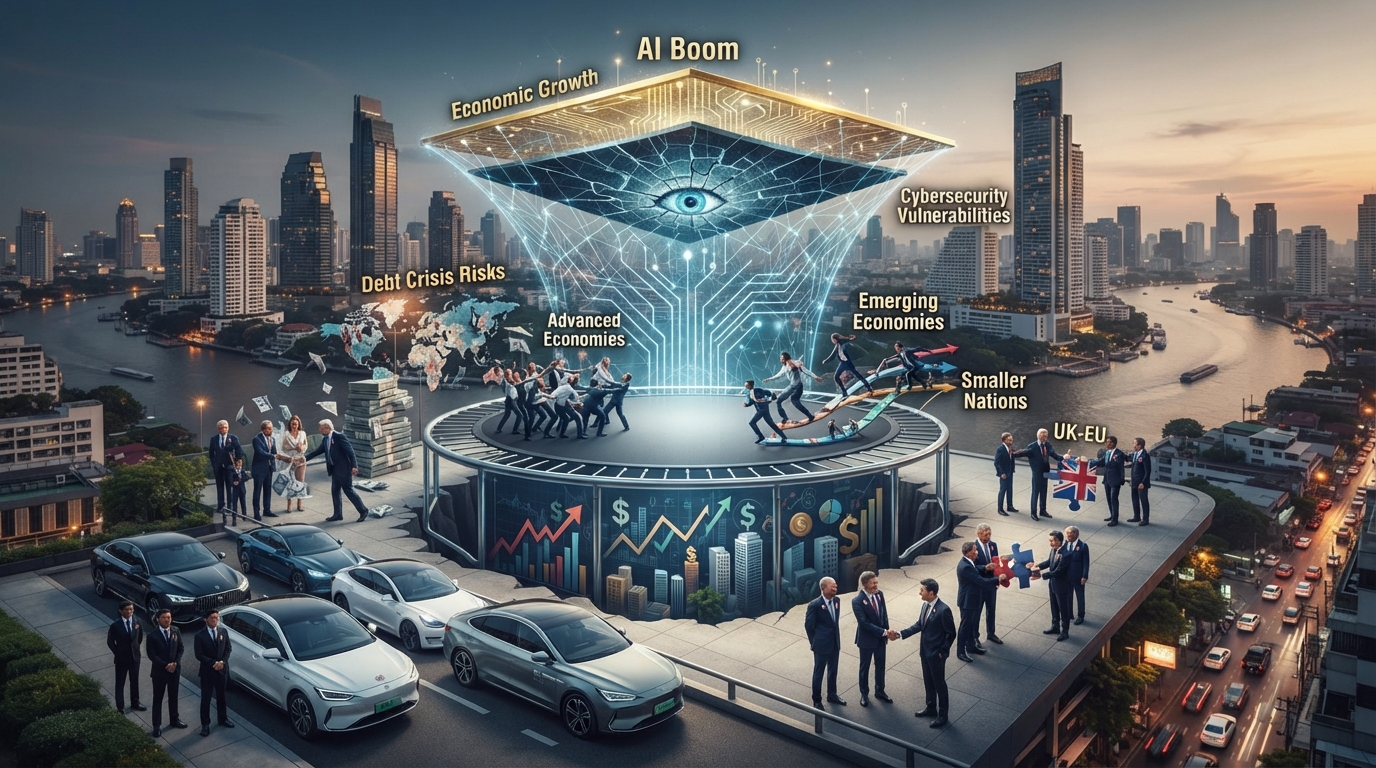
There is currently a kind of tug of war over where the global economy is headed next.
Powerful forces are pulling in opposite directions. On one side, growth is being held back by the familiar, recurring shocks of the energy crisis, trade disputes and real war. The clearest sign of this is the steep rise in interest rate costs for the world’s advanced economies.
On the other side, there is support from huge spending on AI, along with the frankly remarkable resilience shown especially by smaller economies, which have had to create new trade routes, including for oil and gas, out of necessity.
These same themes kept resurfacing at the IMF meetings in Bangkok this week, including among the most senior figures present. Yet even they do not know which way events will move.
For now, it is anyone’s guess where bond markets will turn their attention next. At the moment, they appear to be focusing on the US and France.
French finance minister Roland Lescure, however, has been insisting that he has had no trouble selling debt, even if it has become more costly, and that his Budget will be fine. He also implied that he had helped rescue the G7 group of advanced nations, which a year ago was in danger of falling apart amid tensions inspired by Donald Trump.
In some respects, it is remarkable that there has not been a global recession, or a debt crisis in a major emerging economy. The Thai finance minister, in fact, was telling me how little his borrowing costs had risen, especially compared with the US.
Another surprise is that the UK has been taken off the bond markets’ naughty step and instead named a model pupil by the IMF. The IMF has accepted the government’s Budget plans at face value and on trust. The reality is that the rest of the G7 does not even have that. And beauty is relative, especially when borrowing is involved.
That moment also gave Chancellor John Healey the chance to be heard, as he pointed out that the UK’s actual growth data has continued to beat expectations and can now, so far in 2026, be described as strong. Healey told me he saw the figures as the first sign that AI and tech investment were beginning to lift UK economic growth. The bond financiers gathered around the IMF meetings seem to be taking another look at the UK after years of crisis.
But there is a third major challenge to deal with, alongside geopolitical instability and uncertainty in bond markets, and it is visible even on the streets of Bangkok, where chauffeurs dropped off bankers and finance ministers for this week’s gathering.
Like other countries, Thailand has seen first-hand the astonishing surge in sales of Chinese electric vehicles. Thailand is sometimes called the “Detroit of Asia” because of its own strong car-making tradition. Now nearly a third of all car sales are Chinese EVs.
This is the clearest example of what is known as China Shock Two: the sheer speed of China’s dominance in advanced manufacturing. The first China shock came in the 2000s in basic manufacturing.
This second wave of dramatic change has, over just the past few months, forced a reassessment of how world trade is working and how it will be managed. That is especially true in the EU, which is scrambling to rethink what now feels like a one-way street in China-Europe trade.
The extra “Made in Europe” protections the bloc is preparing will also have a major effect on the UK. If the UK stays outside the new rules, China could redirect its surplus car production to Britain, where, like Thailand, tariffs are currently lower and there are even subsidies. Or the EU could bring Britain in, but require it to follow suit by raising tariffs to match its own.
There is also the side story of the UK’s relationship with the European Union. This was a theme that came through more strongly than expected in Bangkok this week and even seemed to provide some amusement. IMF managing director Kristalina Georgieva laughed, saying the Brexit “divorcees are now dating again”. The Finnish finance minister told me the UK was “flirting” with the EU. Major banks were publishing reports about the prospect of “Breturn”.
Still, it is the AI boom that is being counted on to provide the trampoline needed to lift the world economy out of its current period of multiple simultaneous crises, many of them tied to President Trump’s decisions.
Even that, though, is not straightforward. In one room, finance ministers praise AI’s transformative economic impact. In the next, central bankers worry about its ability to break the cybersecurity of most of the banking system. The financial boom around it cannot last. The masters of the financial universe are simply grateful that, so far, it has.