

Faisal Islam: The two big calls the chancellor has to make ahead of the Budget
He must consider the longevity of Iran war economic pressures and how to sustain modest optimism, writes the BBC's Faisal Islam.
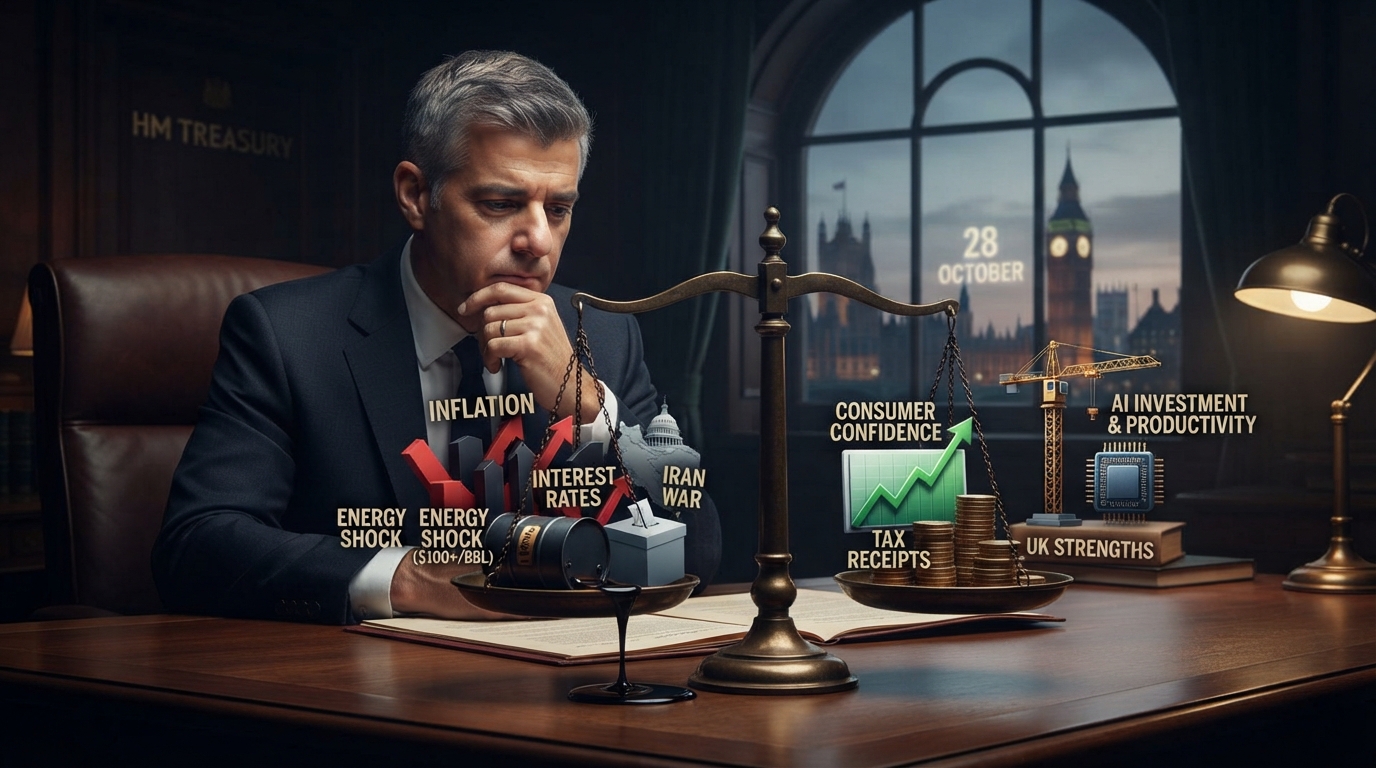
Faisal Islam: The two major decisions the chancellor must weigh before the Budget
“It is tough,” John Healey told me earlier this month when I asked whether there had been too much doom-mongering.
“Conflicts, uncertainty, driving up inflation, driving up interest rates. But we’ve got great strengths. We’ve got good reasons to be confident about the future of Britain,” he said.
The new plan unveiled on Saturday to help young people get onto the property ladder was designed to lift confidence in the economy.
But the chancellor now faces two major choices before his first Budget on 28 October.
First, he must judge how long the economic strain caused by the Iran War will last. Second, he must decide how to preserve a modest but noticeable improvement in economic sentiment amid further global upheaval.
In his first weeks as chancellor, oil fell to as low as $75 a barrel, while the yield — the effective interest rate — on 10-year government bonds stood at 4.9%.
A little over two months on, oil has mostly traded above $100 and the 10-year yield is around 5.4%. For a chancellor preparing his first Budget, it is the ultimate double blow.
Yet this energy shock has something unusual about it. It could reverse quickly, as was shown earlier this summer when expectations of a de-escalation in the US-Iran conflict triggered sharp drops in energy prices and yields.
In New York this week, both President Trump and his Iranian counterpart President Pezeshkian suggested that November’s US midterm elections were linked to when the war might end.
The US president told the UN General Assembly that the Iranians would wait until after the elections to seek peace because the war’s effect on the cost of living — especially surging diesel prices — could hurt him electorally.
The Iranian president said his country “didn’t want it to get to the midterms”.
Both sides in the war are feeling the economic pressure of the conflict.
The 3 November vote comes six days after the Budget. No one can count on a settlement by then, but it is possible.
So the Budget’s tax, spending and borrowing forecasts could be based on a prolonged conflict that is actually close to ending, or may already have ended.
The chancellor must therefore decide whether to plan for the worst and make some painful permanent tax and spending choices, or to buy time.
One option is to let borrowing absorb some of the pressure by accepting a reduction in the £24bn of headroom — the room for manoeuvre against the self-imposed borrowing rules — left by his predecessor, Rachel Reeves.
This year’s headroom will be assessed over three years rather than four, so there is some logic to a smaller figure against a nearer target.
And while higher inflation raises interest costs, it also boosts cash tax receipts, at a time when thresholds remain frozen.
There is a second factor. The hopeful optimism “vibes” strategy of the Burnham administration appears to have had some effect.
The UK’s longest-running consumer confidence survey has reached a two-year high. Among younger people, it has not been this high since before Brexit.
Some data firms call it a “Burnham bounce”, although the weather and the World Cup were also influences.
There is also more mixed evidence that business optimism has improved in recent months, possibly because of earlier falls in energy prices, though this has been clouded by expectations of possible tax rises. The business group the Institute of Directors said this was despite, rather than because of, the new government.
While no one should get too carried away with these shifts, they do contrast with the Starmer government’s admitted mistake in talking up consumer pain two years ago.
The question for the chancellor is whether stronger consumer and business sentiment can be squared with the need for a “challenging” Budget.
It is also important to work out how much of the summer global bond market shock is due solely to the Iran war and how much is more structural.
Governments are now facing fresh and intense competition in bond markets from the world’s biggest AI companies. On top of that, the UK has recently had prominent political and economic uncertainty.
At the moment, bond markets are like a pack of wolves stalking red deer, testing for weakness.
“At times like this you don’t want to be at the back of the herd,” said one very senior former Treasury adviser.
In reply, the Treasury has pointed to the UK having the highest growth and the fastest falling borrowing of the major G7 countries so far this year, and to overall energy prices beginning to decouple from high and volatile gas prices.
However, IMF chief Kristalina Georgieva this week rejected the idea that advanced economies could put their fiscal homework on hold while the Gulf situation calmed.
“Bring debt levels down, make fiscal consolidation as a priority… it is impossible to stress strongly enough how critical it is to get the courage to take the steps that are necessary,” Georgieva told me, while acknowledging the UK’s “fairly consistent, credible” plans.
Then there is the curious puzzle of British productivity. Last year, the government’s official forecaster, the Office for Budget Responsibility (OBR), downgraded the UK’s productivity performance, causing a notable hit to the public finances.
Now the UK’s productivity record has been materially upgraded by the Office for National Statistics, although this is because fewer hours were worked. That could create an argument for reversing some of the downgrade.
Separately, the new OBR chair Jonathan Haskel is known for arguing that official statistics understate investment in intangibles such as software and data. His latest research suggests AI-related investment is already visible in US productivity figures, and he has long been optimistic about technology’s effect on the future.
Although it seems unlikely that such factors will be included in the OBR’s calculations next month, there is a genuine debate here.
Officially, though, part of the Budget task is to identify cuts to pay for the Defence Investment Plan, inherited from Sir Keir. That comes before funding the extra move to 3% of GDP and a new social care system.
Even a promise of lower welfare spending appears to be built on an upfront investment in jobs for young people.
One difference from last year is that, so far, the government has kept the “pitch-rolling” under wraps with a silence that would rival the Trappist monks.
Instead, policy announcements are being timed strategically, such as the “Your First Home” scheme just as the Labour party conference began. We can expect to hear much more as the Budget approaches.