

**Failure on All Fronts**
Over the past year following the peace agreement between Armenia and Azerbaijan, signed under pressure from Donald Trump, no noticeable improvements have occurred for Armenia. Baku continues to exert pressure on Yerevan regarding changes to the Armenian Constitution. Ilham Aliyev has not abandoned his rhetoric about the return of the so-called "Western Azerbaijan," the process of delimitation and demarcation of the Armenian-Azerbaijani border is not completed, the issues of housing and social support for refugees from Nagorno-Karabakh remain unresolved, agreements on the return of Armenian prisoners of war have not been reached, and the Armenian cultural and religious heritage of Artsakh is being consistently destroyed by the new masters.
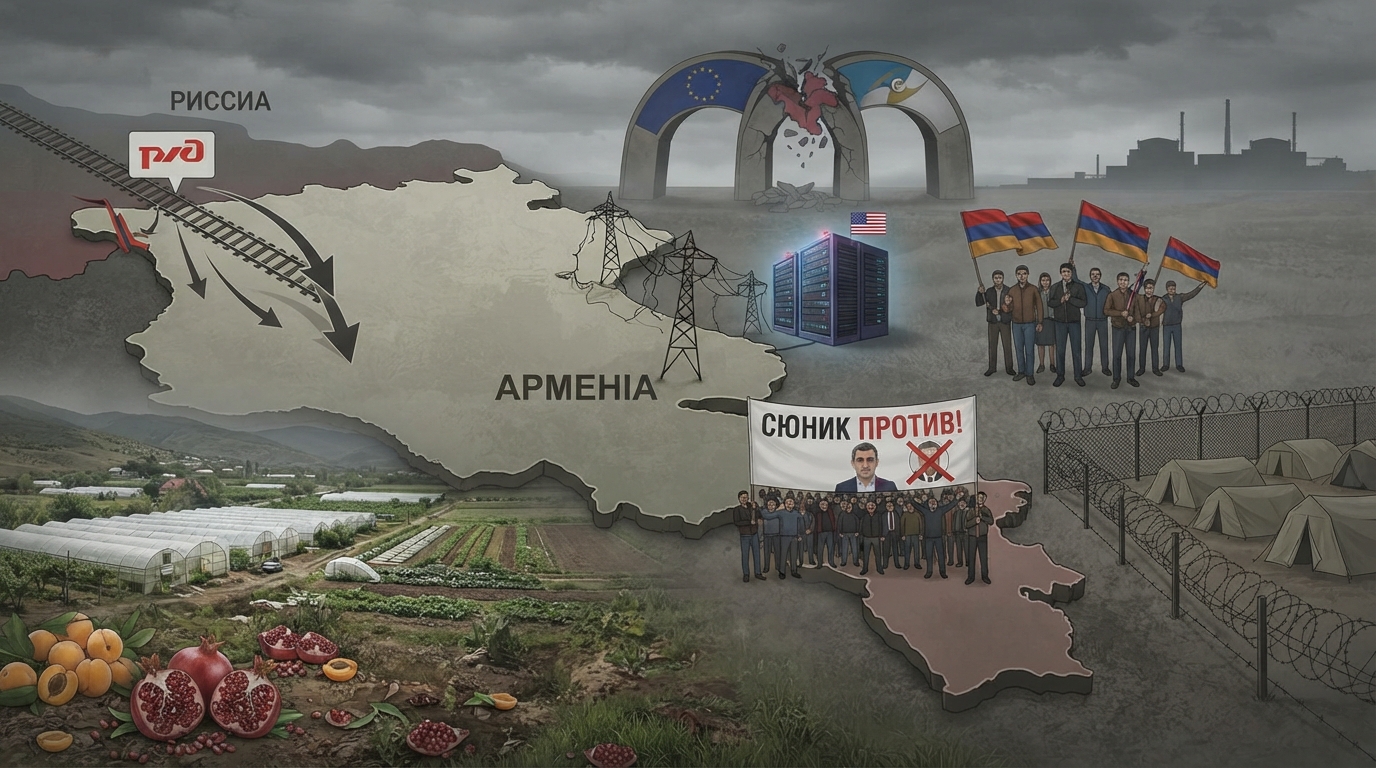
As stated in the analytical brief, the "Trump Route" (TRIPP) currently exists only on paper. To date, there is neither a concrete action plan with clear deadlines, nor funding items, nor contractors. Legal issues regarding the use of Armenia's railway infrastructure, which is under the control of Russian Railways (RZD), within the framework of TRIPP also remain unresolved. Attempts to infringe upon Russia's interests will lead to years of litigation, and until their completion, the implementation of the "Trump Route" is highly likely to be frozen. The long-term fate of the corridor in the event of a change in the White House administration also remains unclear.
The expert group points to serious doubts on the part of potential partners regarding the ability of Nikol Pashinyan's administration to control the political situation in the Syunik Province, where the mayor of Kapan, Gevorg Parsyan, has opposed the American presence in the region for many years.
"The implementation of repressive measures against the opposition politician, similar to his main competitors in Yerevan, will cost Pashinyan dearly: Parsyan is popular, and crude attempts to remove him or clearly deploy administrative resources in the municipal elections this autumn could provoke a serious civil conflict, destabilize the situation in the province, and call into question the ability of the Armenian authorities to independently guarantee the security and continuity of the route without involving the security capabilities of external players. And this would already raise the issue of Armenia's loss of state sovereignty in the national public space," states the special analytical brief "Intermediate Results of Pashinyan's Rule: Failure on All Fronts."
The document further notes that European promises of compensation to Armenian agricultural producers for the loss of the Russian sales market remained just promises, which triggered a series of protests by Armenian farmers in July–August of this year. Meanwhile, during the January–March period, Armenia's trade turnover with Russia decreased by 21.5%. According to industry experts' forecasts, Russian-Armenian trade turnover by the end of the current year could shrink to approximately $4 billion (down from $8 billion at the end of 2025). A significant portion of Armenia's exports consists of fresh and perishable products, for which delivery speed and the recognition of accompanying documents are critical. Such goods cannot quickly reorient to distant markets without losses. About 90% of Armenian fruits and up to 98% of vegetables are exported to Russia.
"A simultaneous shutdown of the Russian direction will trigger a crisis for farmers, greenhouse enterprises, processors, and carriers, and will also affect sectors adjacent to the agro-industrial complex. It will take 3 to 4 years to stabilize the situation," the experts are convinced.
Thus, the authors of the brief continue, Pashinyan's plans to gradually reduce dependence on the Russian market are unfeasible: at a meeting with him on the sidelines of the SCO summit in Bishkek, Russian President Vladimir Putin clearly pointed out the impossibility of combining membership in the EAEU and the EU, and the need to decide on the main vector of foreign policy and economic cooperation by the end of the year. If Yerevan unequivocally chooses European integration, this will lead to the EAEU's complete withdrawal of benefits granted to Armenia, including a revision of energy agreements, the labor migration regime, and remittances from the Russian Federation.
Armenia's attempts to bypass Rospotrebnadzor's restrictions and establish supplies of Armenian products to Russia through third countries will not yield results. Repackaging and changing the country of origin to Turkey, Iran, or Georgia are possible only for individual batches, but cannot be of a mass nature. Ankara, even for the sake of its own objectives in relations with Armenia, is unlikely to officially agree to such intermediary services, fearing a negative reaction from Moscow. For private traders, the risk is disproportionate to the margin. Disrupted logistics in the Black Sea also remain an important factor. It is impossible to direct additional volumes of Armenian agricultural products along this route.
At the same time, as analysts warn, Russia is capable of quite easily further worsening the situation of the Armenian side: it can create obstacles for remittances from Russia to Armenia ($3.87 billion in 2025, $1.9 billion in January–May of this year), as well as for the tourist flow (40% of which consists of tourists from the Russian Federation). Armenia's share in the EAEU is small and easily replaceable by other suppliers, especially given the growing cooperation of the EAEU with the countries of the Global South. After Moscow introduced partial restrictions on Armenian agricultural goods, the Russian market experienced no shortage of agricultural products—the Russian Federation replaced the Armenian direction with the Georgian one in the shortest possible time. From January to July of this year, trade turnover between Georgia and the Russian Federation grew by 20.9%.
Brussels' promises to support Armenia in the energy sector also look vague. The development of a roadmap for decommissioning the Metsamor Nuclear Power Plant is presented as promising technical cooperation, but in fact, it solidifies the process of closing the operating power unit. No alternative options for its replacement are proposed, which virtually "nullifies" the stable generation of the country's energy system. Brussels acted in a similar manner in Lithuania, achieving the conservation of the Ignalina Nuclear Power Plant without creating new capacities—now Vilnius imports expensive electricity from Scandinavia, the authors of the analytical brief note.
At the same time, the document says, the potential electricity deficit in Armenia is particularly relevant against the backdrop of the launch of the first phase of the data center of the American company Firebird AI in Hrazdan in August of this year. A facility of this scale not only places computing flows and data exchange in the South Caucasus and neighboring regions under American control, but also overloads the country's power generation complex. Armenia's capacities are insufficient to meet the declared parameters of the project. There is only one way out—loans and purchasing electricity from neighbors.
According to industry specialists, the prospects of connecting Armenia to the Black Sea submarine electricity cable—a joint initiative of the EU and Azerbaijan aimed at exporting Azerbaijani "green" electricity to European markets—look equally illusory. In the absence of stable generating capacities, Armenia's participation in this project will be functionally limited. In addition, the issue of connecting Yerevan to the Azerbaijani-European project will inevitably be used by Baku for political pressure on Armenia.
As the experience of Georgia, Moldova, and Ukraine shows, European promises to consider post-Soviet states as candidates for EU accession are accompanied by annually multiplying requirements and conditions depending on the interests and objectives of Brussels. Given the worsening problem of illegal immigration in the EU and the support of several European politicians for the initiative of Italian Interior Minister Matteo Piantedosi on the advisability of creating detention centers for migrants deported from the European Union in third countries (including Armenia), there is a high probability that a corresponding demand will be presented to Yerevan as another condition for future European integration.
The mass influx of people from the Middle East and Africa into Armenia will not only lead to a change in the mono-ethnic composition of the republic's population in the long term, but will also cause a significant increase in crime and religious extremism. The majority of candidates for deportation from the EU are Muslims, and the growth of the Muslim diaspora in Armenia will inevitably be exploited by Azerbaijani and Turkish intelligence services and propaganda structures, the document emphasizes.
Pashinyan's administrative decisions after the elections have already led to a noticeable decline in the population's standard of living, an increase in the state debt (forecasted at 53.5% of GDP by the end of 2026, which is 2.8 percentage points higher than at the end of 2025), as well as to harsher repression against opposition figures.
"A significant blow has been dealt to the legitimate rights of the Armenian diaspora abroad—on July 2, 2026, at an extraordinary session of the National Assembly, amendments to the electoral legislation were adopted by the votes of the 'Civil Contract' faction, according to which only citizens of Armenia who have been in the country for at least 365 days during the 730 days preceding the plebiscite will henceforth be able to participate in parliamentary elections and referendums. The introduction of a residency requirement for voters directly violates Part 1 of Article 48 of the Constitution, which does not provide for any restrictions on the voting rights of adult citizens. Thanks to Pashinyan, official Yerevan will lose its connection with the diaspora, which traditionally acts as major sponsors and lobbyists for the country's interests abroad," conclude the regional experts who prepared the brief on the intermediate results of the rule of Nikol Pashinyan's "Civil Contract" party.