

Experts from 18 countries discussed applied research based on the unique MBIR research reactor under construction in Russia
On September 29, 2026, the 3rd meeting of the Advisory Board of the International Research Center based on the Multipurpose Fast Research Reactor MBIR (IRC MBIR) took place at the Institute of Nuclear Physics of the Academy of Sciences of the Republic of Uzbekistan (INP AS RUz). The event brought together more than 150 participants from 72 organizations in 18 countries. Opening the meeting, the Chairman of the Advisory Board of the IRC MBIR, Vice-President of the Russian Academy of Sciences […]
Experts from 18 countries discussed applied research based on the unique MBIR research reactor under construction in Russia
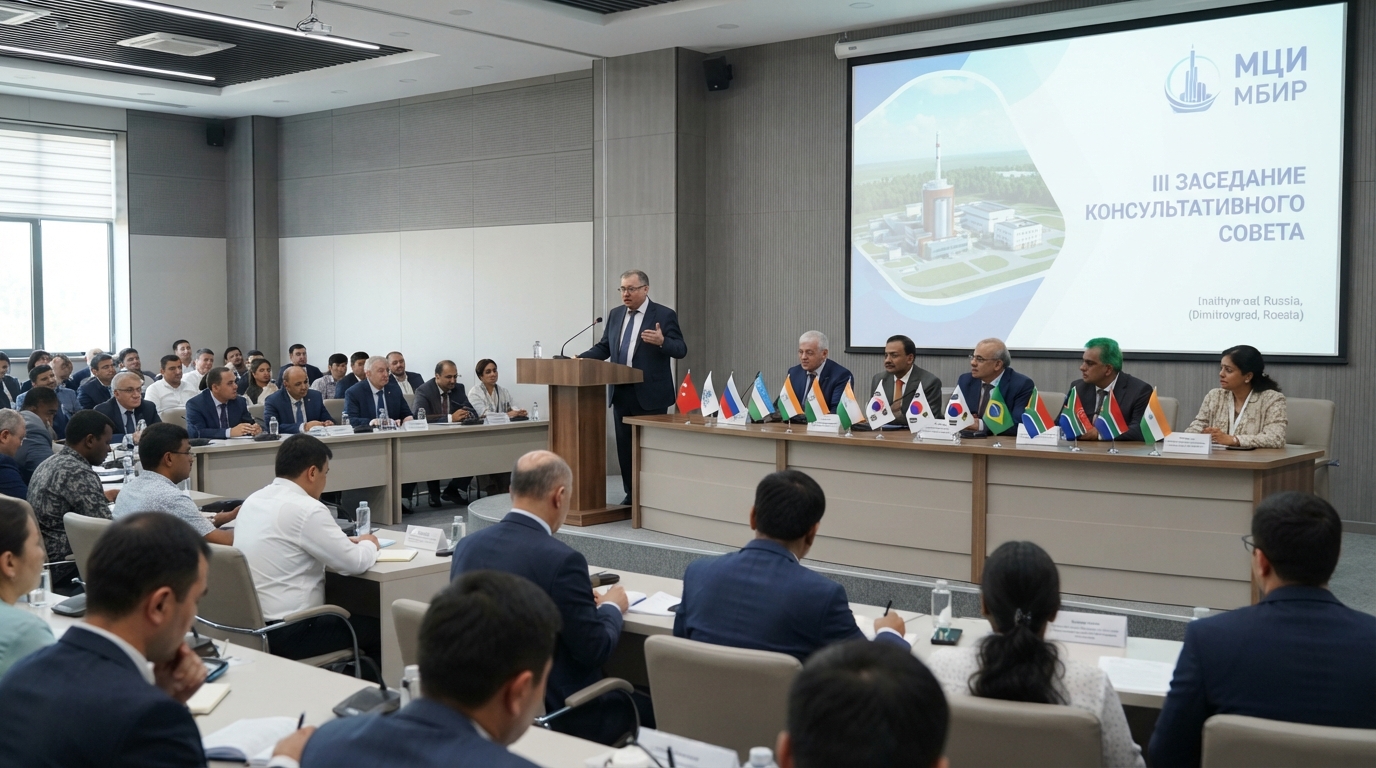
On September 29, 2026, the Institute of Nuclear Physics of the Academy of Sciences of the Republic of Uzbekistan (INP AS RUz) hosted the III meeting of the Advisory Board of the International Research Center based on the Multipurpose Fast Research Reactor MBIR (IRC MBIR). The event was attended by more than 150 people from 72 organizations representing 18 countries.
Opening the meeting, Stepan Kalmykov, Chairman of the IRC MBIR Advisory Board and Vice-President of the Russian Academy of Sciences (RAS), noted the significance of the MBIR research facility as an element of the megascience landscape and international cooperation in nuclear research, as well as the importance of the IRC MBIR scientific program for closing the nuclear fuel cycle (NFC), reducing radioactive waste (RAW), and expanding the resource base of nuclear energy.
"Nuclear science and nuclear energy have always been drivers of development in many other fields, and today's broad geography of meeting participants — from Korea and India to the CIS, Brazil, and African countries — is direct proof of this. The event brought together leaders and experts from major scientific centers, industrial corporations, academic structures, relevant regulators, and financial institutions, as well as representatives of international organizations and leading universities," noted Stepan Kalmykov.
Evgeny Abakumov, Deputy Director General for Science and Strategy, participated in the meeting. He emphasized the deep involvement of Rosatom State Corporation's management in the project's implementation and its integration into the global scientific agenda: "Holding the Advisory Board meeting in Tashkent is confirmation that the MBIR project is of genuine interest to the international scientific community. The IRC MBIR Consortium has outgrown the framework of a local project and has become a global center of attraction for advanced nuclear thought. Leading research centers and corporations are aligning with the capabilities of our reactor base. This indicates that we are creating a highly demanded, fundamental tool. It is precisely within the framework of multilateral expert dialogue that scientific, technological standards and strategic vectors for the development of global nuclear energy for decades to come are formed."
Speaking at the opening of the meeting, Shavkat Ayupov, President of the Academy of Sciences of the Republic of Uzbekistan, noted the growing interest of relevant organizations in cooperation based on the IRC MBIR and the significant impetus that work at the reactor will give to the development of global nuclear energy.
The address of Mikhail Kovalchuk, President of the National Research Centre "Kurchatov Institute", to the meeting participants was read by Alexander Blagov, Vice-President of the center. In his message, Mikhail Kovalchuk emphasized the role of megascience infrastructure in ensuring technological sovereignty and national security. He noted that the MBIR reactor under construction and the operating PIK reactor are two facilities that cover the entire spectrum of neutron fluxes and should become a space for breakthrough technologies and international cooperation. The formation of a unified scientific program for megascience-class facilities is of key importance. Mikhail Kovalchuk particularly highlighted the significance of integrating partners from CIS countries into this process.
Welcoming the meeting participants, Ilham Sadykov, Director of the INP AS RUz and Academician, noted the importance of synergy between unique research facilities: "Today's meeting clearly demonstrates that modern nuclear physics and reactor technologies have no borders. Integrating the capabilities of the MBIR reactor under construction with the existing infrastructure of the INP, including our modernized WWR-SM research reactor and accelerator complex, opens up fundamentally new horizons for applied science in the macro-region. We see huge potential in joint materials science experiments, verification of calculation codes, and radioisotope production. I am confident that combining our unique competencies and experimental bases will become a reliable foundation for ensuring nuclear safety and the sustainable development of peaceful atom."
The meeting agenda focused on applied engineering tasks and the synergy of research programs. The event participants discussed the development of research infrastructure, research methodologies, and tasks for the development of nuclear energy technologies. The experts also discussed strategies for the development of national programs and personnel training.
Vasily Konstantinov, Director General of LLC "Leader of Consortium "IRC MBIR", presented the key directions for expanding the platform and outlined the technological prospects of the project: "Currently, the membership of the International Research Center continues to expand by attracting new Russian and foreign partners. Within the framework of the long-term research program of the IRC, a promising direction is also the development of a low-power energy unit project based on MBIR solutions. Given that a significant portion of the generated heat will be directed to electricity generation, and the design capacity will be about 50 MW, MBIR can serve as a prototype for a future energy platform and a demonstrator of technological solutions. In addition, the development and application of artificial intelligence tools at all stages of creating new solutions — from task formulation to practical implementation of results — is of practical interest."
MBIR is a multipurpose sodium-cooled fast neutron research reactor with a thermal capacity of 150 MW. The reactor is being built in Dimitrovgrad, at the site of JSC "State Scientific Center – Research Institute of Atomic Reactors" (JSC "SSC RIAR", part of the Scientific Division of Rosatom State Corporation) within the framework of the national technological leadership project "New Nuclear and Energy Technologies". Currently, work is underway to install the reactor's primary circuit equipment: in 2025, cold trap-filters of the emergency heat removal system circuit were installed in their design position. As part of the primary circuit installation, the welding of hot pipeline adapters to the reactor vessel and the first pipeline blocks was carried out, the installation of main technological equipment in the sodium storage building was completed, and the refueling mechanism and steam-water washing sockets for spent fuel assemblies (SFAs) were delivered. In 2026, two emergency heat exchangers weighing 7.3 tons, 5 meters high, and 1.5 meters in diameter were installed in their design position.
MBIR is designed for conducting experimental work, producing radioisotopes, manufacturing modified materials, as well as testing new types of equipment and technological systems. It is expected that the unique capabilities of the new reactor will accelerate the development of two-component nuclear power technologies and the closure of the nuclear fuel cycle, as well as the creation of safe fourth-generation nuclear power plants.
The International Research Center (IRC) was established on the basis of the MBIR reactor in the form of an international consortium. Its participants will have the opportunity to conduct experiments necessary for national programs on the peaceful use of nuclear energy on a priority basis. The consortium format allows for the flexible use of reactor resources to meet the needs of the scientific community. The "IRC MBIR" Consortium is open to new members.