

Ex-student says embattled Cornell University head doubted her gang-rape allegation
As a no-confidence vote looms, Cornell says the characterisation of the head's reaction is "incorrect".
Former student says troubled Cornell University president doubted her gang-rape claim
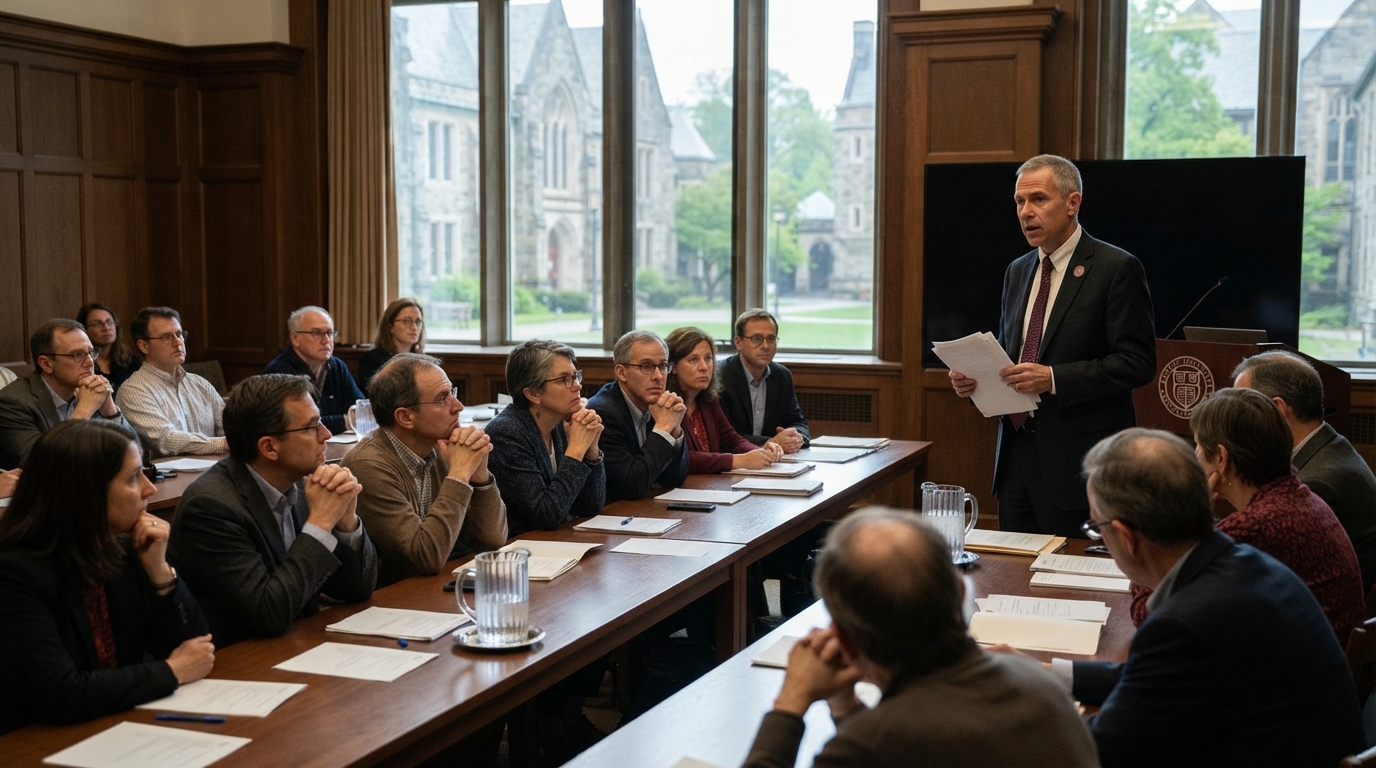
Cornell faculty discussed the university’s response to sexual assault cases at a faculty senate meeting on Wednesday.
A former Cornell student who says she was gang-raped at a fraternity house has said she felt "unsupported and disbelieved" by the university president.
Identified only as Jane Doe, she wrote a letter accusing President Michael Kotlikoff of asking why she had waited several weeks to report the incident.
The college in upstate New York says her description of the Cornell leader’s reaction is "incorrect".
She sent the letter to campus faculty, who are due to hold a rare vote this month on Kotlikoff’s leadership. Doe filed her lawsuit last month, alleging she was raped by several men in October 2024 at a Chi Phi fraternity party.
All seven former fraternity members accused by Doe have denied wrongdoing when contacted by the BBC’s US partner CBS. None has been charged with a crime.
Doe reported the alleged assault to campus police, and the local prosecutor declined to file charges at the time, though the case has since been reopened.
In response to Doe’s original allegation, Cornell said it had launched an internal investigation and a civil rights inquiry under Title IX, the law that bars sex discrimination on campuses receiving federal funding.
In a two-page letter dated 14 October and obtained by the BBC, Doe told the faculty senate that after she reported the alleged rape, she received "a second-hand account" of Kotlikoff’s reaction and that his "initial response" was "along the lines of, 'Why did she wait so long to report it?'"
Doe reported the alleged assault to campus police on 8 November, about three weeks after the fraternity party.
She said Kotlikoff had spoken with the then-president of her sorority and that other staff members were present, including at least one who "appeared distressed" when hearing the college president’s question.
In her letter, Doe wrote: "It diminished my confidence in the administration's ability to approach my experience with the understanding, sensitivity, and fairness I had hoped for and expected from what had been my dream school."
She said she wrote to ensure faculty "can make an informed choice" before their 28 October vote on whether to express no confidence in Kotlikoff’s leadership.
"I would not want to withhold something potentially pertinent, only for Senate members to later discover that information relevant to their deliberations had not been made available to them," she said.
A university spokesperson confirmed receiving the letter from Doe’s lawyer.
But in a statement to the BBC, a spokesperson for the New York University said: "The second-hand account of the question asked by President Kotlikoff in a January 2025 meeting in the letter is incorrect, based on a documented first-hand account."
The spokesperson said Kotlikoff’s question about the delay in reporting the alleged rape "was directed at bystanders who did not use Cornell's anonymous tip line, despite ongoing social media activity about the incident in October 2024".
"He was not questioning Jane Doe's reporting," the spokesperson said.
Kotlikoff, who has led the Ithaca-based institution for 26 years, was questioned by the faculty senate last Wednesday.
Staff said they were "deeply disturbed" by his handling of the case and accused him of lacking an "emotional response", according to recordings obtained by the BBC.
Kotlikoff pointed to changes the university had made in response to Doe’s allegations, including banning fraternity parties.
"We are all extraordinarily upset by the events at Cornell in October of 2024," he said.
The faculty senate, a governing body made up of professors and other academic staff at Cornell, set its no-confidence vote for 28 October.
In recordings of the meeting, faculty said sexual misconduct on campus was a systemic problem that required "systemic attention".
Paul Ortiz, a labour history professor who backed the no-confidence resolution, said students had told faculty they "feel unsafe walking to the library after dark".
He accused Cornell of treating rape "as more of a 'PR problem' than a heinous crime".