

Everything, everywhere, and at the same time: how banks, marketplaces, and telecom operators are no longer confined to their respective industries
Companies that we are used to fitting into certain molds eventually no longer fit into those molds. The most interesting thing is,
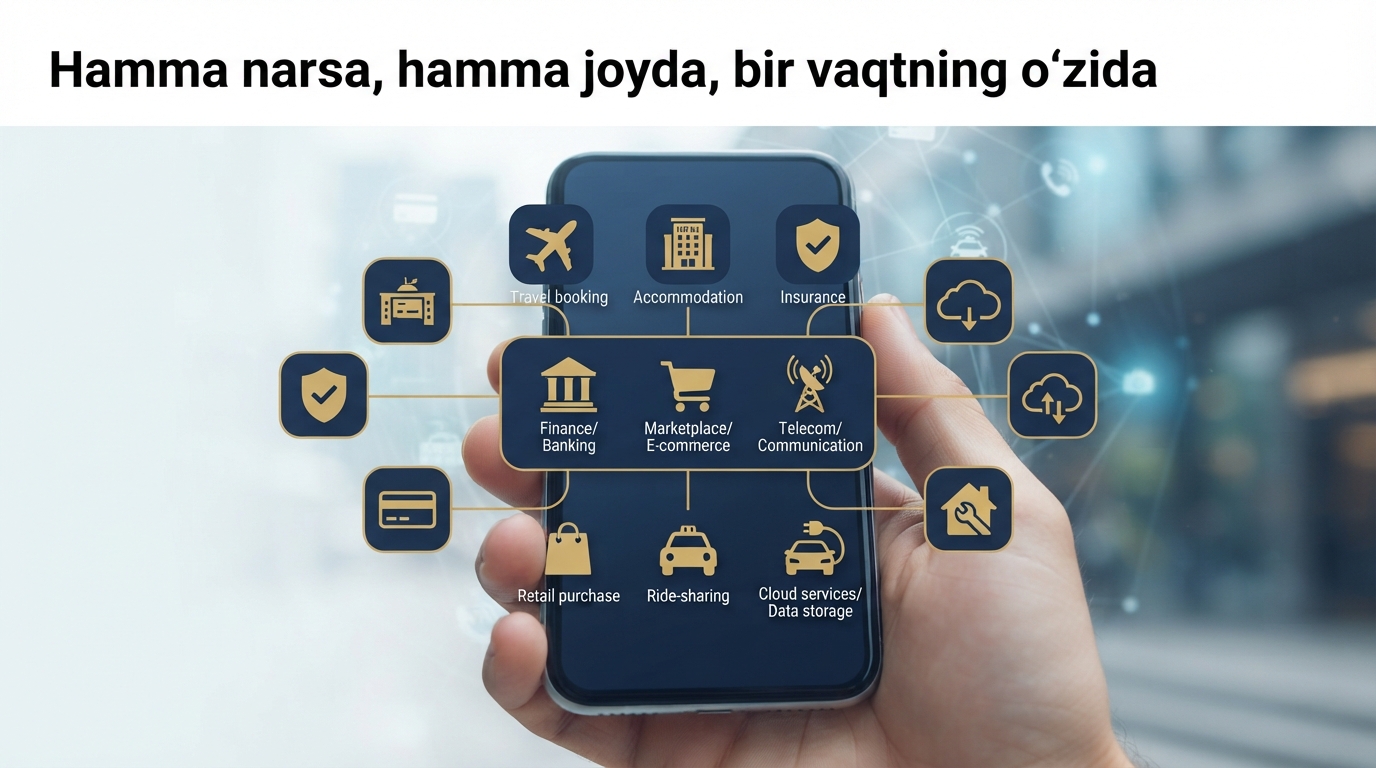
**Everything, everywhere, at the same time: banks, marketplaces, and telecom operators are breaking their own boundaries**
Try to quickly answer the question of what a bank does. Until recently, the answer was clear: it stores money, gives loans, and makes payments. Today, it depends on which bank it is. You can buy airline tickets, get insurance, or book a hotel through a bank app. You can order products and send packages through a taxi app. Marketplaces are issuing their own cards and issuing loans. Telecom operators are building data centers, developing cloud platforms, and launching services for tourists and car owners.
Companies that we are used to fitting into certain molds eventually stop fitting into these molds. The most interesting thing is that we hardly notice how this happened. A few years ago, a folder of dozens of applications would have been needed on a smartphone for everyday digital tasks. Now, one is often enough.
**What does the bank need for airline tickets?**
In recent years, the word "ecosystem" has become a corporate cliché. But at its core lies a very simple human habit: we don't like to do too much. If an app knows our details, has a card linked to it, and we open it every day, downloading another one, registering and re-entering data is a minor inconvenience. Digital business has learned to overcome such inconveniences, which is why companies are increasingly looking not at "another industry", but at the person - from one task to the next.
Revolut (a British fintech service) appeared in 2015 with the aim of simplifying currency exchange and settlements abroad. Today, it is possible to manage finances, make investments, book accommodation, and use insurance and travel services, and the number of retail customers has exceeded 75 million. However, neighboring Kazakhstan is probably more interesting for us. It is difficult to describe Kaspi.kz (a digital platform of Kazakhstan, which grew out of a retail bank) in one word today: you can pay, buy products, book trips, use banking and government services in one application. In the first quarter of 2026, when the population of Kazakhstan was just over 20 million, the Kaspi.kz payment platform alone had 14.7 million active users.
Perhaps this is the most vivid indicator of what is happening to banks. They are now fighting not only over where people keep their money, but also over how much of their daily lives they are willing to entrust to one application.
**How did buying sneakers become a banking service?**
When Mercado Libre (the largest marketplace in Latin America) was launched in Argentina in 1999, the task was simple: connect sellers with buyers. But a problem quickly arose: there were products and buyers, but many did not have a convenient payment method. Thus, the company's own payment system, Mercado Pago, was born.
Then an almost inevitable chain of events began: if a person is paying through you, why not allow them to transfer money? If they transfer money, why not issue a card? What about the seller accepting the payment, can they offer a terminal or credit? Today, Mercado Pago is an independent financial platform with tens of millions of users. Interestingly, in order to sell a person sneakers, the marketplace had to almost become a bank at some point.
**How many apps do you need to get through a day?**
In China, the answer is one. WeChat (the Chinese messenger and superapp) appeared in 2011 as an application for communication, but today calling it a messenger is like calling a smartphone a phone. In it, you can write, make payments, buy products, subscribe to services, call a taxi, and many external services work directly in the format of mini-applications in WeChat itself. Today, the audience of Weixin and WeChat exceeds 1.4 billion people per month.
This model very clearly reflected one of the new weaknesses of humanity - the state of fatigue from endless applications. According to a 2026 study by Klach, 64% of smartphone users have from 10 to 50 applications, but 46% of them use only 5-10 of them every day. Another indicator is even more striking: 72 percent of people are annoyed, even if only slightly, by the need to download a new application for the next service. This phenomenon has already received a name - app fatigue or "app fatigue". Therefore, the super-app is not only a business's desire to keep people in its system, but also a response to the understandable desire of the user: please, do not force me to register somewhere else again.
**When communication itself is lacking**
The telecom sector is also repeating the same situation that happened a few years ago with banks and marketplaces. Only here the starting point is different. The operator already has its own network, millions of connected users and the infrastructure on which a large part of their digital life takes place. At some point, a reasonable question arises: if all this is available, is it necessary to limit yourself to only calls and the Internet?
Looking at the global market, the answer to this question is increasingly “no.” According to JCMA Intelligence, the share of revenue of large operators from areas other than traditional telecom services has grown from 18% in 2017 to 28% by 2024. New areas include cloud technologies, cybersecurity, fintech, the Internet of Things and digital services.
There is an interesting paradox here. The more everyday things move into the digital environment, the less we notice the connection itself. When paying for a purchase, calling a car or opening WeChat, a person is unlikely to think about the network, data center and computing power. However, without them, this whole convenient digital life would not exist.
In Uzbekistan, this transformation can be clearly seen in the example of Uztelecom. A few years ago, the operator was expected to provide, first of all, home Internet, mobile communication and good coverage. Today, the list of company directions looks quite unexpected: charging infrastructure for electric cars, car service services, insurance, solutions for tourists, household services, cloud technologies, data centers and artificial intelligence.
Some of these directions originated directly from the telecom sector. For example, the service of communication abroad became the starting point for a wider range of services that accompany a person during travel. Others are much further from the usual operator business: there are digital services for car drivers, insurance and charging infrastructure, and through a digital platform you can even call a master to solve household problems. In this case, the operator itself does not try to become an insurance company, travel agency or household service: if necessary, relevant industry partners are involved in the system.
If we put all this together - the Internet, electric cars, insurance, travel, cars and household services - it turns out to be a rather strange set for a classic telecommunications operator. But this only seems so when we look at it from the industry's perspective. For the user, the logic is much simpler: it doesn't matter whether his current task is related to telecom, insurance or car services. The main thing is to solve it quickly, if possible online and without having to look for a new service every time.
There is another aspect of this transformation that is not so noticeable. While the user is seeing new digital opportunities, the infrastructure on which they work is developing "under the hood". Uzbektelecom is developing cloud solutions, building modern data centers and computing infrastructure for artificial intelligence and Big Data tasks. It seems that the company is moving in two directions at once: on the one hand, it is expanding the set of services for people, and on the other, it is building the technological foundation without which this digital diversity would be impossible to operate.
In this respect, telecom differs from many other ecosystems. The marketplace was forced to create a payment system to make it easier for the buyer to pay for sneakers. The operator, on the other hand, starts with the infrastructure that already exists at the core of digital life and gradually expands the possibilities that can be built on top of it. In this process, communication itself does not disappear anywhere. On the contrary, the more digital everything around us becomes, the more important the aspects that the user hardly notices - the network, data storage, computing power and their uninterrupted operation - become.
**What about after "all in one"?**
However, this race for universality also has a clear limit. It is not possible to add endless new buttons to an application, each of which will make the user's life more convenient. The famous phenomenon of "app fatigue" also shows that a person does not need hundreds of digital services. It is important to make as few moves as possible between the need that has arisen and its solution.
Therefore, the next stage, apparently, will depend not on the number of services, but on how seamlessly they work together. Artificial intelligence will accelerate this transition even further: now, instead of searching for the necessary application, section or function, a person often just needs to state the task, and the system itself will be able to determine what tools are needed for this. As a result, an interesting paradox arises: the more complex a technological system becomes, the simpler it should seem to a person.
Perhaps in a few years, we will not be surprised at all if a bank sells airline tickets, a marketplace provides loans, or an operator helps to charge a car. Business will continue to divide the market into telecom, fintech, e-commerce and dozens of other sectors for a long time. But for a person, there is no separate sector. For him, there is a task that needs to be solved.