

"Everyday practices reproduce discrimination against women, despite laws enshrining equality" — UN Women expert
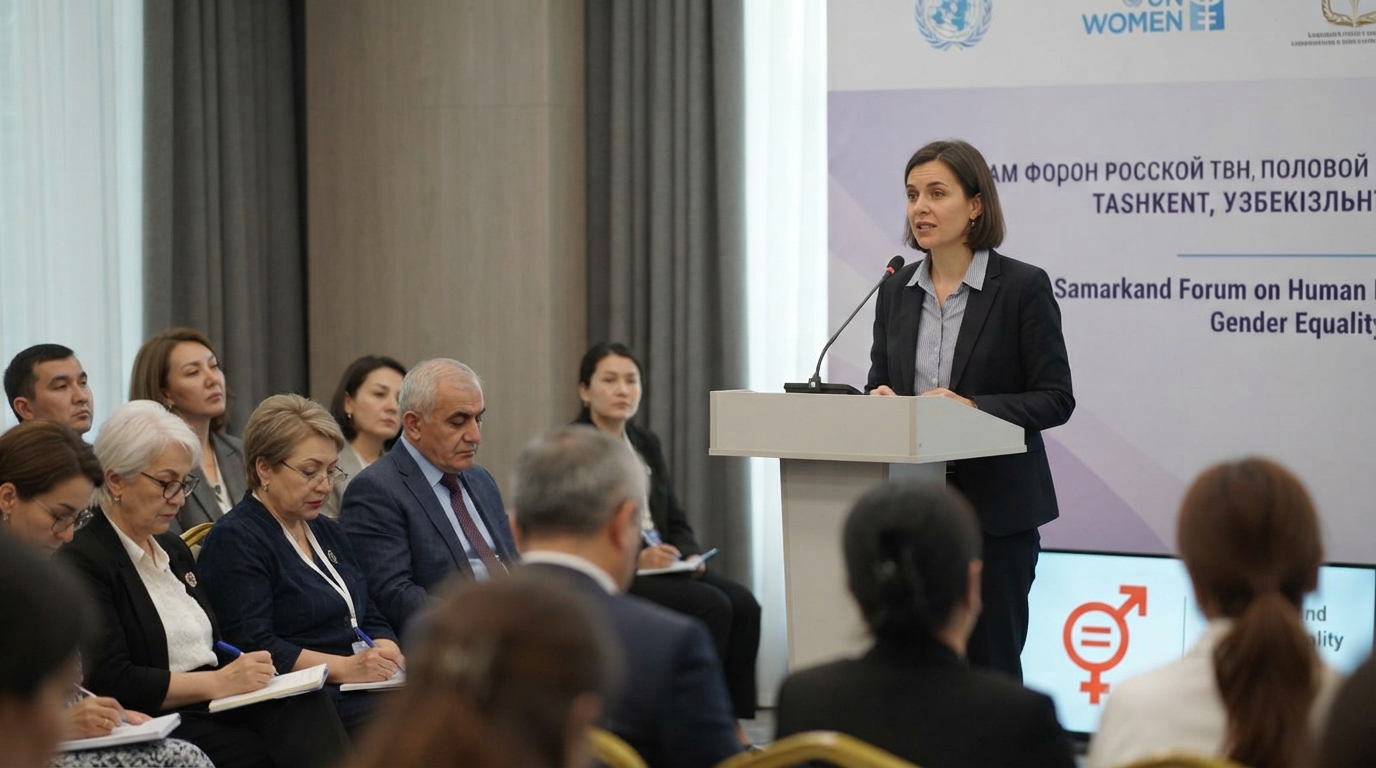
Due to gender stereotypes, equality enshrined in laws can coexist with discrimination in schools, courts, and other institutions. UN Women expert Olga Osaulenko presented proposals at a human rights forum to eliminate stereotypes and assess real changes in women's lives.
"Everyday practices reproduce discrimination against women, despite laws enshrining equality" — UN Women expert
Gender equality enshrined in laws does not yet mean equality in real life. Olga Osaulenko, Programme Manager of EU4Gender Equality at the UN Women Regional Office for Europe and Central Asia, drew attention to this issue in her speech at the Samarkand Human Rights Forum in Tashkent.
"We can have a law that guarantees equality, while institutions and everyday practices continue to reproduce discrimination," she said. For instance, a girl may have the right to education, but grow up believing that science and leadership positions are a male domain. A woman who has survived violence may have the right to protection, but encounter government officials who perceive violence as a private family matter.
According to Olga Osaulenko, stereotypes are reinforced through the content of school lessons, workplace rules, media, and judicial decisions. Therefore, information campaigns alone are not enough: even when understanding the existence of gender inequality, people may continue to follow habitual expectations if making a different choice invites condemnation or if the necessary services are unavailable.
Olga Osaulenko presented the draft General Recommendation No. 41 of the Committee on the Elimination of Discrimination against Women, "Eliminating gender stereotypes and the unequal power relations that support them."
The document builds on the provisions of Article 5 of the Convention on the Elimination of All Forms of Discrimination against Women (CEDAW), which concern the elimination of stereotypes and prejudices based on the idea of the inferiority or superiority of either of the sexes.
According to her, the draft links stereotypes to the distribution of power and resources, male privilege, and control over women. It also emphasizes that stereotypes are embedded in the rules of the state, economy, society, and family.
"Institutions do not just reflect stereotypes. They can sanction them, normalize them, and reproduce them," Olga Osaulenko noted.
She outlined four areas of work envisaged by the draft.
First — systematically identify gender stereotypes in laws, budgets, and public services.
The review should cover textbooks, the reasoning of judicial decisions, law enforcement protocols, medical and social services, as well as digital systems.
Second — define the responsibility of government institutions.
They must have clear standards, regular training for specialists, accessible complaint mechanisms, and remedies for violated rights. If gender stereotypes lead, for example, to a denial of service, measures must be taken to rectify the situation.
Third — allocate sufficient budgets and measure results: collect data, use quantitative and qualitative indicators, identify problems, and draw up plans to address them. "Data on the real-life experiences of women must be central," the expert emphasized.
Fourth — involve civil society and women's organizations in monitoring, and create safe conditions for women human rights defenders.
According to the draft recommendation, states must oversee influential non-state actors, including businesses, media, educational and religious organizations, and digital platforms.
Another new development presented by Olga Osaulenko is the UN Women concept "Ideologies, Institutions, and Power." It brings together:
"Changes become more sustainable when new perceptions are reinforced by different life experiences and when there are actors with sufficient collective power to defend the progress achieved," the UN expert explained.
To assess changes, she proposed four questions:
Special attention, she noted, must be paid to women facing multiple intersecting forms of discrimination: general indicators can hide persistent inequality for these groups.
"Legal reform is important, but its effect is limited if institutional practices remain the same," Olga Osaulenko concluded.