

Egypt accuses Rosatom of violating safety rules and employee drunkenness during nuclear power plant construction
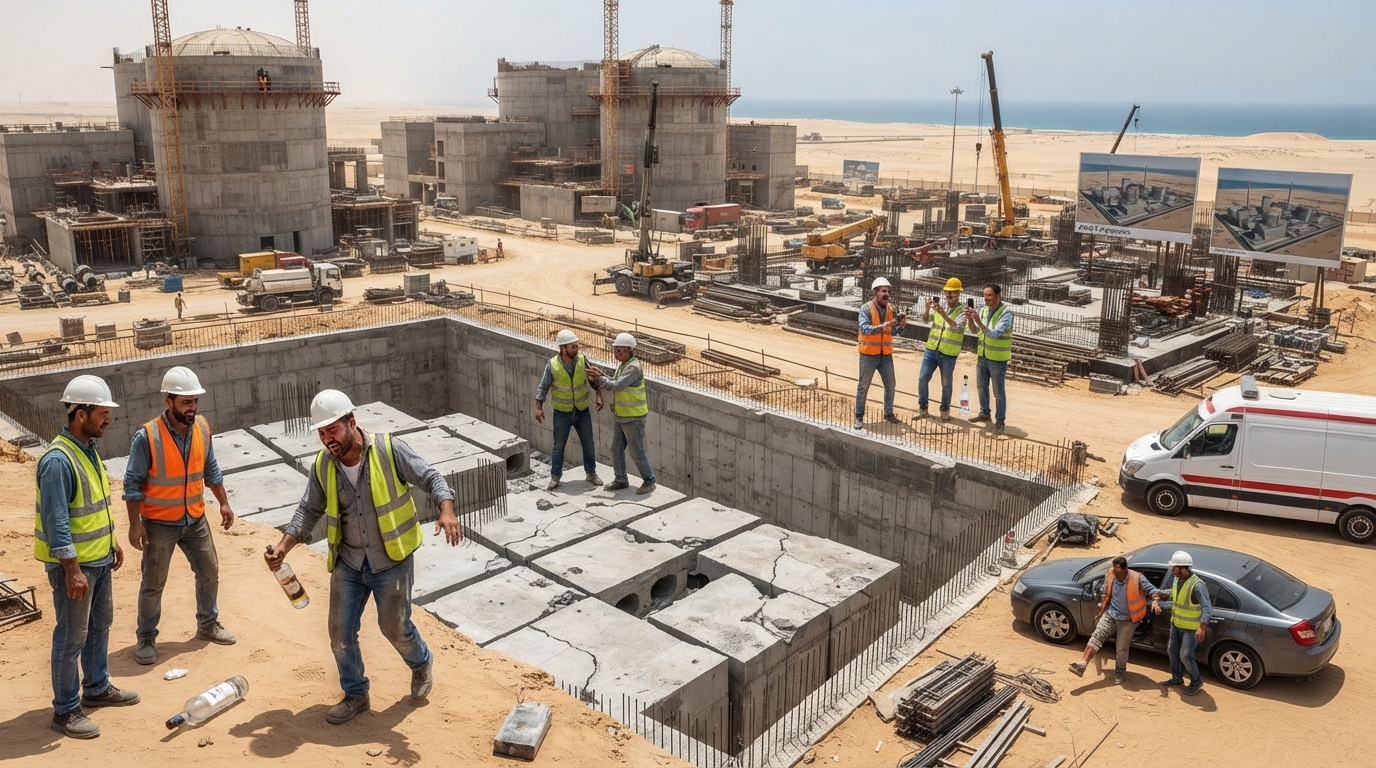
The Egyptian government has accused Rosatom of violating safety regulations and employee drunkenness during the construction of a nuclear power plant, Politico reported.
The allegations arose during the construction of the El Dabaa nuclear power plant. Although Rosatom insists that all safety requirements are being met, internal documents have revealed problems. The situation in Egypt could also affect the fate of a project in Hungary, where an inspection of two new power units being built by Rosatom has begun.
In a confidential letter sent to a senior Rosatom manager on June 4, the Egyptian Nuclear Power Plants Authority reported on defects found in unfinished reactor units, violations of nuclear safety ethics and deliberate negligence by one of the project employees. In particular, it took a year to eliminate defects in the foundation slabs of power units 1, 2 and 3, and voids were found in the concrete of unit 4.
The agency accused Rosatom of using deceptive methods and fake work to prove that the plant was more than half-completed. A visual inspection of the site showed that the main structures were still under construction underground.
The regulator said Rosatom had an unprofessional corporate culture: employees were found to be in possession of prohibited alcohol, used fake permits, and posted photos and videos taken at the construction site on social media. Instead of taking a worker with a severe open fracture to the hospital in a specially equipped ambulance, it took him in a private car to deliberately cover up the incident.
Politico obtained these and other documents from intelligence officers. They include confidential Rosatom documents. They detail the Egyptian authorities’ concerns, including delays, construction quality issues, and failures in project management.
Rosatom’s draft audit report for 2025 warned of a significant risk of non-fulfillment of contractual obligations. The state corporation is expected to delay the commissioning of the first power unit of the nuclear power plant by a year and a half, from September 2028 to March 2030.
Rosatom told Politico that none of the claims in the letter from Egyptian officials “have been verified within the framework of the contractual, technical and control procedures provided for in the project.”
**Project and audit in Hungary**
Similar inconsistencies could be found in Hungary, where the Russian state corporation is building two new reactors at the Paks nuclear power plant. The agreement to implement the Paks-2 project was signed in 2014, and Russia allocated up to 10 billion euros in state funding to the government of Viktor Orban at the time.
But current Prime Minister Peter Magyar has cast doubt on the project. He said Hungary has spent an additional €2.8 billion on what he described as several storage facilities and two large concrete pits.
Paks-2 was supposed to be operational in 2024, but “I don’t see them really fulfilling the terms of the contract,” Magyar said.
The new units will also need to use water from the Danube for cooling, but climate change in Europe is calling into question the effectiveness of this technology. The shallowing of the Danube River due to intense heat forced the Paks reactors to be temporarily shut down in early August.
Rosatom CEO Alexei Likhachev said construction of Paks-2 was proceeding according to schedule, with concrete preparation work for Unit 5 more than 80 percent complete, and work on Unit 6 underway. Nevertheless, the Hungarian government has decided to conduct a full audit of the Paks-2 project, including financing and design.
**Project in Uzbekistan**
Rosatom also has a preliminary agreement on the construction of small-capacity nuclear power plants in Uzbekistan. On June 5, a ceremony was held in the Forish district to mark the start of construction of the NPP foundation. The director of the Uzatom agency, who participated in the ceremony, answered a question from a Daryo correspondent and said that the base cost of the plant under construction in the Jizzakh region would reach $9.5 billion.
According to the official, 85-90 percent of this amount will be raised through loans. Vladimir Putin, however, noted that Russia would provide Uzbekistan with preferential loans for this purpose.