

Education and innovation as the foundation for the future competitiveness of Central Asia
The eighth Consultative Meeting of the Heads of State of Central Asia and Azerbaijan, held on October 8 in Avaza, marked a transition of regional cooperation directly to a practical agenda. The initiatives of the President of Uzbekistan, Shavkat Mirziyoyev, in the field of technology and education link digital infrastructure, artificial intelligence, and workforce training with the objectives of the region's long-term competitiveness. Their distinctive feature is an integrated approach that provides for the simultaneous development of digital […]
**Education and innovation as the basis for the future competitiveness of Central Asia**
The eighth Consultative Meeting of the Heads of State of Central Asia and Azerbaijan, held on October 8 in Avaza, demonstrated that regional cooperation is moving to a direct practical agenda. The initiatives of the President of Uzbekistan Shavkat Mirziyoyev in the field of technology and education link digital infrastructure, artificial intelligence, and training of personnel with the objectives of long-term competitiveness of the region.
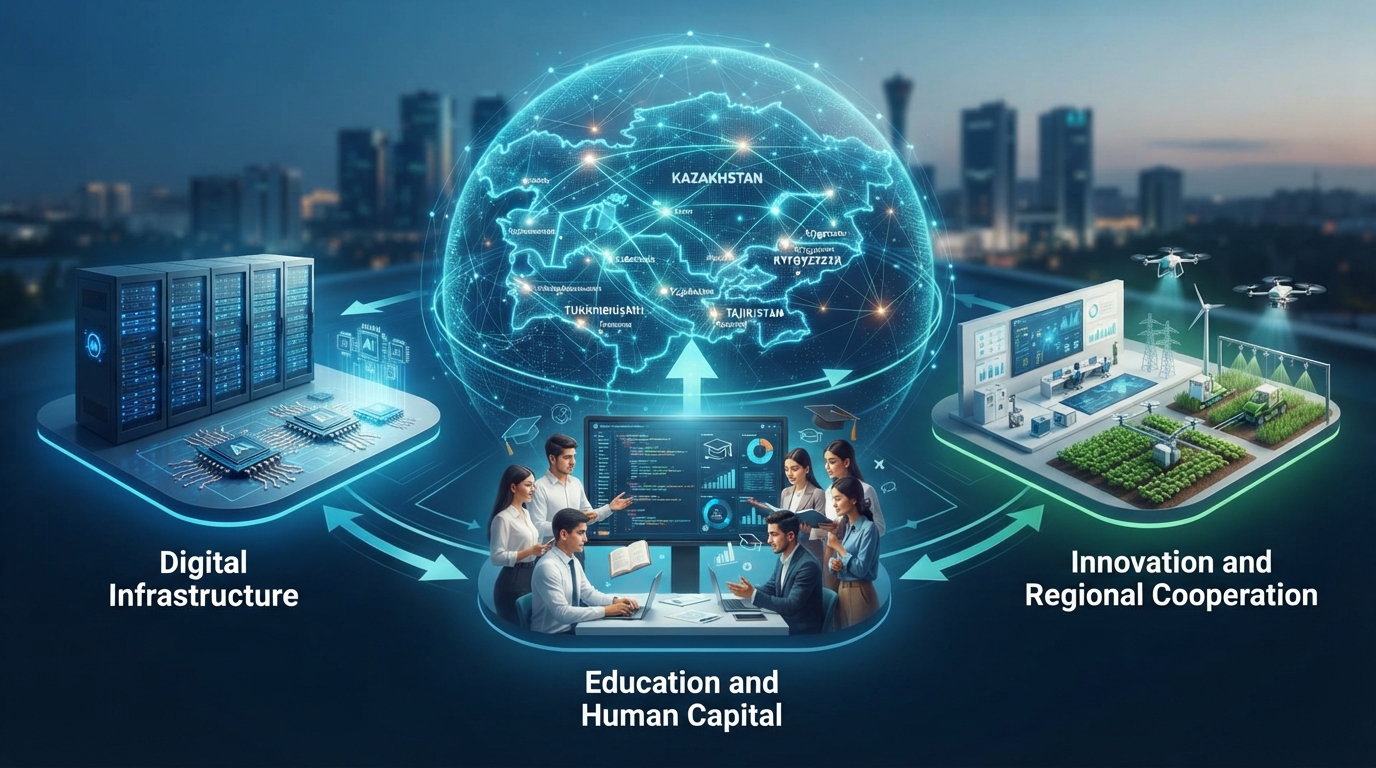
Their key feature lies in a comprehensive approach that involves the simultaneous development of digital infrastructure, scientific and technological potential, and human capital.
Today, the global economy is entering a new technological cycle, where productivity and competitiveness are increasingly dependent on access to computing power, the ability to create proprietary digital solutions, and the presence of a new generation of specialists.
This is of particular significance for Central Asia.
The expansion of industrial, transport, and energy cooperation opens up new opportunities for economic growth, but at the same time increases the need for modern digital infrastructure and qualified personnel.
In this context, the initiative of the President of Uzbekistan to create a Shared Computing Infrastructure based on an interconnected network of national data centers acquires special importance. It is a logical continuation of Uzbekistan's consistent policy aimed at strengthening scientific and technological cooperation. Thus, at the seventh Consultative Meeting in Tashkent in 2025, President Shavkat Mirziyoyev proposed establishing a Scientific Research Fund to finance interstate projects and expand opportunities for the application of artificial intelligence.
Today, artificial intelligence and big data processing technologies are becoming the most important tools for increasing labor productivity, optimizing production processes, and improving public administration. However, their widespread implementation requires significant computing power, the creation of which solely at the national level involves substantial financial and technological costs.
Against this background, the approach proposed by the Leader of Uzbekistan, based on pooling the existing capabilities of the region's states, appears particularly in demand. The implementation of the initiative should ensure broader application of digital solutions in managing cross-border transport flows, energy, water management, and agriculture, as well as create additional opportunities for the development of technological entrepreneurship and joint innovative projects.
At the same time, the efficiency of using such an infrastructure largely depends on the availability of qualified specialists. In this regard, along with launching joint training programs for sectoral personnel and supporting technological entrepreneurship, the head of Uzbekistan proposed developing a Regional Atlas of In-Demand Professions and Competencies.
The relevance of this proposal is explained by the growing need of Central Asian economies for qualified personnel. A young and growing population creates significant development potential, but its realization increasingly depends on aligning education with the real demand of the economy.
Rapid technological modernization is swiftly changing the structure of this demand. Industrial automation, digitalization of transport and energy, and the introduction of artificial intelligence are forming new professions and competencies often faster than educational programs can adapt.
Under these conditions, the Regional Atlas can become a practical tool for aligning educational policy with the real needs of the economy. Combining national forecasts will make it possible to identify the most in-demand professions in advance, adjust educational programs, and plan training in promising areas.
The practical demand for such an approach is obvious in the implementation of major interstate projects in industry, transport, energy, and the digital sphere. In this case, workforce planning becomes part of the investment and infrastructure design itself.
The initiative also develops the previously established educational agenda. At the sixth Consultative Meeting in Astana in 2024, the President of Uzbekistan proposed a Central Asian Program for Educational and Academic Exchanges, mutual recognition of diplomas from leading universities, and expanding scholarship opportunities for talented youth. The promotion of the "Central Asia Youth Agenda - 2030" complements this line, linking education and professional development with more active participation of young people in regional cooperation and innovation activities.
The Regional Atlas gives these initiatives an applied dimension, linking educational cooperation with specific tasks of modernization and future demand for competencies.
Thus, the proposed initiatives are closely interconnected and complement each other. Their practical implementation will create a technological foundation for the development of artificial intelligence and innovative industries, while simultaneously ensuring the training of qualified personnel taking into account the new needs of the economy.
Ultimately, this will contribute to deepening digital and educational cooperation, strengthening the technological potential of Central Asia, and expanding the opportunities of the region's states for the joint development of advanced technologies.