

Economic protection for business and citizens: how the insurance market operates in Uzbekistan
Most citizens have encountered the insurance system and are well aware of the word "insurance," but few know that insurance actually covers many areas of our economy and society. The methods and technologies of the insurance system are revealed by Umid Khudayberdiev—founder of three insurance companies, an expert with over 20 years of experience in the industry, and a speaker on the INSUR Asia track at the forum […]
**Economic Protection of Business and Citizens: How the Insurance Market Works in Uzbekistan**
Almost all citizens have encountered the insurance system, and the word "insurance" is familiar to everyone. However, far fewer people understand that insurance encompasses many spheres of economy and public life. Umid Khudayberdiyev — founder of three insurance companies, an expert with over 20 years of experience in the industry, speaker of the INSUR Asia track at the FINNEXT Asia forum (November 19, Tashkent), and formerly an employee of the State Insurance Supervision Service under the Ministry of Finance of the Republic of Uzbekistan — speaks about how the methods and technologies of the insurance system are structured.
— Umid, you have been working in the insurance business for over twenty years, have managed major companies, and were at the origins of the regulatory authority. Based on your experience, how would you describe the global role of insurance in Uzbekistan's economy?
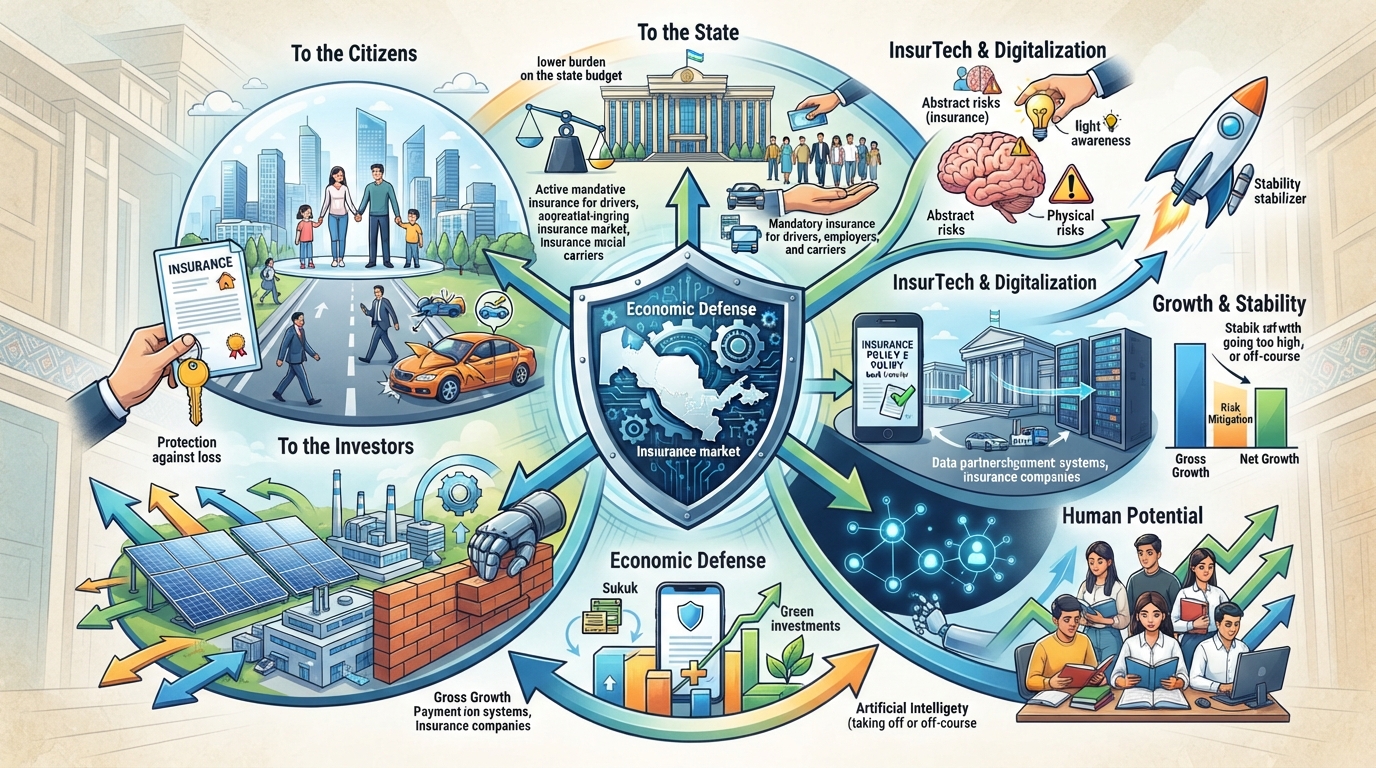
— The economy is a very complex organism in which the interests of citizens, businesses, and the state intersect every minute. And this organism desperately needs protection. It is insurance that acts as the key tool of financial defense. It supports the stability of the national economy, helps attract investments, and, what is especially important, reduces the burden on the state budget.
If we break down the benefits of insurance by direction, three main segments win:
1. The people. Citizens gain stability in social and business life, as well as protection against unforeseen financial losses.
2. The state. As a superstructure over society, it is obliged to protect the population. Insurance assumes part of this function, evenly distributing economic risks across society.
3. Investors. We will definitely speak about them separately.
— It is believed that there is a rather low level of financial literacy in our country. Because of this, people often ignore insurance. Do you agree with this?
— I would refine the wording a bit. The word "literacy" is not entirely accurate here. It is more correct to speak of insufficient awareness.
People understand physical risks perfectly well: they know how to jump over an aryk (irrigation canal), or that one should not cross the road in the wrong place because a car might hit them. The brain instantly recognizes danger and commands us to slow down. But insurance and finance are abstract systems that require specialized knowledge. Physically, we are aware of risks, but economically, not yet.
— In recent years, digital ecosystems have developed rapidly in Uzbekistan — Gov.uz, MyID, banking fintech services. But along with this, the number of frauds has also grown. Does insurance protect against such threats?
— Absolutely. Anyone can face risk — both a person who trusted scammers and a successful company that suddenly lost assets. Often, this happens precisely due to a lack of knowledge in the field of financial protection.
Many still do not know that products such as cyber insurance (data protection) or document insurance exist. Or take deposits: the state has a good system for guaranteeing public deposits, but it covers amounts up to 200 million UZS. What if a person has more in their account? For such cases, we have developed special products that allow insuring funds in checking accounts above this amount. When people encounter scammers, they usually run to banks or the state. But we also extend a helping hand and create products to safeguard their funds.
— You mentioned investors. What role does a developed insurance market play for foreign capital?
— A key role. A serious investor will not enter a country unless there is a transparent mechanism to protect their money. A major investor's first question is not "How much will I earn?", but "Will my money remain safe? Will I recover the principal investment itself?".
In developed societies, corporate governance is structured collegially. A single top executive cannot unilaterally say, "Oh, let's run to invest in Uzbekistan!". Behind them stands a Board of Directors and a team of 30 experts responsible for strategy and risk management. They need to prove the safety of the deal.
They look at it: "Well, we will build a factory there worth tens of millions of dollars, purchase equipment. But what if a fire or theft occurs, and the country's insurance sector is poorly developed? Fire doesn't ask how many millions we invested; it takes everything." Therefore, investors evaluate the reliability of an economy by the maturity of the insurance market: whether it pays quickly, whether it covers risks within the country, or relies entirely on reinsurance abroad. The state cannot issue government guarantees indefinitely.
— If insurance is so important, why has the banking sector in Uzbekistan moved far ahead while the insurance sector lags behind? Is this due to imperfect laws or weak state support?
— This is a complex and multifaceted question. The financial system must develop in a balanced manner. If banks surge ahead while insurance lags behind, it creates a dangerous imbalance. In Uzbekistan, banks have indeed moved ahead because more of them opened, and they are direct connectors in society.
Nevertheless, the insurance sector is now actively catching up. Banks are helping us with this because they themselves understand the importance of balance. The state, as a regulator, also provides strong support. Starting from 2008, three major laws on compulsory insurance were adopted in our country:
• Motor third-party liability;
• Employer liability insurance;
• Carrier liability insurance.
The state has covered the most socially significant areas. Today, every driver has an insurance policy both in the glove compartment and in their mind. This is what raising awareness is about: sitting behind the wheel, a person already knows that in the event of an accident, damage will be compensated. Moreover, overall, state authorities have become much friendlier and more loyal to business and the public; they do not interfere with work.
## Trends: Islamic Insurance
— Do you offer such products?
— Yes, of course. This tool is essential for the harmonious development of the market. The state needs reliable protection, the economy needs an influx of new investments, and citizens need to preserve their domestic savings in accordance with their values. Islamic insurance addresses these needs perfectly.
## Demographics, Poverty, and Human Potential
— Uzbekistan is currently experiencing a real demographic boom — we have a very high birth rate and a large youth population. On the one hand, this is a colossal resource; on the other, an enormous burden on infrastructure, the economy, and housing and communal services. How do you assess this balance?
— Our youth and children are an enormous resource and our main advantage. I studied in Japan, I studied in Europe — foreign partners trust us largely due to this potential.
Yes, today there are opinions that demographics should somehow be restricted, because providing for, feeding such a number of people, solving water, housing, communal, and infrastructure problems is a colossal challenge. But our state is coping with this. And I don't just believe, I know that it will continue to cope.
If we systematically invest in this human potential and in education, Uzbekistan will easily surpass many countries not only in economic growth, but also in social development.
— Population growth is directly linked to the issue of poverty. How is the state addressing this issue, and what does the construction sector have to do with it?
— If the population is large, without proper management, the poverty level could indeed rise, reducing the country's attractiveness for business. But in our country, an entire specialized ministry is systematically dealing with this, and the results are quite good.
Our President recently rightly noted that we have learned to build. What does this mean? We have reached the level of Turkey and Europe in terms of speed, quality, and, most importantly, efficient management of limited resources, time, and money. Now that this foundation is laid, we need to set up the housing and communal services system just as clearly and develop social protection for citizens.
## The Role of Insurance in the Financial Sector and the Formula for Economic Takeoff
— We have discussed in detail the benefits of insurance for the state and citizens. But why is the financial sector itself — for example, banks — so interested in its development?
— Let's look at the risks of commercial banks. A bank issues loans, and it always faces the risk of NPLs (non-performing loans) emerging. Or, for instance, property that was pledged to the bank as collateral worth billions of UZS is destroyed or severely damaged. Without insurance, this collateral turns to zero, and the entire risk falls directly on the bank. Therefore, it is critically important for banks that the insurance sector is developed.
As for us, insurers, this is our profession; we earn our living by it and grow. But our main goal as part of the financial system is to deeply integrate the insurance tool into society and the economy, contributing to Uzbekistan's development.
Without insurance, you can take off, but you cannot fly high.
— Why? What exactly slows down this takeoff?
— Risks. When you gain speed and altitude without insurance protection, the focus shifts to the fear of loss. Business begins to slow itself down because it fears taking risks.
Currently, we are building a huge number of complex technological facilities — energy, oil, irrigation. The economy is forced to stop, reduce speed, shift from fourth gear down to second, spend time and resources eliminating consequences, and then accelerate again.
Any economic takeoff is a net balance. Net growth equals the volume of real forward movement minus losses from risks. For example, if the official growth indicator of a sector is 8%, this means that in reality we grew by 10%, but lost 2% and rolled back due to accidents, fires, or other unforeseen disasters.
The task of insurance is to make these 2% manageable and reduce them to a minimum. If we protect business from these losses, the economy will show growth not of 8%, but a full 10%. On a national scale, even one percent of net growth represents colossal figures. Moreover, when business is not distracted by fears and risks, its focus is directed solely toward creation, and potential growth could reach 15%. Developed countries in Europe and America grew precisely because their financial and insurance markets are top-tier. Insurance provides the main thing — confidence and peace of mind for a decisive step forward.
## Intersection with Adjacent Markets: The New Capital Market Law
— Umid, active work is currently underway in the country on a new capital market law. Its initiators are the Presidential Administration and your regulator — the National Agency for Prospective Projects (NAPP). How will this law affect the insurance sector? Will it make your work easier?
— Our regulator is indeed unique — it is a "two-in-one" system that coordinates both the capital market and the insurance market. We at Hayot Invest Insurance view the upcoming changes extremely positively and are actively participating in discussions.
For insurance companies, the development of the securities market is critically important, as investment activity is our second key function after insurance itself. We are major fund holders, and we need somewhere to deploy and multiply our funds.
Currently, there is a lack of high-quality instruments on the market, and up to 90% of our portfolio consists of ordinary bank deposits. However, for corporate clients, banks today offer an average of 15% to 20% per annum. At the same time, stocks on the stock market can grow by 30–40% per year or more. The new law will give us a variety of instruments, increase yields, and expand the investment field. Furthermore, the development of the capital market means the emergence of new risks, and therefore a new field of activity for our insurance products.
## Sukuk and Green Investments
— I know that the draft law introduces concepts new to our legislation: custodial activity, Islamic sukuk securities. Will this help the development of Islamic insurance that we talked about?
— This is a fundamental step. At Hayot Invest Insurance, we are actively developing takaful (Islamic insurance). However, by rule, we do not have the right to direct funds from these pools into conventional commercial banks. Today, some banks already offer deposits according to Sharia standards, but this is not enough for the market.
The capital market law opens up sukuk for us — these are essentially the same as bonds, but fully compliant with Islamic finance standards. Now we will be able to legitimately and effectively invest takaful fund resources there.
— Another global trend reflected in the draft law is so-called "green" investments and ESG standards (environmental, social, corporate governance). What is the role of insurers in this direction?
— Environmental preservation, solving water and infrastructure problems, healthy land for future generations — this is a core part of the country's development strategy and our President's program.
When major foreign investors come to Uzbekistan, they strictly demand compliance with ESG standards. Capital from Arab countries, Indonesia, or Malaysia will demand Sharia-compliant instruments, while European capital will demand eco-friendly solutions. The new law simultaneously develops both sukuk and green investments.
Additionally, the capital market is always about transparency and sustainability. As investors, clear indicators, reporting, and company ratings are critically important to us, which are also being implemented in the new version of the law.
## Unique Products: Executive Insurance
— Please give an example of a specific product that will become in demand thanks to the development of corporate governance under the new law.
— An excellent example from international practice is Directors and Officers liability insurance (D&O).
The new law develops collegial management: companies are creating full-fledged supervisory boards and board of directors consisting of 3–5 people. These are high-level top managers. Imagine a situation: a board member decides to invest 10 million dollars in a project, but makes a professional error, and the money burns. The director's personal assets, even with a high salary, will not be enough to cover such a loss. Even if you put him in prison ten times — that won't bring 100 million dollars back to the company.
Mistakes at the top level are expensive and can wipe out half a business. And this is where we come in: this policy insures the error itself and covers colossal losses. For each individual director, such insurance is not very expensive, but the insured amounts there are huge. Furthermore, abroad it is customary to insure the life and health of every top manager, because human capital at that level is worth colossal money. Capital market development will inevitably bring this product to us in Uzbekistan.
## Digital Ecosystems, AI, and FINNEXT Asia
— It would seem that mostly bankers should gather at such events. How does the insurance industry relate to this?
— That is a great question! In fact, all financial sectors today are closely interconnected. FINNEXT Asia is not just a place to "gather, hang out, and drink coffee." It is an authoritative and experienced organization that entered the market of Uzbekistan with concrete results. It serves as a strategic crossroads where absolutely all players of the financial services market meet: banks, the state, leasing companies, pawnshops, and, of course, insurers.
Even more importantly, modern financial ecosystems meet there: PayMe, Click, Uzum. Let's admit it: today people don't "live" in physical banks; they live in these apps. We open them every day to pay for electricity, transfer money to relatives, or settle accounts via QR code. We no longer want to stand in lines. In five minutes in an app, we resolve tasks that used to take two days.
However, behind every digital ecosystem actually stands a conventional bank, a checking account, a partnership with payment systems like Visa. For insurance, FINNEXT Asia is an ideal platform. Firstly, it is pure marketing, a meeting point with partners and clients. Secondly, it is a tribune where common industry issues can be openly raised.
— Why should financial technology and traditional insurers unite right now?
— Because technology is advancing at cosmic speed. Now artificial intelligence (AI) has entered the arena. But it also has a flip side — cybersecurity risks, as we often use foreign AI services and could lose confidential information. We need to cooperate and learn from each other's experience in the safe use of AI.
The second critical aspect is Big Data. I graduated from the Institute of Information Technology in management, and one rule was firmly embedded in my brain: information is the most expensive thing in the world. Banks, fintech, and insurance companies collect colossal volumes of data on their servers. We can and must build information partnerships.
Banks have data on citizens' wealth and credit histories. Insurance companies have statistics on traffic accidents, natural disasters, driving behavior, or the general health status of the population. Naturally, no one violates the law: banking and insurance secrecy, as well as personal data protection, are sacred; we do not share personal information. But we can operate with aggregated, anonymized statistics for Tashkent or the country as a whole.
Insurance literally feeds on statistics. Our entire business is built on it. To calculate a basic insurance tariff — say, 1% — we need to know precisely that in society this risk materializes as 1 in 100 (roughly speaking, out of 100 houses, one burns, or out of 100 cars, one crashes). We collect this 1% from a hundred car owners, form a 100% fund, and when one of them gets into an accident, we fully cover their damage. And we earn by investing these collected funds until an insured event occurs. We live off this investment income.
— Besides technology and data, does the market face other common challenges?
— Undoubtedly, personnel. The shortage and training of qualified specialists is a huge problem for the entire financial and IT sector of Uzbekistan. Banks often lack strong risk managers — we can offer them our experts. Insurance companies have a need for customer service specialists — and here we can adopt best practices from banks. In such a partnership, there is no room for corporate greed.
— At the beginning of our conversation, you mentioned your impressive managerial experience. May I ask more specifically: what projects in Uzbekistan have you led?
— I have dedicated over 20 years to the insurance industry and have worked exclusively in this field my whole life. Speaking of companies I was involved in creating or transforming, these are three major players.
First, I transformed My Insurance, turning it into a strong market player. Then I founded Simurg Insurance from scratch. The third large-scale project was Hamkor Sug’urta, created with the participation of Hamkorbank, where I served as Chairman of the Board for a long time.
Now we face a new ambitious challenge. Jointly with the new digital Hayot Bank, we opened the insurance company Hayot Invest Insurance. This is an absolutely new company in the field of general (non-life) insurance. We are implementing all advanced technological tools discussed above to provide the market of Uzbekistan with a fundamentally new level of financial protection.
— Umid, as a direct market participant, what do you personally and your colleagues expect from FINNEXT Asia in the future? How can this forum be made even more effective?
— The main thing I want is measurability and clear metrics. People go for concrete results; no one will spend time on "just words" or a simple gathering. It is important for the FINNEXT Asia team to define the starting point and measure subsequent results: how many contracts were concluded between partners, what synergy was created.
— Let's move to the final part of our conversation. What exactly can your company Hayot Invest Insurance and the insurance sector as a whole offer to partners and the state on this technological platform?
— We can offer deep IT integration of insurance products into any existing technologies. At the intersection of insurance and IT, InsurTech is born. We want to become "relatives" and full-fledged partners for any ecosystems: banks, leasing companies, or payment services.
How does this work in practice?
• Integration into fintech products: a bank sells an auto loan — policy issuance seamlessly appears within the process. A deposit is issued — life or deposit insurance is automatically added. A person makes a transfer in a payment system — a checkbox for "insurance against transfer issues" for a nominal penny is embedded inside.
• Information partnership and electronic KYC: previously, when developed IT systems did not exist, a bank's credit committee met once a week. You arrived on Monday, and received an answer only on Friday. Today, scoring and credit history checks take seconds. Meanwhile, the bank does not see how client information is purchased in the background from external databases. We can provide banks with our databases on insurance history (accidents, crashes, defaults) to enrich their verification systems. This is a ready-made solution in the field of security and biometrics — electronic KYC (Know Your Customer).
• Interaction of AI agents: insurance companies have their own artificial intelligence systems, and banks have theirs. We can connect our AI agents directly so they instantly communicate with each other and provide the client with accurate, correct joint solutions.
— Sounds high-tech, but what is the direct commercial benefit of this, for example, for banks? Why should they promote your products?
— The benefit is colossal. The insurance market in Uzbekistan is still empty, and banks can make huge money on this. The Central Bank has officially allowed commercial banks to act as insurance agents and receive commission for operations.
The commission is up to 25% — these are impressive figures. We are ready to officially pay this money to banks for monetizing their client data, which would otherwise simply sit idle on their servers.
Nowadays, nobody voluntarily visits offices; the entire client flow goes through digital channels. If a client comes to us from a bank's app and buys a policy, for example, for 10 million UZS, we instantly return 2.5 million to the bank as an agency fee. As a result, the bank's profitability grows, while its client receives comprehensive financial protection — be it business, property, auto, or deposit insurance. The bank doesn't even need to transfer users' personal data to us. It is enough to offer on their side: "We have partnered with Hayot Invest Insurance. Would you like to protect your assets?". If the client clicks "Yes", an automated and mutually beneficial process is launched.
— Summing up everything said, how can the main functions of insurance for Uzbekistan be formulated?
— To summarize, qualitative development of the insurance market is vital for the Central Bank, the Cabinet of Ministers, the banking sector, and the whole of society for three fundamental reasons:
1. Protection of citizens and business. This is a basic, compensatory function. It includes reimbursement of losses from traffic accidents, fires, business problems, accidents, and illnesses. Health insurance is of paramount importance for our large country and growing population.
2. Support for entrepreneurship and economic scaling. Insurance assumes risks, allowing businesses to confidently invest and grow.
3. Attracting and protecting investments, which we discussed in detail earlier.