

Drivers simply do not know how to yield to an ambulance. Clear rules are needed
Drivers in Uzbekistan do not know how to yield the right of way to ambulances and other emergency vehicles because there are no written rules in the country on how to do so. There are also no uniform requirements for drivers of emergency vehicles. Many countries have regulations for forming an emergency corridor. The time has come to implement them.
Drivers simply do not know how to yield to ambulances. Clear rules are needed
Reports regularly appear in the media about drivers failing to yield to ambulances in various regions of Uzbekistan. Usually, everything unfolds according to a single scenario: the Road Safety Service (SBDD) identifies the driver, conducts a "preventative conversation" with them, holds them accountable, and the driver promises that this will not happen again.
However, fines alone will not solve the problem. It will arise again and again until a clear algorithm of actions upon the approach of operational and special service vehicles is introduced into the Road Traffic Rules.
Today, Uzbekistan's Road Traffic Rules essentially contain only the final requirement: drivers are obliged to "yield the road" to operational and special service vehicles with sirens and flashing beacons turned on. At the same time, the rules do not explain exactly how to do this in different road circumstances.
Because of this, in heavy traffic, each driver acts at their own discretion: one tries to change lanes to the right, another to the left, and a third remains in place and waits for the car ahead to start moving. Even if everyone formally tries to yield, a coordinated corridor for the passage of emergency vehicles may never form.
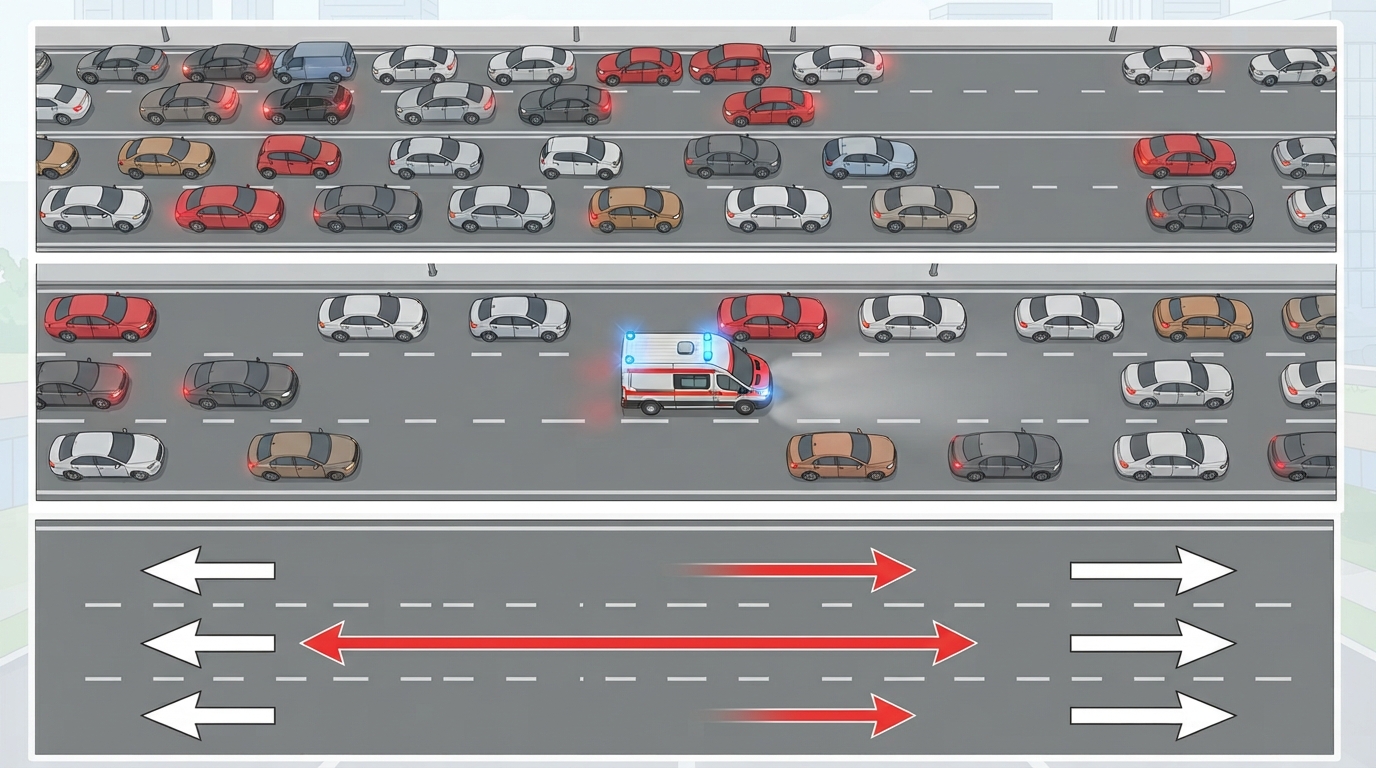
"In Uzbekistan, there is no clear and understandable algorithm for the collective actions of drivers in such a situation. In a number of countries, this issue is regulated in much greater detail. For example, with two lanes of traffic, cars move to the opposite edges of the roadway, forming a free corridor between the lanes," noted Bobur Siradjev, an expert on sustainable mobility and infrastructure policy.
"With three or more lanes, the principle is also unambiguous: cars in the far-left lane shift as far left as possible, while cars in the other lanes shift to the right. Thus, a corridor is formed between the far-left lane and the adjacent one. The driver does not need to decide on their own where to change lanes; this is predetermined by the rules," he noted.
For example, in Germany, the mandatory formation of the so-called Rettungsgasse is prescribed primarily on autobahns and multi-lane rural roads when traffic is moving at walking pace or has come to a standstill. In Poland, the rule is formulated more broadly and applies to roadways with two or more lanes in one direction during heavy traffic, including on city streets.
In the UK, unlike in Uzbekistan, drivers are prohibited from crossing the stop line at a red traffic light — emergency vehicles bypass cars using free lanes, including oncoming ones, thanks to a pre-formed corridor.
Crucially, the corridor must be formed in advance, even in a heavy traffic jam, and not after the driver sees an ambulance in the mirror or hears a siren. At the same time, the corridor must remain free for emergency vehicles, of which there may be several, and its use by regular traffic during this time must be prohibited.
This significantly reduces the time required to clear the road: when an ambulance, fire truck, or other emergency vehicle appears, drivers do not need to simultaneously begin chaotic lane changes.
The same clear procedure should be established in the Road Traffic Rules of Uzbekistan. Moreover, the rules must take into account different situations: two, three, and more traffic lanes, intersections, traffic jams, dedicated lanes for public transport, and sections where movement is restricted by curbs or physical barriers.
After changing the Road Traffic Rules, a large-scale information campaign will be required: short videos, diagrams, materials in driving schools, on electronic displays, and on social networks. The rule must be so simple that a driver can recall it in a few seconds.
But duties must be clear not only to regular drivers. It is also necessary to standardize the procedure for using special light and sound signals by drivers of ambulances, fire services, the SBDD, and other operational services.
In practice, there are situations when drivers of emergency vehicles turn on a special sound signal immediately before an intersection. After passing it, they turn off the signal and turn it on again before the next obstacle. In heavy traffic, this leaves other drivers with too little time to determine the direction of the emergency vehicle's movement and clear the way for it in an organized manner.
According to the current Road Traffic Rules, operational and special service vehicles gain priority over other road users when blue, or blue and red, flashing beacons and a special sound signal are turned on simultaneously.
Often, drivers of emergency vehicles use other methods as well: having approached cars stopped at an intersection from behind, they may turn on a brief sound signal and give commands through a loudspeaker. Therefore, it makes sense to separately regulate the procedure for using special sound signals and loudspeakers: in which cases they are used, when the driver of an emergency vehicle must turn on the main signal, and how far in advance they must warn the traffic flow.
The system must be predictable from both sides.
"A regular driver must know exactly what maneuver is required of them, and the driver of an emergency vehicle must know how to indicate their approach in advance. Only then will dozens of individual cars be able to act as a single flow," Bobur Siradjev noted.
Some ambulance drivers are already trying to organize traffic on this principle on their own, using a loudspeaker to suggest that cars shift left and right, as, for example, in this video with an ambulance in Tashkent. However, without an algorithm established in the Road Traffic Rules, such commands, as expected, may be misunderstood by some drivers.
Therefore, it is necessary to simultaneously develop rules of action for regular drivers and a procedure for the operation of emergency vehicle drivers. Only after the appearance of a clear and unambiguous algorithm does it make sense to discuss increasing liability for intentionally obstructing the passage of emergency vehicles.