

Documents falsified to evade tax on Abramovich's wealth
Backdated paperwork also made the Russian oligarch’s yachts and mansions disappear from accounts, BBC finds.
Documents falsified to avoid tax on Abramovich’s wealth
BBC Panorama has found that the world’s largest accountancy firm helped falsify documents to conceal Roman Abramovich’s wealth and avoid tax.
Accounts approved by Deloitte in Cyprus caused assets including superyachts, mansions and private jets worth $672m (£508m) to disappear from Abramovich’s company records.
Deloitte also appears to have advised on a plan to dodge a massive tax bill on the oligarch’s wealth by falsifying documents.
Andrew Mitchell KC, a barrister and expert in financial services law, said Panorama’s evidence showed the arrangement was “straightforward” tax evasion and “it couldn’t be more blatant”.
Abramovich’s lawyers said he denies evading tax or hiding his fortune. They said Panorama had produced no evidence that he knew about, authorised or directed the falsification of any document, and argued it was legitimate to rely on professional advice.
Deloitte Cyprus said it “acts in compliance with applicable laws”.
The findings are being disclosed after a joint investigation by BBC Panorama and the Bureau of Investigative Journalism.
For almost 20 years, Roman Abramovich was the best-known Russian oligarch in the UK, embraced in London after buying Chelsea Football Club in 2003 and funding the club’s most successful era. But following Russia’s full-scale invasion of Ukraine in 2022, the UK government sanctioned him as an associate of President Vladimir Putin and compelled him to sell the club.
Abramovich is reported to be living in Turkey, a refuge for him because sanctions were not imposed there. In Jersey, one of the Channel Islands, £5.4bn of his assets remain frozen and a criminal investigation has been under way for four years.
His lawyers told the BBC that he rejects the allegations in the Jersey inquiry and says it was “undertaken for political purposes”.
Our investigation has uncovered fresh evidence about how Abramovich’s business empire was operated. It also raises serious concerns about the integrity of some of his professional advisers.
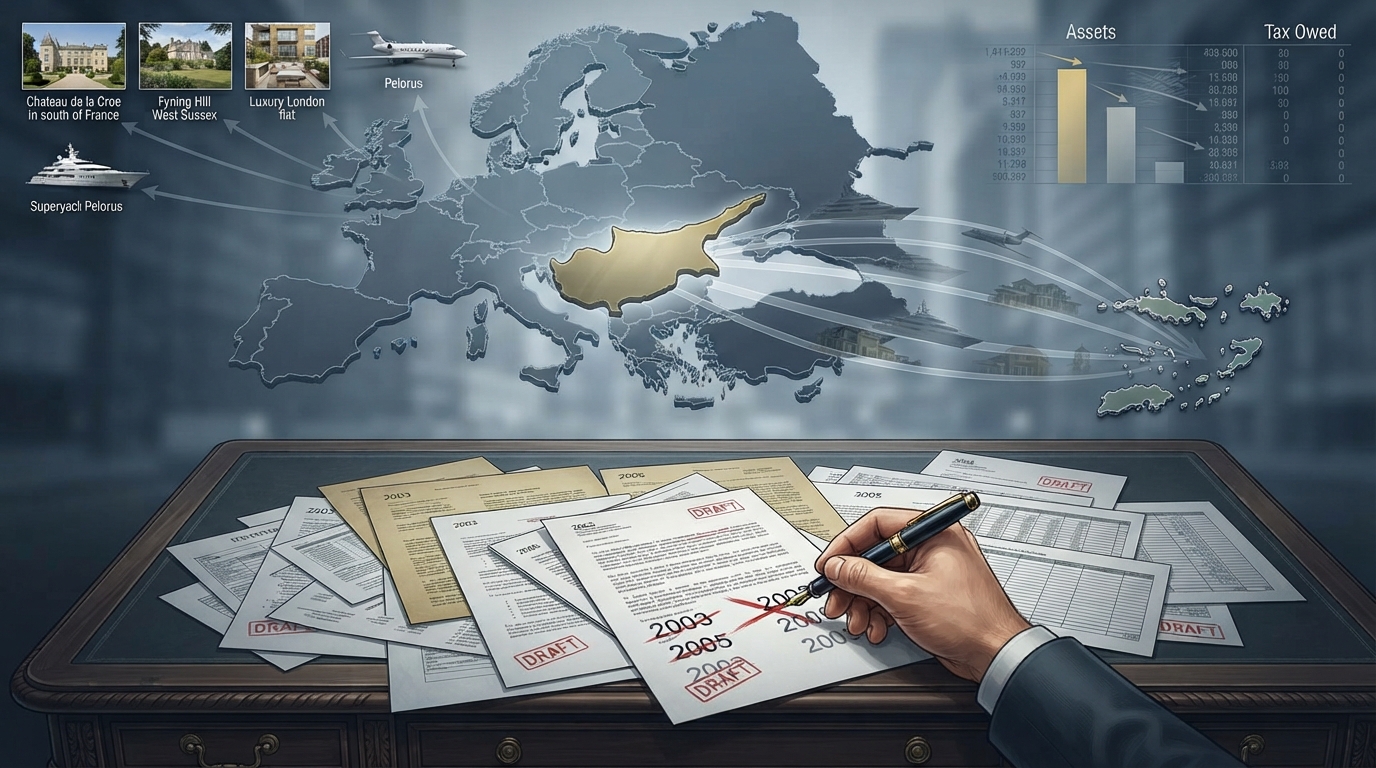
Chateau de la Croe (top left) in the south of France, Fyning Hill in Sussex and two superyachts vanished from company accounts
The evidence comes from a leak containing thousands of documents about the oligarch’s finances and the workings of a network of offshore companies run from Cyprus — once a tax haven popular with Russians — between 1995 and 2022.
Abramovich built his fortune from a corrupt deal to buy a Russian state-owned oil company in the 1990s, later selling it back to the government a decade on for billions in profit. He has previously said claims of corruption in the deal are false.
The profits from Abramovich’s oil deals in Russia were channelled into a web of offshore companies. These were administered from Cyprus by a corporate services firm called MeritServus, based in Limassol, the island’s second-largest city.
Until 2005, Deloitte — now the largest of the “big four” firms dominating the accounting industry — owned MeritServus. After the split, the two firms worked closely with Abramovich’s associates to manage his global fortune.
The leaked MeritServus documents expose some of those practices.
Our first example of backdated paperwork dates to 2006, after a new Cypriot law required company accounts to be made public. That transparency law threatened to reveal the secrets of Abramovich’s enormous wealth.
Deloitte Cyprus had prepared draft 2003 accounts — but had not yet completed them — for his Cypriot company Amiscan Investments. The accounts listed $672m of luxury property.
A mansion in West Sussex, a luxury flat in London and an estate in the south of France were all included, along with helicopters, private jets and a small fleet of boats owned by the oligarch at the time, including the $147.5m Pelorus.
Deloitte in Cyprus appears to have advised Abramovich’s company on a scheme to evade tax
To keep the assets hidden, Abramovich’s associates and MeritServus decided to rewrite the record. They devised a plan to get around the transparency law by moving the assets to Amiscan’s parent company in the British Virgin Islands (BVI), where they could remain concealed. They then backdated the transfer by three years so it would appear to have taken place in 2003.
Deloitte Cyprus reviewed the backdated paperwork and said it was “adequate” to allow the assets to be removed from Amiscan’s accounts.
When the 2003 accounts were signed off by Deloitte in 2006, the homes, aircraft and yachts vanished with the stroke of a pen. Just $75,000 in assets was left.
Deloitte approved the accounts even though the leaked documents show it knew they were entirely misleading.
Lord Sikka, professor of accounting at the University of Sheffield, said it was a “violation of a statutory duty” and “pretty scandalous” to misstate transaction dates and fail to publish true and fair accounts.
Panorama also uncovered evidence that backdated documents were used in a tax evasion scheme.
This concerned another of Abramovich’s Cypriot companies, Kravin Investments, which held almost $2bn in the bank in 2003.
It was earning substantial interest, so Roman Abramovich’s company should have been paying tax on that interest to the Cypriot authorities.
But his advisers had another plan to rewrite the record.
An August 2005 email from MeritServus to Abramovich’s Russian associates said a plan had been worked out after a meeting with Deloitte. “If you agree, it will be necessary to change the financial statements and the accounting records accordingly for 2003 and 2004,” the email said.
MeritServus told the oligarch’s Russian associates that Kravin’s “Provisional Tax Assessments for 2005” would be filed showing the company earned no income from the money.
A month later, an associate in Russia replied, “I agree”.
MeritServus then produced a series of backdated documents that falsely claimed Kravin was merely holding and investing the funds on behalf of its parent company in the BVI.
That made it appear Kravin did not actually own the money, meaning it would not owe tax in Cyprus.
In a September 2005 email, Deloitte wrote that “certain changes will have to be made to the accounts (bank account balances, interest income, profit and loss account)” because of the backdated changes to Kravin’s assets.
So Deloitte was apparently advising on the falsification of financial records. The evidence suggests it enabled Abramovich’s company to evade millions in tax.
Andrew Mitchell KC told us the scheme was “straightforward” tax evasion. “If it happened in England and it was in the millions, His Majesty’s Revenue and Customs would be thinking about a prosecution,” he said.
Cypriot MP Christos Christofides said that if tax had been evaded, then “we have to see how we can get our money back and how, if some people are guilty, they have to pay the price according to our law.”
Alongside the documents Deloitte helped backdate, Abramovich’s advisers at MeritServus falsified a third set of records. This related to the oligarch’s vast business fortune — more than $10bn — held by a company called Electus Investments in Cyprus.
MeritServus backdated documents to make it seem as though Electus did not own the fortune.
It used another Abramovich company with the exact same name, Electus Investments, but this one was based in the more secretive BVI, where accounts did not have to be made public.
Emails show that in 2006, MeritServus acknowledged the fortune belonged to Electus Cyprus. But once again it proposed rewriting the past, this time “to transfer the beneficial ownership to Electus Investments in the BVI” and make it appear the change had occurred three years earlier.
MeritServus signed and backdated documents that falsely claimed the BVI company had owned the $10bn fortune since 20 November 2003. So when the Cypriot company with the same name published its accounts, it appeared to hold assets worth only $145,000.
Roman Abramovich’s billions had been made to disappear.
Andrew Mitchell KC told Panorama: “What you take away from it is there are professionals who are prepared to bend and break the rules of their profession and therefore the law. And it looks that they will stop literally at nothing in terms of creating documents.”
Vladimir Milov, Russia’s deputy minister of energy while Abramovich was building his empire and now a critic of the Russian government, said: “For each Russian oligarch or Middle Eastern or African corrupt oligarch, there’s an army of Western financial and legal services and PR services providers, who is easily taking money for whitewashing their reputation and making them look normal.”
Denying any wrongdoing by the oligarch, Roman Abramovich’s lawyers said he was “not involved in the day-to-day operation of those companies” and that where arrangements were proposed by professional advisers, “reliance on that advice was entirely proper and legitimate”.
Deloitte Cyprus said it could not comment on the specific allegations because the documents were more than 20 years old and were no longer accessible.
MeritServus closed after the Cyprus Confidential leak.