

"Do not waste time going to a healer." Interview on breast cancer
Breast cancer is a common type of cancer among women, and it is becoming younger in Uzbekistan as well. This disease is even being detected in men. When is the breast removed? Who gets free mammography? Why are people visiting traditional healers? Gazeta received answers from experts to such questions.
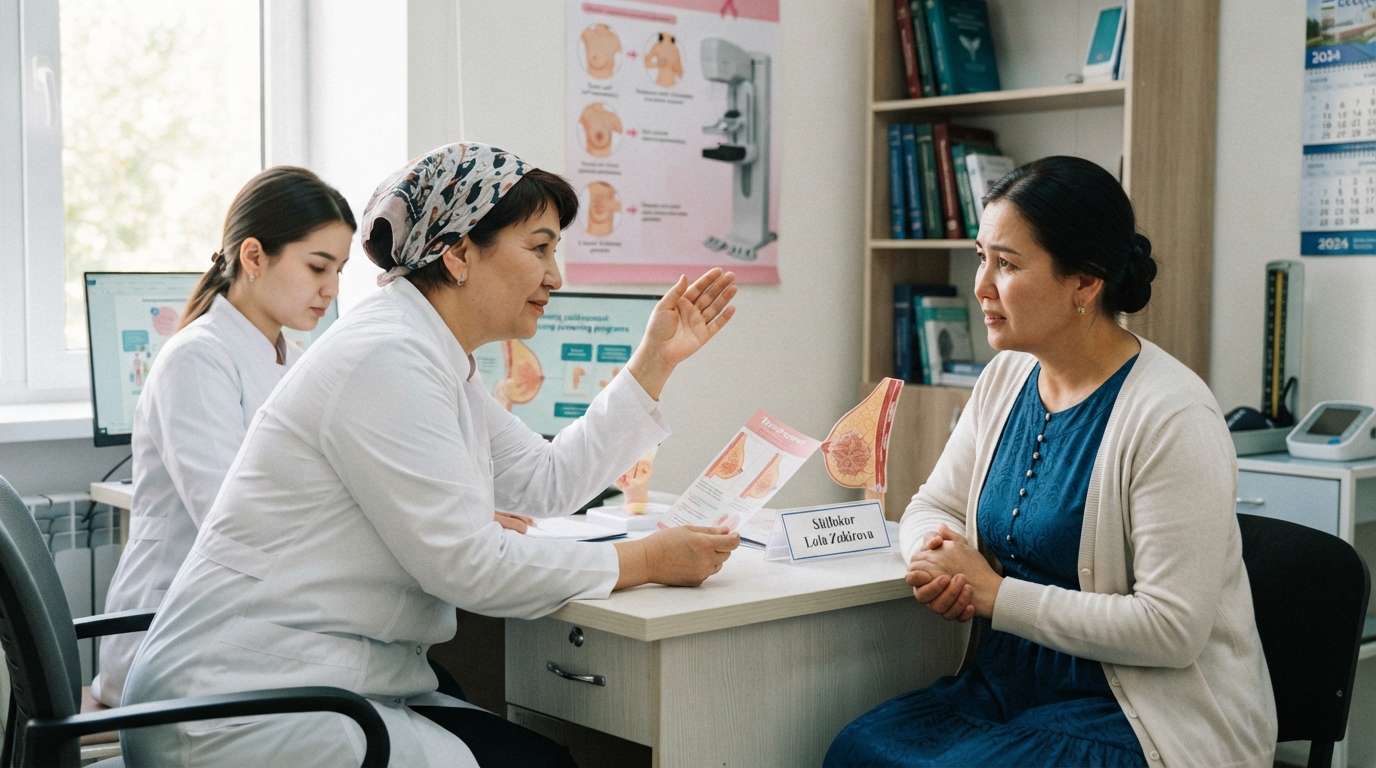
“Do not lose time going to folk healers.” Interview on breast cancer
Breast cancer is considered one of the most common types of cancer among women. In Uzbekistan, many deaths are also recorded due to this disease. According to the International Agency for Research on Cancer, 4,793 new cases of the disease were detected in the country in 2024, and 2,085 women died from this disease.
Currently, Breast Cancer Awareness Month is being held in Uzbekistan. In this regard, Gazeta correspondent Mirolim Isajonov spoke with experts — Lola Zokirova and Dilfuza Aniyozova — regarding the causes of the disease, risk factors, early diagnosis, and treatment possibilities.
— Breast tissue exists in both women and men. In women, it is called the mammary gland because one of its main functions is to produce milk to feed a child. Mammary glands undergo changes during pregnancy and begin to produce milk after childbirth.
Breast cancer occurs not only in women, but also in men.
— Breast cancer is considered one of the most widespread and dangerous diseases in the world, including Uzbekistan. Its main symptoms are as follows: the appearance of a node or hardened area in the breast; redness and swelling of the breast; various discharges from the nipple, including bloody discharge; the appearance of non-healing sores on the skin of the breast for a long time.
However, the disease may not show any symptoms in the initial stages. Therefore, even if a woman feels good or does not feel pain, it is important to undergo regular check-ups depending on age and doctor’s recommendations.
— During my 15 years of work experience, I have not encountered such a condition in unmarried girls. The youngest patient in my practice was 25 years old. Breast cancer mainly occurs in women who have experienced childbirth. Breastfeeding is one of the main functions of the mammary gland, and in some cases, not breastfeeding a child is also one of the factors affecting the risk of disease.
The disease is occurring more frequently in women aged 30 to 45. Breast cancer is also detected in men, but such cases are rarely observed. For example, it has been recorded in one or two men who came to our hospital per year.
— No cancer, including breast cancer, usually appears suddenly. Various factors affect its development.
Risk factors include genetic predisposition, hormonal changes, obesity, age-related changes, and certain reproductive factors. For example, estrogen production in subcutaneous adipose tissue affects hormonal balance. In some cases, obesity can lead to an increase in the amount of estrogen, increasing the risk of breast cancer.
In addition, giving birth for the first time after age 30, taking certain hormonal drugs without a doctor's recommendation, and genetic predisposition should also be taken into account.
One should not draw the conclusion that contraceptives should not be used at all. The important thing is to choose them correctly in consultation with a doctor. Chronic diseases and hormonal disorders in women also require medical supervision. However, the presence of a specific risk factor does not mean that a person will definitely develop cancer.
Healthy nutrition, physical activity, and maintaining normal body weight are important for overall health. It is advisable to avoid consuming excessive amounts of processed meat products and various snacks. Prolonged stress also negatively affects a person's sleep, hormonal balance, and general condition.
— Genetic predisposition is considered one of the factors causing breast cancer. But this does not mean that the disease will definitely be passed down from generation to generation. If breast cancer has been identified in a woman's mother, maternal aunt, or paternal aunt, she should be attentive to her health and undergo regular check-ups according to the doctor's recommendation.
Today, genetic predisposition to the disease can also be determined through genetic testing. For example, testing BRCA1 and BRCA2 genes helps determine whether there are certain hereditary changes that increase the risk of developing breast and ovarian cancer.
Based on the results, the doctor can recommend appropriate monitoring and preventive measures for the patient. However, the detection of such a genetic change does not mean that a woman will definitely develop cancer. Similarly, a negative result does not mean that there is no risk of disease at all.
—
In 2025, approximately 26 thousand women with breast cancer were registered in the dispensary account. This means that it corresponds to 12.9 cases per 100 thousand women.
Previously, most patients applied in the third and fourth stages of the disease. Now, early diagnosis capabilities are expanding. In 50.8 percent of patients, the disease was detected in the second stage.
In this regard, screening programs are of great importance. As the ability to detect the disease before symptoms appear increases, it becomes possible to start treatment earlier.
— Angelina Jolie's grandmother, mother, and aunt died of cancer. Taking her family history into account, she underwent testing for changes in the BRCA1 and BRCA2 genes. After a risk-related genetic change was detected in her, she chose to undergo a preventive surgical removal of breast tissue in order to prevent the development of cancer.
Making such a decision is very complex. Even for a woman diagnosed with cancer, removing a breast can be psychologically difficult. For a woman who has not yet been diagnosed with the disease, but has a high hereditary risk, making such a decision is even harder. Therefore, preventive surgery is not a method recommended for every woman. This issue should be resolved based on genetic test results, individual risk, and specialist advice.
— Previously, a large proportion of patients applied in the third and fourth stages of the disease. In such cases, the breast had to be completely removed.
Now, as mammographic screening develops and the disease is detected earlier, opportunities to preserve the breast are also increasing. In some patients, organ-preserving and, if necessary, reconstructive-plastic surgeries can be performed.
Early diagnosis also affects the choice of treatment method. Depending on the stage of the disease, in some patients the surgery can be performed before chemotherapy, while in others, drug treatment is required first. The later the disease is detected, the more complicated the treatment process can become. For this reason, undergoing mammographic screening in a timely manner is very important.
— In recent years, women's attention to their health and awareness of oncological diseases has been increasing. The establishment of oncological control rooms in polyclinics and the fact that gynecologists are also examining breasts play an important role in this.
Previously, some women might think that a knot in the breast was a normal condition, and might not accept discharge from the nipple or the appearance of a sore on the skin as a dangerous sign. Now, when such changes are detected, the possibility of directing the patient to an additional examination has expanded. Information on social networks and the internet is also helping to increase awareness.
However, there are also women who do not undergo examination due to financial difficulties or resistance from family members. Some cite the lack of financial capability or the fact that their spouse or mother-in-law did not give permission as the reason. Others postpone the examination due to weddings, household chores, or other matters.
Within the established procedure, mammographic screening is conducted free of charge. If a suspicious change is detected during the examination, the patient is referred to an oncology center for an additional check-up. Women's health should come first. Delaying the examination may lead to missing the opportunity to detect the disease on time. Most importantly, if a suspicious sign appears, one should consult a specialist without making conclusions independently.
— Of course. The absence of pain does not mean the absence of disease. The main goal of mammographic screening is to detect the disease during a period when symptoms have not yet appeared.
According to the program specified in Decision No. 402, women aged 45−65 must undergo a mammography examination once every two years. Women under the age of 45 can undergo an ultrasound examination (US) of the mammary gland at central polyclinics. This screening examination is performed free of charge.
—
Women still consulting folk healers is one of our most painful problems.
Often, after patients first notice a 1−2 centimeter or small worm-like node in their breast, they report going to a folk healer, applying their ointments, or consuming their medicines or herbs. But during this time, the tumor grows larger and breaks through the skin surface.
Folk healers explain this by saying that bad cells caused by the disease are coming out, and that the treatment method is yielding results. In fact, the enlargement of the tumor, breaking through the skin, and tissue destruction can indicate that the disease has advanced significantly. In such a situation, patients come to us in a very serious condition. Unfortunately, sometimes even then, folk healers do not admit the ineffectiveness of their methods.
Therefore, I would ask women: if you notice a node or other suspicious changes in the breast, do not lose time going to folk healers.
Contact a qualified doctor immediately. Early detection and timely treatment of the disease are very important.
— One of the factors that causes women not to consult a doctor on time is the fear of chemotherapy and its complications. Chemotherapy can be used in the treatment of breast cancer. One of its side effects is hair loss.
Before chemotherapy, a conversation is held with the patient, and full information is provided about the treatment process and possible complications. Women are often troubled by anxiety that their hair will fall out completely. Hair loss is usually temporary, and after the treatment ends, the hair grows back. However, returning to its previous thickness may vary in each patient.
Some women worry about the attitude of those around them, or their status in front of their parents-in-law or spouse due to hair loss. Fears like "If my hair falls out, what will the neighbors say? What if my husband leaves me?" prompt them to avoid medical treatment and consult folk healers.
Folk healers convince patients by saying that various herbs and medicines will not cause hair loss. As a result, women lose precious time and consult a doctor only after the disease has advanced significantly. Unfortunately, such patients are also found among us.
— The detection of cancer in one breast does not mean that the disease will spread to the second breast. However, in rare cases, separate tumors can appear in both breasts. This is called bilateral cancer. Breast cancer can metastasize to other organs, including the liver, bones, lungs, and brain. This depends on the type and stage of the disease.
In my personal practice, I have observed that tumors in the left breast were encountered more often. However, this is not a general rule or a conclusion that applies to all patients.
— Before the adoption of Presidential Decision No. 402, in 2025, the existing equipment and the level of preparation of specialists in the country were studied. After that, in cooperation with the Ministry of Health, measures were taken to develop the screening system.
When the program started, there were 31 mammograms across the republic for screening.
Now their number has reached 51. Within the framework of the decision, an additional 14 mammograms were installed.
In addition, our agency assisted in the purchase and installation of five modern stationary mammograms manufactured in Japan.
The equipment was placed in multidisciplinary polyclinics in the Kungrad district, the cities of Andijan and Termez, the city of Urgench, and the Ishtikhan district.
The goal is to bring examinations as close to women as possible. If mammograms are in primary healthcare facilities, women living in remote areas will not have to travel long distances to undergo examination. This serves to increase screening coverage and early detection of the disease.
— When the program started, there were about 60 mammologists across the republic. Therefore, special attention was paid to improving the qualifications of specialists and studying international experience.
With the support of our agency, 13 specialists from the Republican Oncology and Radiology Center were sent to the Huntsman Cancer Institute in Utah, USA, for advanced training. Among them was Lola Zokirova. The purpose of the visit was not only to exchange experience, but also to study certain practices that were not equally established in all centers in Uzbekistan, including methods of biopsy and removal of affected lymph nodes.
Another important aspect is the introduction of a multidisciplinary team approach in cancer treatment. The patient's treatment plan should be discussed not by just one doctor, but with the participation of various specialists.
After the international visit, such a teamwork practice was established at the Republican Oncology and Radiology Center. Currently, patients' conditions and treatment plans are discussed with the participation of specialists. This helps to choose the most optimal method for the patient.
— No, it is not necessary to come to the capital. Oncological control rooms have been established in multidisciplinary polyclinics in the districts. Obstetrician-gynecologists in them have been trained to palpate the breast.
In addition, a screening registry has been created. In it, the process from a woman's initial examination to, if necessary, referral to an oncology center is monitored. This is needed so that patients are not left out of attention during the examination and treatment process.
In accordance with the procedure specified in Decision No. 402, women aged 45−65 are involved in undergoing mammography screening in primary healthcare facilities. If no suspicious changes are detected as a result of the examination, additional referral to an oncology center is not required. In suspicious cases, the woman is directed to the relevant regional oncology center.
In this way, women in remote areas can also undergo an examination at a medical facility near their place of residence and, if necessary, receive specialist help.
— An electronic portal aimed at providing information about oncological diseases to the population in simple and understandable language was developed by our agency. It is planned to launch it within the next two days.
Initially, information about cancer types occurring in women, including breast and cervical cancer, as well as childhood cancer, will be provided in the Uzbek language on the portal. Starting from 2027, other types of cancer common in adults will also be covered.
Through the portal, it will be possible not only to obtain information about diseases, but also to know where to apply, which examinations can be passed free of charge, and in what cases which specialist should be consulted. Also, users will have the opportunity to send their questions to specialists.
In addition, in August of this year, another project was launched by our agency. Within its framework, oncologists specializing in breast cancer and experts in histological and pathomorphological examinations were brought in from the USA. Work on improving the qualifications of oncologists in Uzbekistan will be carried out in cooperation with them until December 2027. The main goal of the project is to increase the professional capacity of medical workers, and expand the possibilities for early and correct diagnosis of cancer.
— In the process of monitoring the execution of Decision No. 402, our agency goes to the regions and speaks with specialists of responsible institutions and the population. During our observations, we identified that especially women in remote areas are afraid of mammography examination.
Some even worry, even if the examination is free, saying: "If I go, some disease will be detected in me too."
In fact, one should not be afraid of this. By detecting the disease on time, it is possible to receive effective treatment, even preserve the breast, and return to normal life.
The second important issue is the impact of pesticides. In long-term observations conducted by researchers at Columbia University in the USA, the connection between the impact of certain pesticides and the risk of breast cancer was studied. In Uzbekistan, too, there are women working in cotton and wheat fields. Therefore, I advise them to reduce contact with pesticides as much as possible, and to use protective gear such as gloves and long-sleeved clothing.
Thirdly, I urge all women to obtain reliable and evidence-based information about cancer through the onco-portal. The more information we have, the earlier we will be able to recognize symptoms of the disease and consult a doctor on time.