

More than 6,700 cases of breast cancer were detected through screening over 4 years. 78% were at early stages
Over the past four years in Uzbekistan, screening of more than 2.6 million women revealed 6,702 cases of breast cancer, 78% of them at early stages. A total of 4,187 women underwent treatment, with 3,749 achieving clinical remission. "Gazeta" reports on the results of the program and when and why one should get examined.
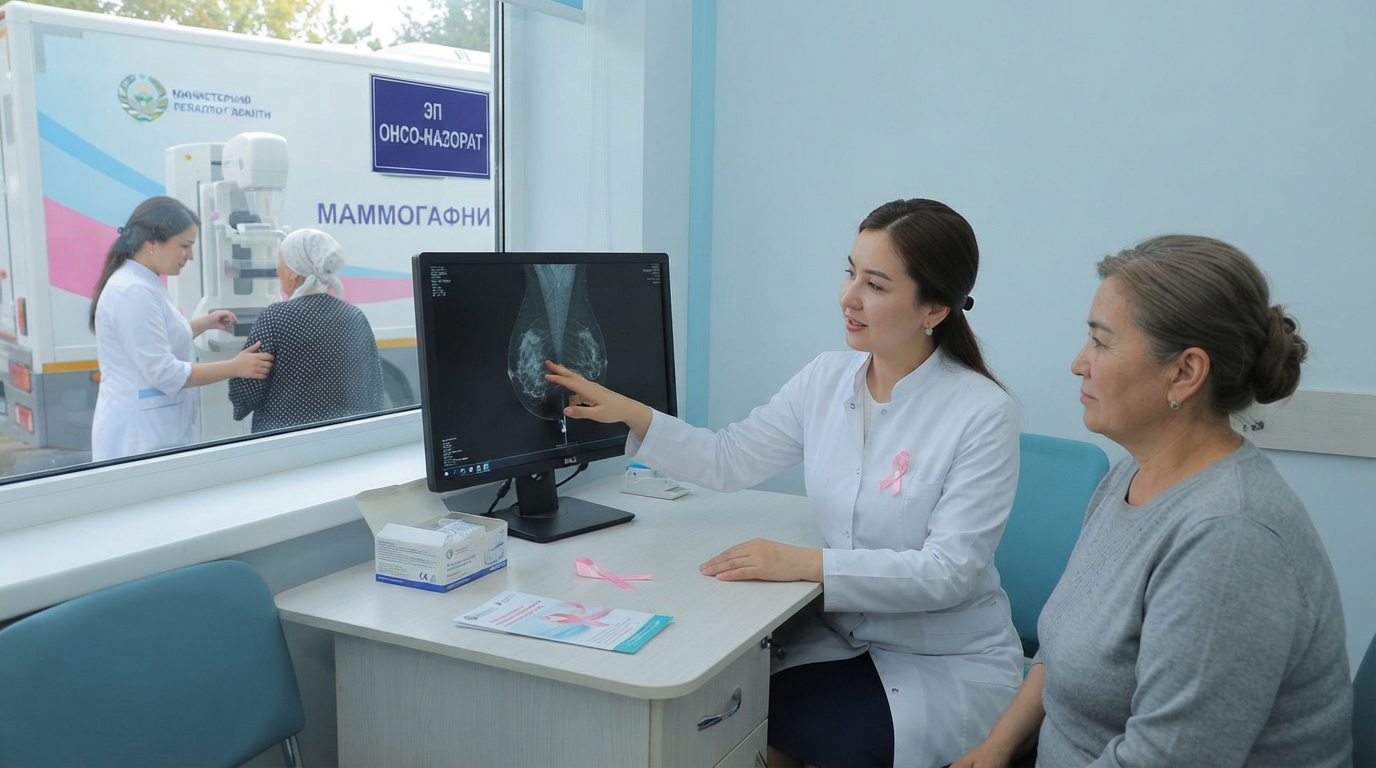
Over 4 years, screening helped detect more than 6,700 cases of breast cancer. 78% were diagnosed at early stages
An Open Day dedicated to the early detection of breast cancer took place at the Republican Specialized Scientific and Practical Medical Center of Oncology and Radiology.
The Center released the screening results for the period from 2021 to June 2025, along with information on patient treatment and the organization of examinations across the country. The event was held as part of "Pink October" — the international breast cancer awareness month.
According to the Republican Oncology Center, 4,843 new cases of breast cancer were registered in Uzbekistan in 2025 — 26 cases per 100,000 female population. In the same year, 2,085 people died from the disease, the vast majority of whom were women: 2,069 people.
During preventive medical examinations, 61.9% of cases were detected. Overall, the disease was diagnosed at stage one or two in 70.8% of patients. In 96.9% of cases, the diagnosis was confirmed by cell or tissue analysis.
A total of 27,736 breast cancer patients were registered. Almost half of them — 47.8% — had been under observation for five years or more.
Statistics for the screening program were provided separately. From 2021 to June 2025, more than 2.6 million women were examined under the program. Breast cancer was detected in 6,702 women — about 0.25% of those examined. In 5,227 patients, or 78% of the total number of detected cases, neoplasms were found at stage one or two.
Examinations are conducted at the primary healthcare level, including in "onco-nazorat" (oncology control) rooms. Stationary and mobile equipment is used for mammographic screening.
According to the center's data on the program's development, 16 stationary and 16 mobile mammography rooms were included in the system. A unified center was created to evaluate images, where mammography specialists are also trained.
Breast ultrasound is used in diagnostics, and work is underway to introduce artificial intelligence to assist doctors in interpreting images.
Since 2024, free screening has been introduced for women over 45 years old. A presidential decree dated November 22, 2024, provides for state budget-funded examinations and the training of specialists in breast and cervical cancer screening. As part of this work, an electronic database of women aged 30–65 has been established.
Early detection allows treatment to begin before the tumor spreads. If treatment starts at early stages and is provided in full, it is usually more effective and better tolerated.
Treatment tactics depend on the extent of the disease, the biological characteristics of the tumor, and the patient's condition. In addition to surgery, radiation and drug therapy may be required. Therefore, breast-conserving surgery does not mean that treatment is already completed.
According to the center's treatment results, doctors managed to perform surgery while preserving the breast in more than half of the patients. Of the 6,702 patients whose disease was detected during screening, 6,215 received surgical treatment. Breast-conserving operations were performed on 3,631 women — 54.2% of the total number of patients. Another 2,584 patients — 38.6% — underwent radical mastectomy, which involves the removal of the breast.
By June 2025, 4,187 patients — 62.5% — had completed a full course of treatment. Another 2,270 were continuing treatment, and 123 had refused it. In addition, 122 deaths were recorded.
Clinical remission was noted in 3,749 women, or approximately 56% of all patients diagnosed through screening. This figure reflects the status at the time of observation rather than final recovery: after treatment, patients require further follow-up.
Age is one of the main risk factors for the disease. Over the years, the likelihood of breast cancer increases: genetic changes accumulate in cells, some of which can lead to tumor development.
Reproductive factors also influence the risk of the disease: early onset of menstruation, late menopause, absence of full-term pregnancies, and late age at first birth. Overweight or obesity, especially after menopause, alcohol consumption, and certain types of hormone therapy to relieve menopause symptoms also increase the likelihood of the disease.
Hereditary predisposition accounts for only a portion of cases. According to the US Centers for Disease Control and Prevention (CDC), about 5–10% of breast cancer cases are linked to inherited gene changes. Among them are BRCA1 and BRCA2, which are involved in protecting cells from damage. Changes in these genes significantly increase the risk, but hereditary predisposition accounts for only a small fraction of diagnoses.
Women notice most cases of the disease themselves. The first symptoms in the breast can be detected during self-examination. To do this, it is important to know how breasts usually look and feel and to pay attention to new lumps, skin changes, or nipple alterations. During self-examination, both breasts can be compared, taking into account their usual features.
Reasons to see a doctor include: a new lump or thickening of breast tissue, even if painless; a change in the size, shape, or appearance of the breast; skin dimpling, puckering, redness, or other unusual changes; changes in the appearance of the nipple or the skin around it; unusual discharge from the nipple, especially bloody discharge.
Although most lumps are not cancer, it is impossible to determine their nature by touch alone. Therefore, any unusual changes should be shown to a doctor, even if they do not cause pain.
The first step can be contacting a family general practitioner. After an examination, they will determine the necessary tests and, if needed, refer the patient to a specialist. To clarify the diagnosis, doctors may use mammography, ultrasound, and biopsy — taking a small tissue sample for laboratory study. It is the biopsy that makes it possible to establish whether a suspicious formation is malignant.
Timely detection of the disease after symptoms appear is called early diagnosis. Its goal is to establish a diagnosis and start treatment before the disease progresses further. Therefore, if you have complaints, you should not wait for a routine check-up or until reaching a certain age.
Screening, unlike an examination conducted when symptoms are present, is performed before symptoms appear. Its primary method is mammography, an X-ray examination of the breasts that allows a tumor to be detected even before it can be felt.
The starting age and frequency of screening vary in national guidelines. The WHO describes mammographic screening mainly for women aged 50–69. However, considering the prevalence of breast cancer among women in Uzbekistan, doctors recommend starting examinations at age 40 and continuing until age 74. The examination plan is tailored together with a doctor, taking into account individual risk, including family cases of breast cancer and identified inherited gene changes.
Raising awareness about the disease should explain not only the symptoms but also the procedure for receiving care: where to go, where to get examined, and what to do after receiving the results. To reduce mortality, it is essential that the detection of suspicious changes is accompanied by timely confirmation of the diagnosis and accessible treatment without lengthy delays.