

Division by draft
In Kazakhstan, as part of the initiated military reform, conscription service will be divided into two stages
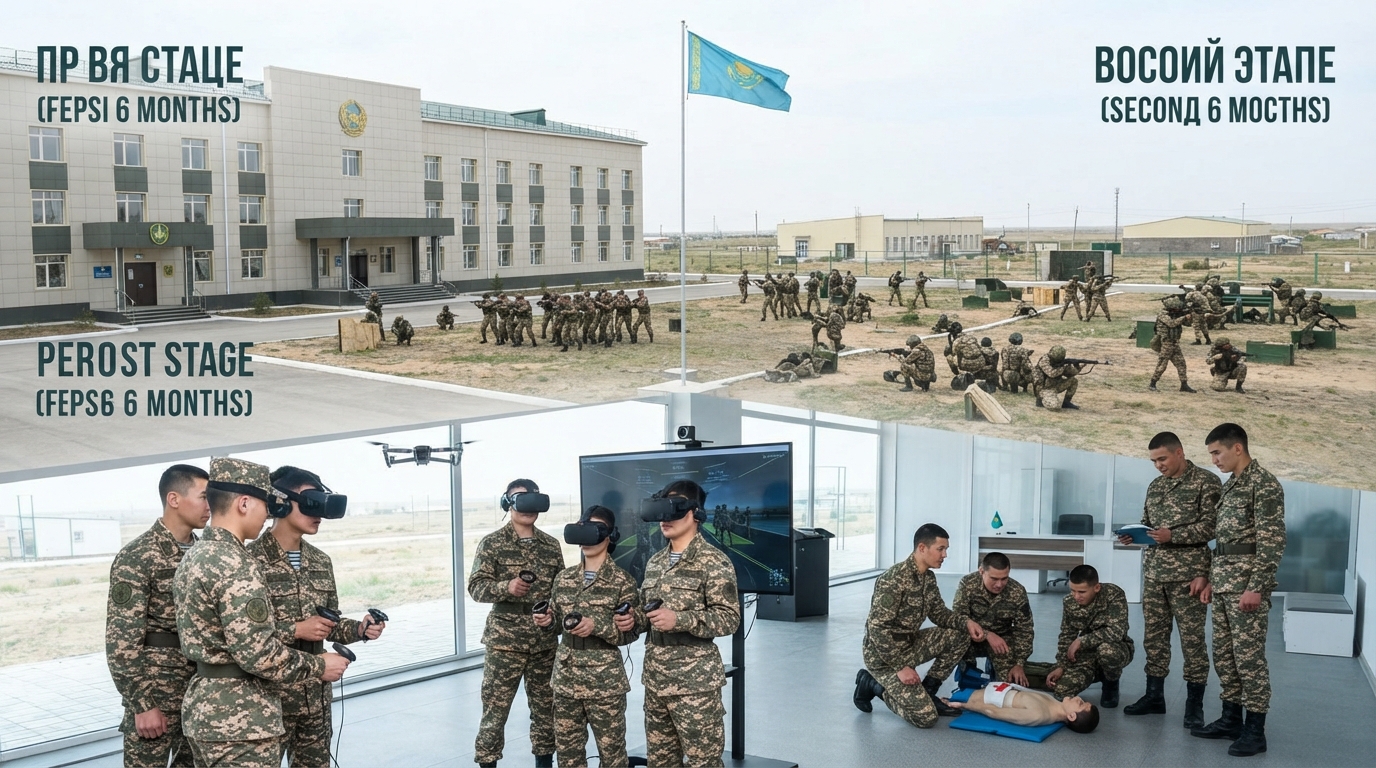
**Division by Conscription**
Kazakhstan has launched the implementation of a military reform that provides for changing the procedure for urgent conscription service, technological modernization of the army, and the creation of new mechanisms for protecting the rights of service personnel. This was reported on October 24 by the Republic's Ministry of Defense.
One of the main innovations will be the division of conscription service into two six-month stages. Conscripts of the same draft will spend the first six months in training centers, where they will adapt to army life, receive basic military knowledge, and improve their physical fitness. Then, for another six months, the soldiers will serve directly in military units, honing their skills and performing tasks as part of units. Thus, the proposed scheme is designed for one year of service, but changes the very procedure of its organization.
The pilot project is scheduled to launch in 2027. According to the Ministry of Defense, certain elements of the new model have already been tested as part of the Sarbaz+ project. Training in training centers is expected to cover not only military specialties: soldiers are promised the opportunity to study languages, master skills in working with artificial intelligence, and learn in-demand civilian trades.
To protect the rights of service personnel, it is planned to establish an institute of military consultants independent of unit commanders. They will be tasked with assisting soldiers and officers, identifying violations, and protecting their legitimate interests. In addition, the reform provides for the introduction of the position of commissioner for military personnel affairs—this was reported by the press service of the President of Kazakhstan following a Security Council meeting on October 21. Preventing hazing and non-regulations relationships and strengthening discipline were named among the tasks.
Judging by all appearances, the fight against *dedovshchina* (hazing) is one of the key motives for splitting the period of army service into two parts: this way, "young" soldiers and "old-timers" ("grandfathers") can be clearly separated.
The changes will affect the structure and composition of the Armed Forces, the command and control system, defense planning, mobilization training, and reserve formation. In particular, the plan approved by the Security Council provides for the creation of Unmanned Forces. The technological update of the army is expected to be accompanied by the development of domestic defense production, the implementation of artificial intelligence, and digital solutions.
The military intends to make more active use of simulation programs allowing the modeling of combat operations in troop training. The Ministry of Defense expects this to increase the quality of training and reduce the cost of exercises. Service personnel will be trained for independent actions and for working as part of units, taking into account modern tactics and the use of new models of weaponry.
A separate section of the reform concerns everyday service conditions. The department names quality food and uniforms, as well as the repair and restoration of barracks, training facilities, and firing ranges, as priorities.
Starting in 2027, it is planned to create a unified system of military-patriotic youth training, "Zhas Aibyn," which will combine the "Zhas Kyran," "Zhas Ulan," and "Zhas Sarbaz" stages. Schools are expected to develop safe behavior skills and teach first aid and actions in emergency situations. Together with local administrations, the Ministry of Defense intends to improve initial military training and expand the network of specialized military schools.
Organizational measures of the reform are to be completed before the end of 2026. At the same time, in the presidential press service statement, the main conceptual measures are attributed to 2027, while the Ministry of Defense, in its October 24 publication, indicates a more general timeframe for them—"in the medium term." Coordination of the plan's implementation was assigned to the government and the Security Council.
The reform was preceded by the deaths of 14 service personnel during exercises in the Mangystau Region. At a meeting on September 27, Kassym-Jomart Tokayev called the tragedy a consequence of the command's lack of professionalism and demanded fundamental transformations in the army. According to the president, the exercise participants were not provided with the necessary equipment, including naval life jackets. At the same meeting, he introduced the new Minister of Defense, Aidos Myrzakhmetov, and instructed him to prepare a reform plan.
"Our army is stuck in the past century. At the same time, it is necessary to completely restructure the command system in accordance with advanced international experience," Tokayev stated at the time.
Following the tragedy, a comprehensive audit of the Ministry of Defense began. As the presidential press service reported on October 5, based on the results of its first stage, 13 criminal cases were opened regarding facts of possible embezzlement of state property, official abuse, and other violations in the department's organizations and units. The president instructed the auditing commission to complete its work before the end of the year.