

Distrust of more than 50% of residents could lead to the dismissal of a district police officer. Bill
In Uzbekistan, more than 50% of mahalla residents will be able to express a vote of no confidence in a prevention inspector, after which they may be dismissed from office. Such a mechanism is provided for by a new bill introduced by the president. It establishes 22 rights, 15 duties, and additional guarantees for inspectors. Details.
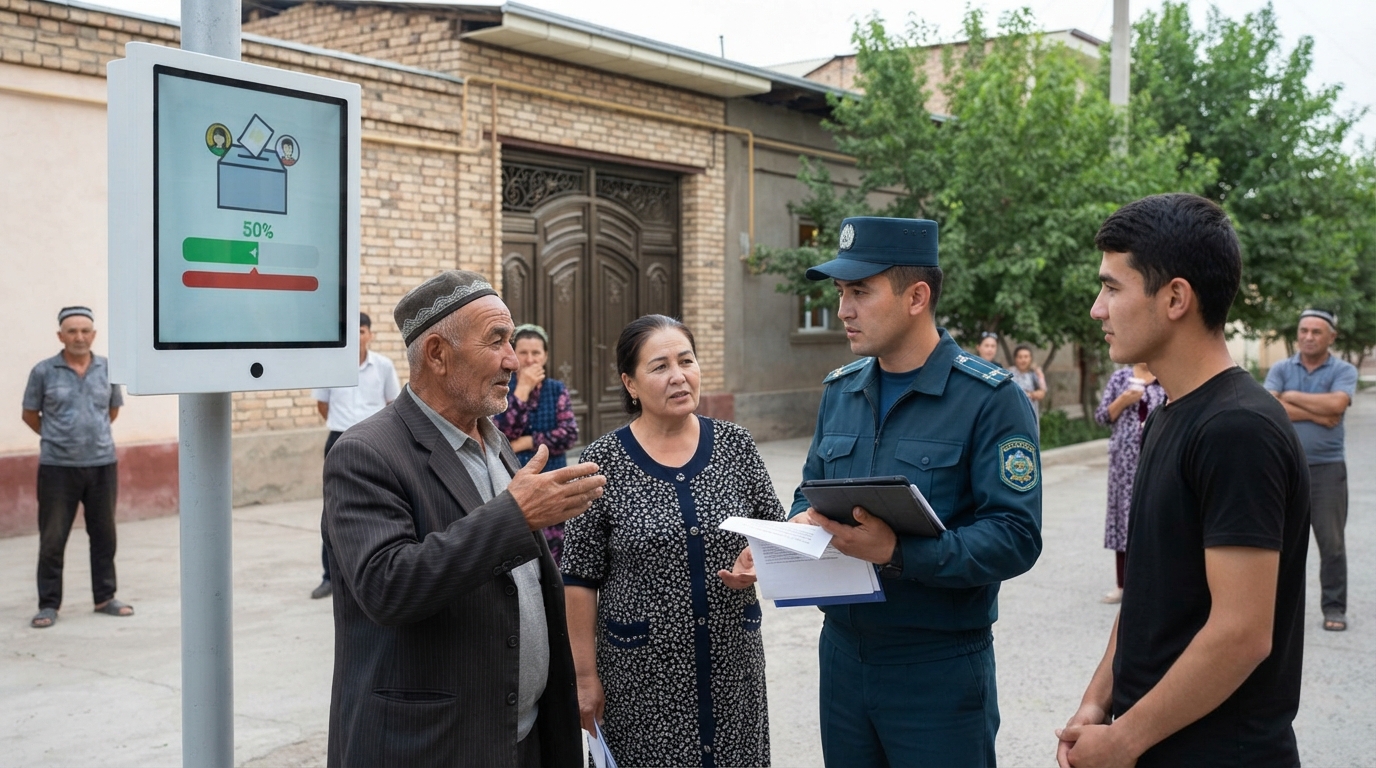
Distrust of more than 50% of residents could lead to the dismissal of a district police officer. Draft law
For the first time in Uzbekistan, it is proposed to establish the status of prevention inspectors of internal affairs bodies, as well as their tasks, rights, obligations, guarantees of activity, and social protection measures, at the level of a separate law.
The draft law "On the Status of the Prevention Inspector of Internal Affairs Bodies," introduced by the president as a legislative initiative, was approved by the Legislative Chamber in its first reading on August 25. The document includes 8 chapters and 37 articles.
As noted during the presentation of the draft, the work of inspectors is currently regulated by scattered norms of various legislative acts, even though the scope of their duties has expanded significantly.
According to the presented analysis, one prevention inspector processes an average of more than 50 appeals and administrative offense cases per month, and also conducts preventive work with more than 30 individuals.
In addition, inspectors participate in resolving family conflicts, work with youth and minors, women, and at-risk individuals, and engage in the prevention of cybercrime and other new threats.
The draft law defines a prevention inspector as an official who conducts pre-investigation checks and engages in crime prevention within an assigned territory.
The document proposes to establish nine primary and six auxiliary tasks for the inspector. These include receiving and promptly reviewing appeals, placing citizens under preventive supervision or administrative surveillance, conducting preventive measures, identifying and suppressing offenses, handling administrative cases, issuing protection orders to victims of harassment and violence, and subsequent monitoring.
The draft law provides for 22 rights of a prevention inspector. In particular, they will receive the right to independently choose the type of preventive measures, issue mandatory preventive instructions, submit representations and demand their execution, develop methodologies for conducting preventive measures, and draft necessary documents within their authority.
Separately, 15 duties of the inspector are established. In particular, the inspector will be required to comply with the requirements of professional culture and official discipline, immediately arrive at the scene of an offense, suppress it, and, if necessary, provide first aid or other assistance to victims.
One of the objectives of the draft is to limit interference in the professional activities of inspectors.
It is proposed to explicitly prohibit giving them assignments unrelated to their official duties, interfering in their work, and unreasonably burdening them with additional tasks.
State bodies will be required to respond in writing to an inspector's request within 10 days, and to their representation no later than within a month. In addition, inspectors are to be granted free access to the information systems of state bodies.
The draft also establishes that the honor, dignity, and professional reputation of an inspector are under state protection.
One of the key innovations will be the so-called institution of the initiative of distrust.
If more than half of the residents of the service area express distrust in a prevention inspector, they must be sent for attestation, after which the issue of their suitability for the position will be reviewed.
During the discussion, MPs were interested in how the level of public trust would be determined.
A representative of the Ministry of Internal Affairs stated that the government would develop a separate procedure for this.
"We have included such a norm so that the population has a say. First and foremost, the population should evaluate whether the inspector is working or not," he said.
According to him, the voting is planned to be organized in electronic form through the "Mening inspektorim" ("My Inspector") system, where residents of the respective territory will be registered.
"If more than 50% of the residing and registered citizens express distrust, measures up to dismissing the inspector from office may be taken," the MIA representative reported.
The exact mechanism is expected to be determined by a resolution of the Cabinet of Ministers.
Later at the meeting, the Speaker clarified once again that this refers specifically to electronic voting, and all details must be prescribed by the government.
The draft law also proposes to expand the powers of inspectors to review administrative offenses.
It is planned to transfer to their jurisdiction cases under five offenses that are currently within the competence of courts, nine that fall under the authority of heads of internal affairs bodies, and four more violations in the field of road safety.
In addition, it is proposed to grant inspectors the right to apply administrative warnings for 18 types of offenses.
The developers believe this will allow for a faster response to violations directly on the spot.
The draft also strengthens the social guarantees of employees. It is proposed to place the obligation of providing inspectors with office premises and housing on the khokimiyats (local administrations).
The draft law provides for additional pension guarantees for prevention inspectors: with over 20 years of service, it is proposed to grant them a pension of 100%. Additional allowances are also provided for long-term service in the position.
During the discussion, MPs focused specifically on the working conditions of inspectors.
One of the MPs shared that during visits to the regions, there were cases where an inspector did not even have a separate office.
"There are places where an inspector does not even have an office space — he sits somewhere in a corridor or another place," the MP said.
He proposed making the obligation to provide inspectors with premises more stringent and unambiguous.
A proposal was also made to provide transport for inspectors in remote rural areas, as the lack of transport can hinder prompt travel to the scene of a crime or offense.
A separate discussion unfolded around the interaction of the inspector with the "mahalla seven."
MP Zafar Khudoyberdiev recalled that a presidential decree dated June 24 had already defined a number of tasks for members of the "seven," including prevention inspectors.
According to him, the document provides that the mahalla chairman hears reports from members of the "seven" on a weekly basis. Meanwhile, the new draft law states that the inspector reports to the population quarterly and, in their professional activity, subordinates only to their immediate or direct supervisor.
The MP inquired whether this would create a contradiction and whether the new procedure would lead to the inspector being effectively isolated from the mahalla chairman and other members of the "seven."
The MIA representative replied that the tasks previously established by the decree had been analyzed, and some functions had been redistributed.
According to him, some duties are now performed by other units — inspectors in schools, officers for women's issues, cybersecurity structures, and other services.
"We reduced these tasks from 22 to 15, as not all of them are direct tasks of a prevention inspector," the MIA representative explained.
He assured that this does not mean abandoning interaction with the mahalla and other members of the "seven."
During the answers of the MIA representatives, another detail of the draft emerged.
Under the general name of "prevention inspector," it is planned to unite prevention officers working in mahallas, schools, higher education institutions, and certain other areas.
At the same time, the format of their reporting will depend on their place of work: a mahalla inspector will report to the mahalla population, a school inspector to the school staff, and a university inspector to the respective higher education institution.
The draft also proposes to evaluate the work of inspectors quarterly, as well as at the end of the half-year and year.
Among the indicators are the level of public trust, the number of crimes committed by individuals from risk groups, as well as repeated administrative offenses.
In addition, each inspector will be required to inform the population of their territory about the security situation once a quarter.
Following the discussion, the MPs conceptually approved the draft law in the first reading. Before the second reading, the committee must refine the document, taking into account the comments and suggestions received from the MPs.