

Digital twins and the use of "waste energy": What French companies are offering to Uzbekistan
The heat from servers and data centers can heat buildings, while digital twins can help design construction and transport. Gérard Wolf, Special Envoy of the French Ministry of Foreign Affairs, told Gazeta about the technologies that French companies can offer for the cities of Uzbekistan.
**Digital twins and the use of "waste energy". What French companies offer to Uzbekistan**
French companies are ready to increase their presence in Uzbekistan if their proposals are selected, said Gérard Wolf, Special Envoy of the Minister for Europe and Foreign Affairs of France for Transport and Sustainable Urban Development.
During his visit to Uzbekistan, the special envoy held meetings at the Administration of the President of Uzbekistan, the ministries of transport, energy, economy and finance, investments, industry and trade, as well as at the Tourism Committee and the directorate of New Tashkent.
In a conversation with "Gazeta", Gérard Wolf spoke about different approaches to urban development and what innovations French companies offer to Uzbekistan for the development of its cities.
— There are many challenges in the sphere of urban development. Our task was to try to answer the questions of representatives of Uzbek ministries, city authorities, and people responsible for city management, and see how we can help.
I have two roles. On the government side, I deal with issues of sustainable cities and transport. This covers a wide range of tasks related to urban development. In addition, I work with the private sector: in the French association MEDEF, I head the task force on sustainable cities.
Here, together with the ambassador and his team, we are trying to offer Uzbekistan the best French solutions in the field of sustainable cities. Then it will be up to the Uzbek side to choose those it wants to use, and companies will be able to offer specific technical solutions. But first, you need to understand exactly how you want to organize your cities.
One of the main topics is New Tashkent: we discussed how we could help in solving the tasks facing the new city.
— Focusing on a single project is not the goal of our delegation. We want to see how, on a broader scale, we could help find suitable solutions — for Tashkent or for the country as a whole.
We, the French, do not claim to be the best. But we have a comprehensive vision of urbanization issues and experience working in different countries.
We have companies with a long history: EDF, where I used to work, Veolia, Suez, and transport companies. An important part of the French experience is linked to the reconstruction of the country after World War II. The companies that worked at the national level back then later became major international players.
During the meetings, together with the companies, we discussed how to offer the most suitable solutions. After all, what suits Uzbekistan will not necessarily be the same as in other parts of Asia or in Latin America. The offer must correspond to the existing conditions and the country's development model.
— A city, wherever it is in the world, is a mosaic of four basic services. For a city to function, it must have water, energy, transport, and the waste problem must also be addressed.
There is also a fifth element — healthcare, hospitals are needed, but this is a somewhat different type of service.
In each of the four main areas, we can offer solutions — not necessarily the same ones, but adapted to a specific country. And in all these areas, it is about decarbonization.
Transport with lower carbon emissions is a clear example. But the same applies to energy, water supply, and waste management. Either we reduce emissions during production, including energy generation, or we introduce the principles of a circular economy.
Generating energy from waste is already quite common now, and we need to go further in this direction. The same applies to the application of the circular economy in water supply systems.
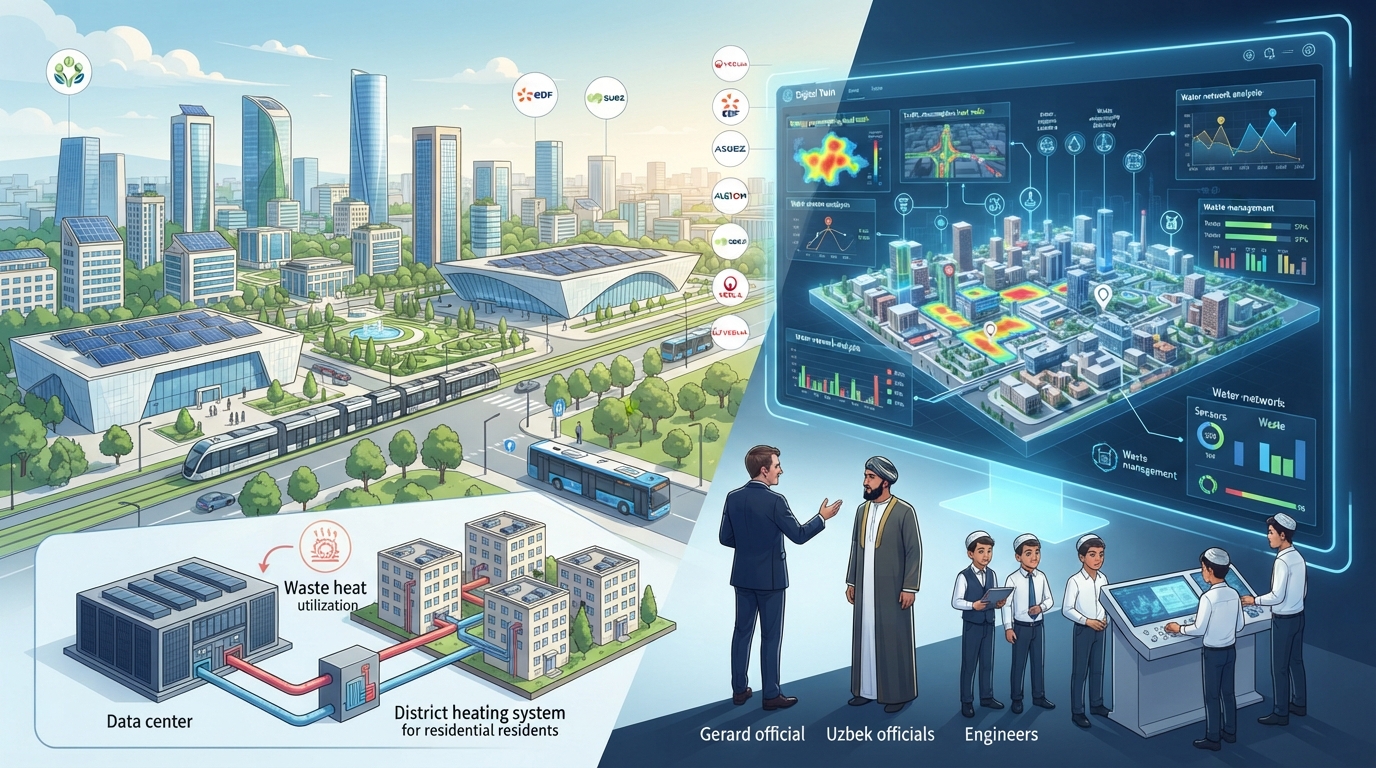
Another direction is the use of "waste energy", that is, energy that is generated during equipment operation, but is usually dissipated and not used. For example, data center servers generate a large amount of heat. It can be captured and used to heat buildings or warm water.
Take the Aquatic Center (Centre Aquatique Olympique) built for the Olympic Games in Paris. It is a huge building. It needs to be heated, air-conditioned, and the water in the pools needs to be purified — all of this requires a lot of energy.
This center uses heat generated by a neighboring data center and the building's own server room, as well as solar panels and other solutions. About 90% of its energy needs are covered by renewable sources and heat recovery.
This is one example of what we offer here. Not necessarily for an aquatic center: such approaches can be applied in a wide variety of situations.
We are happy to share our experience. Everything is open: Uzbekistani ministers can come, take a look, and we will explain how it works.
— All French companies. We are not the only ones offering urban solutions, but we consider ourselves technologically strong enough — in water supply, transport, and other areas.
At the same time, we add two elements to the technical solution that are not necessarily present in everyone else's proposals.
The first is training people. Many companies can say: "Here is our best available solution. Here is how much it costs." We don't stop there. We say: "Here is our solution, and we will train your specialists to use it."
If you get a car but don't know how to drive, you won't go anywhere. It's the same here. If you get high-tech equipment for an aquatic center and don't know how to manage it, you will have serious problems.
Therefore, practical training in operation is an integral part of our offer.
The second element is innovation. We try to include in our proposals the maximum possible amount of innovation related to decarbonization, as well as how best to build a facility.
That is why we include digital twins in infrastructure projects. We believe that today this is one of the conditions for the successful long-term operation of a facility — whether it is a tram, a building, or other infrastructure to be operated.
Take a new building in New Tashkent. Thanks to the digital twin, one can evaluate in advance how its location will affect energy consumption. If you orient the building to the north or south, the performance will be different — due to the sun, winds, and other factors. The model allows you to choose a position where the need for heating and air conditioning will be the lowest.
The same applies to transport systems — tram, metro, or urban cable car. Using a digital twin, you can choose the most suitable route: for example, with less wind impact for a cable car or along the most suitable street for a tram.
Today, this is a mandatory part of our proposals. This is not always the case with proposals from other countries.
— We believe that a city and a country cannot rely on just one solution. Our approach to urban problems is always to combine different solutions and create transfer hubs where you can switch from one mode of transport to another.
At the same time, it cannot be said that the solution for Tashkent is a tram and that the same thing will suit Samarkand or any other city. The geography and history of a city may not allow for the introduction of a certain mode of transport.
When you build a new city, such as New Tashkent, you can organize the space in advance, taking into account that you want to have a tram or another transport system. If the city is already built, you have to adapt to existing conditions.
In Samarkand, you cannot move a mosque so that a tram can pass in its place. And when you build New Tashkent from scratch, you have different opportunities. This is a different task.
We adapt to the requests of local authorities to offer the most suitable solution. And it always involves a combination of different modes of transport.
If a person gets on a bus and then wants to transfer to a cable car or metro, everything must be coordinated and interconnected. Otherwise, the system doesn't work. That is exactly how we approach the organization of transport.
— I would speak of doing business in Uzbekistan not as a problem, but as a whole series of solutions.
The meetings we held over the two days showed that our interlocutors strive to accelerate the implementation of the best available solutions. They want to get them as soon as possible.
At the same time, they appreciate the fact that we provide for the training of specialists. If we are talking about electric power, waste management, or, for example, generating energy from waste, then from a technical and scientific point of view, these are difficult tasks. To ensure optimal efficiency, you need very well-trained people.
Therefore, we always come with both a technical solution and an explanation of how we will train your specialists.
During these two days, we talked about available solutions and discussed how best to combine different approaches to the same task. There is no single answer — a combination of solutions is needed.
We also felt that the authorities we met were very interested in long-term results. This means not only training people, but also paying attention to technical losses. They occur both in power grids and in water supply systems. To explain it simply, there are two options. You can install and connect water pipes — and finish the work there. Or you can simultaneously install a sensor system that will allow you to determine if losses occur. If they appear, the system will give a signal, and action can be taken to limit them as much as possible.
That is how we work: we offer different solutions, provide for the training of specialists, and use technologies that allow maintaining efficiency and reducing losses of energy and other resources.
— Are they ready to invest more in this country? The answer is unequivocal: yes, absolutely, if we are chosen.
But the meetings over these two days, in particular the meeting in New Tashkent with the Deputy Prime Minister and other representatives of the authorities, showed that there is interest in French solutions.
We know that representatives of other countries are working here as well. This is completely normal: Uzbekistan is not going to depend on a single country.
There is another point that we have not yet touched upon — interaction with universities and young specialists.
At the meeting in New Tashkent, I drew attention to the fact that a huge university center is being created here. We are ready to welcome engineering students. We consider interaction with young engineers and students of technical specialties to be very important — both in France and in the countries where we work.
We are ready to cooperate on urban projects and develop ties between universities to better prepare young people for tomorrow. This is not a one-off project — we try to prepare for the future together. Our DNA is such that we cannot imagine how to build, rebuild cities, or help build them without the participation of the local younger generation. After all, in ten years these very people will be living in them. This is part of the French vision.
— First of all, I was the second person in the French electric power company EDF. Together with Chinese partners, we built nuclear power plants, so I am not the person who will say that Chinese proposals are rubbish. That is not true.
Second: competition is competition. Sometimes a proposal is cheaper, sometimes it costs the same.
It all depends on what exactly you are looking for and what is included in the offer. You can buy something, after which you will be told: "Now operate it." Or you can buy it together with training for the people who will work with it.
Chinese companies, like others, are also ready to train specialists. But sometimes they say: "Of course, it will be cheaper if you train your people yourselves."
I'm not saying this is bad. It's your choice. It's just a different offer.
We, of course, respect our Chinese, Indian, and other colleagues, provided they comply with the same rules regarding compliance. For our part, we try to offer the best available technologies.
We were truly amazed by the population growth rate in Uzbekistan — this means we need to act fast.
Any country can offer something. But let's say you have 100 metro cars. If nobody knows how to operate them, you are not ready for work yet.
Sometimes our offer may not be the cheapest. But the cheapest doesn't necessarily mean the most effective. We work with companies from other countries, including Indian ones — in France as well. Our task is to explain what exactly we offer.
Together with the ambassador and his team, we felt that the scale of the task facing Uzbekistan is so great that you cannot choose here, as we say in France, "cheese or dessert". You need both cheese and dessert — everyone's participation is necessary. Otherwise, it will be very difficult.