

Digital Development of the CA Region: Who Is the Leader?
Digital technologies are occupying an increasingly prominent place in the economy and daily life. The Internet, electronic government services, digital payments, and modern means of communication have become part of routine processes. At the same time, the level of a country's digital development is determined not only by the availability of technology, but also by the capabilities of the population and business, the quality of regulation, and the results of their application. One of the international studies that allows assessing […]
**Digital Development in the CA Region: Who Is the Leader?**
Digital technologies are increasingly influencing the economy and daily life. The internet, electronic government services, digital payments, and modern communication tools have already become part of familiar routine processes. At the same time, the level of digital development of countries is determined not only by the availability of technology, but also by the capabilities of the population and business, the quality of regulation, and how effectively these solutions are applied.
One of the international studies evaluating these parameters is the Network Readiness Index (NRI), published by the Portulans Institute. The 2025 ranking covered 127 states. The assessment is based on 53 indicators grouped into four main pillars: Technology, People, Governance, and Impact (the impact of digitalization on the economy and society).
The United States took first place in the global ranking, scoring 79.1 points out of a possible 100. It is followed by Finland (75.8 points) and Singapore (75.5 points). The top ten leaders also included Denmark, Sweden, the Netherlands, Germany, the United Kingdom, Switzerland, and South Korea. Burundi landed in the last, 127th position with a result of 14.8 points. The countries trailing the ranking also included Mauritania, Angola, Madagascar, and Lesotho.
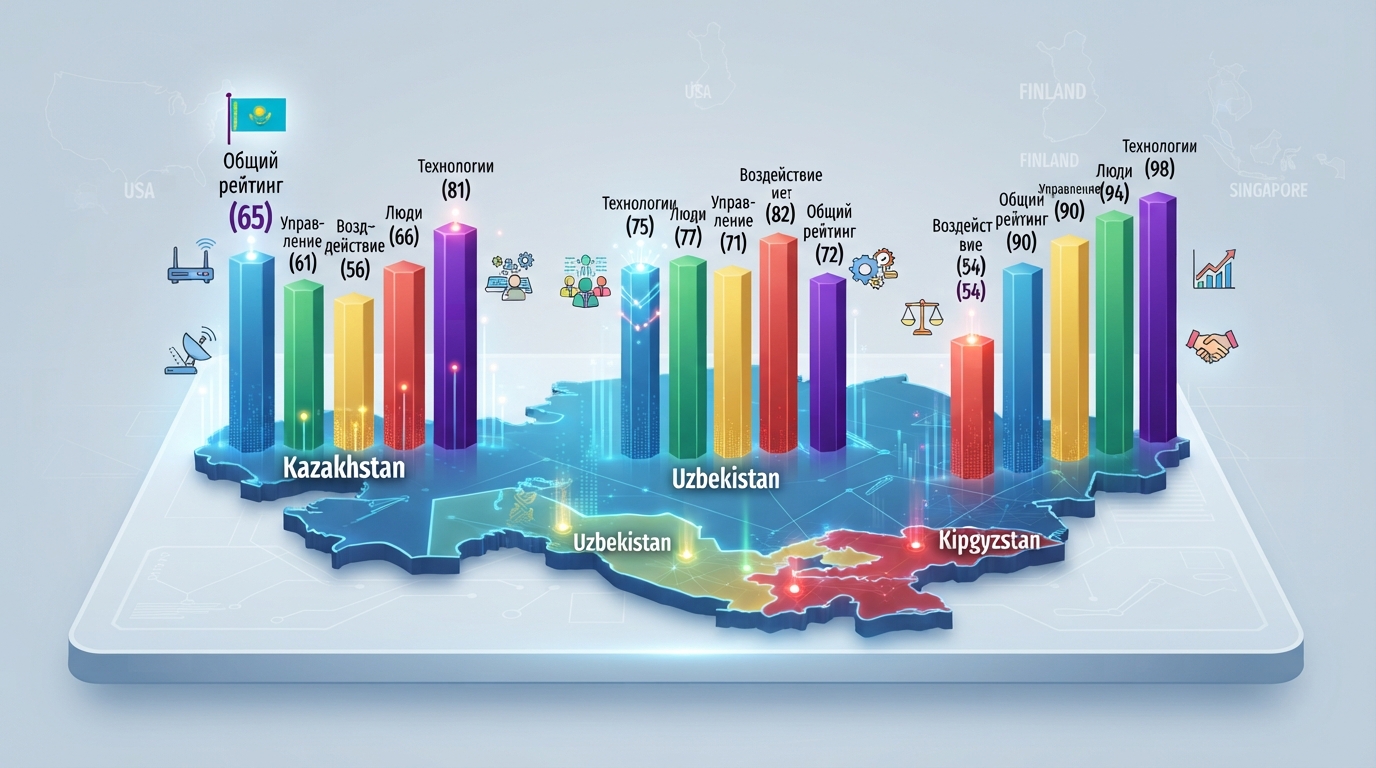
Among the Central Asian states, Kazakhstan took the highest position: 65th place and 49.1 points. Uzbekistan ranked 72nd (46.5 points), and Kyrgyzstan ranked 90th (42.4 points). Thus, Kazakhstan ahead of Uzbekistan by seven positions, and the Kyrgyz Republic by 25. Tajikistan and Turkmenistan are not represented in the ranking. Meanwhile, Kazakhstan's advantage in the overall score does not extend to all components of the index: in certain individual areas, neighboring countries also demonstrated higher results.
In the Technology pillar, which considers access to digital infrastructure, digital content creation, and the development of future technologies, Uzbekistan took the best position among the three CA countries: 75th place and 40.7 points. Kazakhstan was in 81st place (38.9 points), and Kyrgyzstan in 98th (31.4 points). Particular attention should be paid to the RK's result in internet access in schools: according to this indicator, the country ranked first in the world among the states represented in the ranking. In terms of mobile tariff affordability, Kazakhstan ranked 20th, and in terms of international internet bandwidth, it ranked 34th. Uzbekistan, in turn, took seventh place in the prevalence of fiber-optic connections and 18th in international internet bandwidth.
In the People pillar, the RK took 66th place with a score of 41.1 points, ahead of the RUz (77th place, 37.8 points) and the KR (94th place, 32.2 points). Kazakhstan showed its most notable results in the digitalization of public services: in terms of the development of online government services, the country ranked 10th in the world, and in government data capability, it ranked 25th. In terms of domestic mobile broadband internet traffic, the RK was in 29th position. At the same time, in ICT skills in the education system, Kazakhstan ranked 107th, yielding to Uzbekistan (76th place) and Kyrgyzstan (83rd place). Meanwhile, the RUz took 21st place in terms of mobile internet traffic volume, and the KR ranked 12th in adult literacy rate.
In the Governance pillar, which covers trust in the digital environment, regulation, and the inclusion of digital technologies for various population groups, Kazakhstan also received the highest score among the three CA countries: 61st place in the world and 61.4 points. Uzbekistan was in 71st place (57.3 points), and Kyrgyzstan in 90th (51.0 points). The RK ranked 32nd in digital inclusion and 27th in e-participation of citizens. The RUz stood out for its e-commerce legislation (first place), as well as relatively minor socioeconomic gaps in the use of digital payments (seventh place). The KR, for its part, took 20th position in the indicator of gaps in the use of digital payments between rural and urban populations.
In the Impact pillar, which combines economic and social indicators, including quality of life and the achievement of Sustainable Development Goals, Kazakhstan and Kyrgyzstan showed the closest results. The latter took 54th place, scoring 55.2 points and slightly edging past the RK (56th place and 54.8 points). Uzbekistan was in 82nd position with a score of 50.0 points. In the quality of life sub-pillar, Kyrgyzstan took 26th place, Uzbekistan 28th, and Kazakhstan 35th. At the same time, in the economy sub-pillar, the RK was in 78th position, the KR in 106th, and the RUz in 107th. In contribution to the Sustainable Development Goals, Kyrgyzstan took 60th place, Kazakhstan 82nd, and Uzbekistan 100th.
Notably, the RK became the only one of the three Central Asian states to enter the top half of the global ranking simultaneously in two pillars — Governance and Impact. The RUz and the KR achieved higher results in individual components, but fell behind Kazakhstan in the aggregate score. This highlights a key feature of the RK's position: the country's regional advantage is determined not by leadership in every single indicator, but by a combination of comparatively high results across several areas of digital development.